

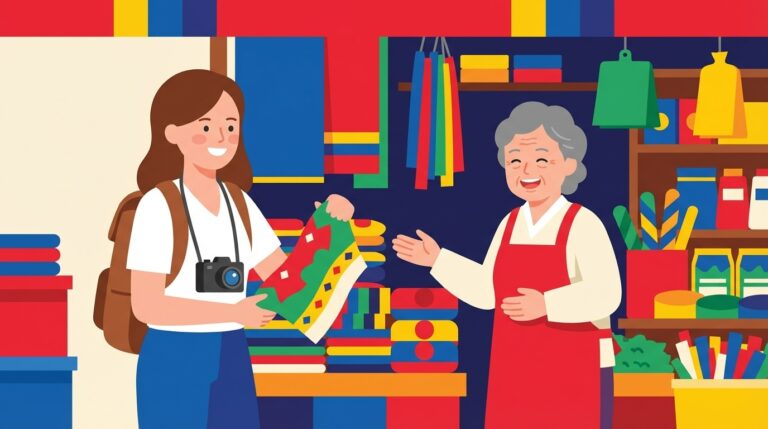
Master the Art of Bargaining in Korean Markets!
Hello! Welcome to [Daily Hangul], where we upgrade your Korean skills one post at a time!
Have you ever walked through a bustling Korean market, mesmerized by all the sights and sounds, but felt a little intimidated when it came to buying something? Today, we’re going to tackle a fun and essential skill for any traveler in Korea: bargaining! Lately, retro-style traditional markets like Gwangjang Market have become super trendy spots for both locals and tourists to visit and post on Instagram. Knowing how to bargain here will not only save you some won but also give you a more authentic and interactive local experience. Let’s learn how to haggle like a pro!
Core Expressions for Market Bargaining
Here are the essential phrases you need to know.
1. 얼마예요? (How much is it?)
* Pronunciation [Romanized]: Eolmayeyo?
* English Meaning: How much is it?
* Detailed Explanation: This is the most basic and essential question for shopping anywhere. It’s a polite and standard way to ask for the price of an item. You can use it in markets, shops, and even taxis.
* 💡 Pronunciation Tip: The ending ‘예요 (yeyo)’ is used after a word that ends in a vowel, like ‘얼마 (eolma)’. If you were asking the price of something ending in a consonant, like ‘이것 (igeot)’, you would say ‘이거 얼마예요? (Igeo eolmayeyo?)’ for a natural flow.
2. 너무 비싸요. (It’s too expensive.)
* Pronunciation [Romanized]: Neomu bissayo.
* English Meaning: It’s too expensive.
* Detailed Explanation: This is your gentle opening to start the bargaining process. Saying it with a friendly, slightly disappointed smile is more effective than saying it aggressively. It signals to the vendor that you’re interested but the price is a bit high for you.
* 💡 Pronunciation Tip: Notice the ‘ㅆ (ss)’ sound in ‘비싸요 (bissayo)’. This is a tensed consonant. To make this sound, tighten the back of your tongue and push the air out forcefully, without any puff of air like you would for ‘ㅅ(s)’. It’s a sharp, strong ‘s’ sound.
3. 깎아주세요. (Please give me a discount.)
* Pronunciation [Romanized]: Kkak-kka-ju-se-yo.
* English Meaning: Please give me a discount.
* Detailed Explanation: This is the magic phrase! ‘깎다 (kkakda)’ means ‘to cut’ or ‘to shave’, and in this context, it means to ‘cut the price’. Adding ‘아/어 주세요 (a/eo juseyo)’ makes it a polite request. This is the most direct way to ask for a lower price.
* 💡 Pronunciation Tip: The first syllable is ‘깎 (kkak)’. When it’s followed by the vowel ‘아 (a)’, the final ‘ㄲ (k)’ consonant sound ‘links’ to the next syllable. So, instead of a pause like ‘kkak-a’, it flows smoothly into [kka-kka]. This linking rule, called ‘연음 (yeoneum)’, is crucial for sounding natural in Korean.
4. 서비스로 좀 더 주세요. (Please give a little extra as a service.)
* Pronunciation [Romanized]: Seobiseuro jom deo juseyo.
* English Meaning: Please give a little extra for free (as a service).
* Detailed Explanation: This phrase is brilliant when buying things like food or small items where a price cut might be difficult. ‘서비스 (seobiseu)’ is the Korean-style English word for ‘service’, but it often means ‘something extra for free’. It’s a very friendly way to get a little more bang for your buck, and vendors often appreciate the warm approach.
* 💡 Pronunciation Tip: In the word ‘더 (deo)’, the vowel ‘ㅓ (eo)’ can be tricky. It’s similar to the ‘o’ sound in ‘song’ but without rounding your lips. Keep your mouth relaxed.
Example Dialogue at Gwangjang Market
Let’s see these phrases in action!
- A: (Pointing at a cute retro-style hairpin)
사장님, 이거 얼마예요?
(Sajangnim, igeo eolmayeyo?)
Excuse me, how much is this? -
B: (The vendor)
그거 만 원이에요.
(Geugeo man won-ieyo.)
That one is 10,000 won. -
A: (With a friendly smile)
아… 너무 비싸요. 조금만 깎아주세요!
(A… neomu bissayo. Jogeumman kkak-kka-ju-se-yo!)
Ah… it’s a bit expensive. Please give me a small discount! -
B: (Smiling back)
허허, 알겠어요. 그럼 8천 원에 가져가요.
(Heoheo, algesseoyo. Geureom palcheon won-e gajyeogayo.)
Haha, okay. Then take it for 8,000 won.
Culture Tip & Trend Deep Dive
In Korea, bargaining at traditional markets is not just about saving money; it’s a part of the culture and a form of friendly interaction called ‘정 (jeong)’. It’s a feeling of connection and warmth. By engaging in this friendly negotiation, you’re not being cheap; you’re participating in the culture. This is completely different from department stores or chain supermarkets where prices are fixed.
Pro-Tip for Z-Gen Travelers: When you successfully get a discount, saying ‘감사합니다! (Gamsahamnida!)’ with a big smile and a slight bow is key. Building that positive rapport might even get you a small ‘서비스 (service)’ on your next purchase! Using cash instead of a credit card can sometimes give you more bargaining power, too.
Let’s Practice!
Time to check what you’ve learned! How would you ask for a discount on a t-shirt that you think is too expensive?
- First, you ask the price: 이 티셔츠 ______? (I tisyeocheu ______?)
- Then, you say it’s a bit pricey and ask for a discount: 조금 비싸요. ______! (Jogeum bissayo. ______!)
Great job today! You’re now ready to conquer the bustling markets of Korea with confidence.
Leave a comment below using one of the phrases we learned today! We’d love to see you try them out.







