

Beyond the Skyline: Describing Future Cities in Korean
Hello! Welcome back to [Maeil Hangul], your key to unlocking the next level of Korean!
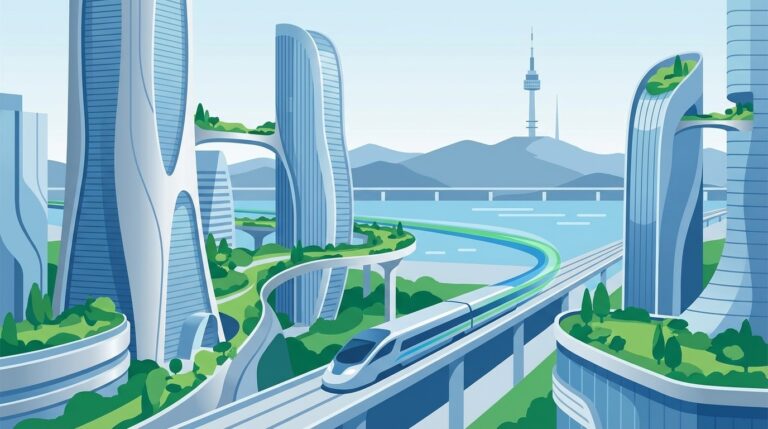
Today, we’re moving beyond everyday conversation and into the realm of imagination and philosophy. Have you ever wondered what cities might look like in 50 or 100 years? We’ll learn the essential Korean vocabulary to describe the architecture and design of these future cities. In Korea, a country known for its hyper-modern cityscapes and cutting-edge smart city projects, these aren’t just abstract ideas—they’re concepts being actively discussed and built. Let’s learn how to join that conversation!
Core Expressions for Future-Forward Thinkers
Here are some key terms you’ll need to sound like a true design expert.
1. 지속 가능하다 (jisok ganeunghada)
- Pronunciation [Romanization]: Jisok ganeunghada
- English Meaning: To be sustainable
- Detailed Explanation: This is a crucial term in modern design and urban planning. It’s a combination of 지속 (jisok), meaning ‘continuation’ or ‘persistence’, and 가능하다 (ganeunghada), meaning ‘to be possible’. It refers to development that meets the needs of the present without compromising the ability of future generations to meet their own needs, especially in terms of environment and energy.
- 💡 Pronunciation Tip: The ‘ㄱ’ (g) at the beginning of a word, like in 가능 (ganeung), has a sound that’s a soft blend of ‘g’ and ‘k’. Try to pronounce it without a strong puff of air, making it sound smooth and natural.
2. 유기적이다 (yugijeogida)
- Pronunciation [Romanization]: Yugijeogida
- English Meaning: To be organic
- Detailed Explanation: This doesn’t just refer to food! In architecture and design, 유기적 (yugijeok) describes forms that are flowing, natural, and harmonious, like those found in nature. It’s the opposite of rigid, geometric, or artificial structures. Think curves instead of sharp angles.
- 💡 Pronunciation Tip: The syllable 적 (jeok) is a common suffix. When followed by 이다 (ida), it flows smoothly. Practice saying 유기적이다 (yugijeogida) as one continuous, fluid phrase rather than three separate parts.
3. 인간 중심적 (ingan jungsimjeok)
- Pronunciation [Romanization]: Ingan jungsimjeok
- English Meaning: Human-centric; anthropocentric
- Detailed Explanation: This term is a perfect example of how Korean builds concepts. It’s made of 인간 (ingan) for ‘human’, 중심 (jungsim) for ‘center’, and the suffix -적 (-jeok) to make it descriptive. A 인간 중심적 design puts human well-being, comfort, and experience at the forefront of the planning process.
- 💡 Pronunciation Tip: The ‘ㅇ’ (ng) sound at the end of 인 (in) and 중 (jung) is a nasal sound made at the back of your throat, similar to the ‘-ng’ in the English word ‘singing’. Make sure not to pronounce it like an ‘n’.
4. 융합되다 (yunghapdoeda)
- Pronunciation [Romanization]: Yunghapdoeda
- English Meaning: To be fused; to be converged
- Detailed Explanation: This powerful verb describes the seamless blending of two or more different elements into a new whole. It’s perfect for describing future cities where nature and technology, or public and private spaces, are no longer separate but are integrated. For example: “자연과 기술이 융합된 건축” (Architecture where nature and technology are fused).
- 💡 Pronunciation Tip: The vowel ‘ㅠ’ (yu) in 융 (yung) is a ‘y’ sound combined with an ‘u’ sound (like ‘oo’ in ‘moon’). Start with your lips puckered as if to say ‘y’ and move into the ‘oo’ sound.
Example Dialogue
Let’s see how these terms might be used by two architecture students, A and B.
A: 미래의 도시는 어떤 모습일까요? (Mirae-ui dosineun eotteon moseubilkkayo?)
What do you think cities of the future will look like?
B: 저는 자연과 기술이 융합된 지속 가능한 도시가 될 거라고 생각해요. 건물 디자인도 딱딱한 직선보다는 더 유기적인 형태가 많아지고요.
(Jeoneun jayeongwa gisuri yunghapdoen jisok ganeunghan dosiga doel georago saenggakhaeyo. Geonmul dijaindo ttakttakhan jikseonbodaneun deo yugijeogin hyeongtaega manajigoyo.)
I believe they will be sustainable cities where nature and technology are fused. Also, building designs will feature more organic forms rather than rigid, straight lines.
A: 맞아요. 무엇보다 인간 중심적인 설계가 가장 중요하겠죠. 사람들이 편안함을 느끼는 공간을 만드는 것이요.
(Majayo. Mueotboda ingan jungsimjeogin seolgyega gajang jung-yohagetjyo. Saramdeuri pyeonanhameul neukkineun gongganeul mandeuneun geosiyo.)
Exactly. And above all, a human-centric design approach will be the most important thing, right? Creating spaces where people feel at ease.
Culture Tip & Trend Deep Dive
In Korea, these concepts are already taking shape. The famous Dongdaemun Design Plaza (DDP) in Seoul, designed by Zaha Hadid, is a perfect example of 유기적 (yugijeok) architecture with its stunning, flowing curves. Furthermore, Korea is a global leader in developing ‘smart cities’. Projects like Songdo in Incheon are real-world experiments in creating 지속 가능한 (jisok ganeunghan) urban environments where technology is 융합된 (yunghapdoen) into every aspect of life. This focus on 인간 중심적 (ingan jungsimjeok) design is also reflected in Seoul’s recent urban renewal projects, which are transforming old highways into beautiful parks and pedestrian walkways.
Let’s Review & Practice!
We’ve learned four amazing words to discuss future architecture: 지속 가능하다 (sustainable), 유기적이다 (organic), 인간 중심적 (human-centric), and 융합되다 (to be fused).
Now, try this quick quiz!
Fill in the blank:
A building design that uses flowing curves inspired by nature can be described as ________. (Hint: It’s not about vegetables!)
What’s your vision of a future city? Try describing it in the comments below using today’s vocabulary! We’d love to read your ideas!
Frequently Asked Questions (FAQ)
Q: What does "지속 가능하다 (jisok ganeunghada)" mean in Korean and how do you pronounce it?
A: In Korean, "지속 가능하다 (jisok ganeunghada)" is pronounced [Romanization] and means: To be sustainable
Q: What does "유기적이다 (yugijeogida)" mean in Korean and how do you pronounce it?
A: In Korean, "유기적이다 (yugijeogida)" is pronounced [Romanization] and means: To be organic
Q: What does "인간 중심적 (ingan jungsimjeok)" mean in Korean and how do you pronounce it?
A: In Korean, "인간 중심적 (ingan jungsimjeok)" is pronounced [Romanization] and means: Human-centric; anthropocentric
Q: What does "융합되다 (yunghapdoeda)" mean in Korean and how do you pronounce it?
A: In Korean, "융합되다 (yunghapdoeda)" is pronounced [Romanization] and means: To be fused; to be converged






