

Hello! Welcome to Maeil Hangul, where we upgrade your Korean skills every day!
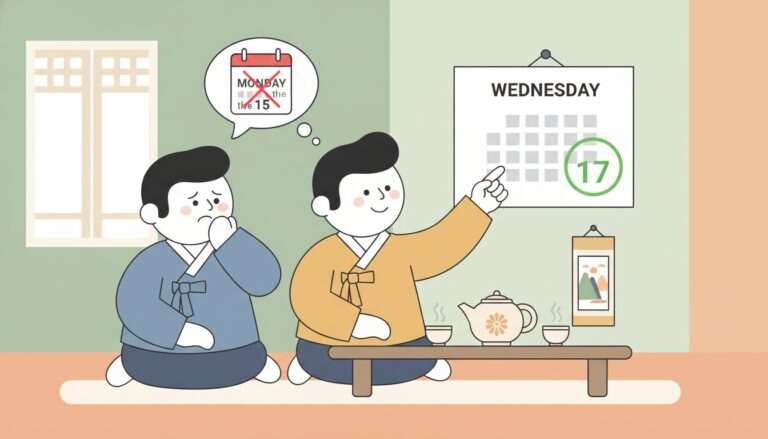
Have you ever been invited to something but couldn’t go? Saying ‘no’ can be tricky in any language. Today, we’ll learn how to politely decline an invitation in Korean while suggesting another time, so you can keep your friendships strong!
Lately in Korea, with so many new trendy cafes and pop-up stores, everyone’s schedule is packed. Knowing how to reschedule is an essential skill for your social life in Korea. Let’s learn how to do it like a native speaker!
Key Expressions for Rescheduling
Here are the essential phrases you need to master!
1. 그날은 좀 어려울 것 같아요. (Geunareun jom eoryeoul geot gatayo.)
* Pronunciation [Romanization]: Geu-na-reun jom eo-ryeo-ul geot ga-ta-yo.
* English Meaning: I don’t think I can make it that day. / That day seems a bit difficult.
* Detailed Explanation: This is a wonderfully soft and indirect way to say ‘no.’ Instead of a direct “I can’t,” you’re saying it “seems difficult.” The word 좀 (jom), meaning ‘a bit,’ makes the refusal even gentler. It’s a very common and polite phrase used among friends and colleagues.
* 💡 Pronunciation Tip: The final consonant ‘ㄹ’ in 어려울 (eoryeoul) is pronounced clearly. It’s not silent! Make sure to pronounce it like a light ‘L’ sound at the end of the syllable: eo-ryeo-ul.
2. 혹시 다음 주는 어때요? (Hoksi daeum juneun eottaeyo?)
* Pronunciation [Romanization]: Hok-si da-eum ju-neun eo-ttae-yo?
* English Meaning: By any chance, how about next week?
* Detailed Explanation: This is the perfect follow-up! 혹시 (hoksi) means ‘by any chance’ or ‘perhaps’ and adds a layer of politeness, showing you’re being considerate. 다음 주 (daeum ju) means ‘next week,’ and -는 어때요? (-neun eottaeyo?) is the classic pattern for making a suggestion, ‘How about…?’
* 💡 Pronunciation Tip: In 어때요 (eottaeyo), the ‘h’ sound (ㅎ) after the ‘t’ sound (ㄸ) is silent. You don’t pronounce it. So, it sounds like [eottaeyo], not eottae-hyo.
3. 대신 (Daesin)
* Pronunciation [Romanization]: Dae-sin
* English Meaning: Instead
* Detailed Explanation: This is a useful connector word. You use it to link your refusal to your new suggestion. It shows you still want to meet up, just at a different time. You can put it at the beginning of your suggestion sentence. For example: “대신 다음 주에 만날까요?” (Shall we meet next week instead?).
* 💡 Pronunciation Tip: The vowel ‘애’ (ae) in 대 (dae) is pronounced like the ‘a’ in the English word ‘apple’. Open your mouth wide and say ‘ae’!
Example Dialogue
Let’s see these expressions in a real conversation! Friends A and B are talking about a new cafe that’s trending on Instagram.
- A: 지수야, 이번 주 토요일에 새로 생긴 ‘서울숲’ 카페 갈래? 사람들이 엄청 많대!
(Jisoo, do you want to go to the new ‘Seoul Forest’ cafe this Saturday? I heard it’s super popular!) - B: 아, 미안해. 그날은 좀 어려울 것 같아. 다른 약속이 있어.
(Oh, I’m sorry. That day seems a bit difficult. I have other plans.) - A: 진짜? 아쉽다.
(Really? That’s a shame.) - B: 대신 혹시 다음 주 토요일은 어때? 그때는 괜찮아!
(Instead, how about next Saturday, by any chance? I’m free then!) - A: 좋아! 그럼 다음 주에 보자!
(Sounds good! See you next week then!)
Culture Tip & Trend Deep Dive
In Korean culture, maintaining harmony is very important. Directly saying “no” (아니요) or “I don’t want to” can sometimes sound too strong or confrontational, especially in social settings. This is related to the concept of 눈치 (nunchi), the subtle art of sensing others’ moods and feelings.
By using soft expressions like “어려울 것 같아요” (it seems difficult), you are being considerate of the other person’s feelings. The most important part is to show your enthusiasm to meet up by suggesting an alternative date. This proves you value the relationship, not that you’re rejecting the person!
Let’s Practice!
Time to test your new skills! Your friend sends you a message:
“우리 이번 주 금요일에 같이 저녁 먹을까?” (Shall we have dinner together this Friday?)
You are busy on Friday. How would you politely say no and suggest Saturday instead? Use at least two of the expressions we learned today!
Leave your answer in the comments below! We’d love to see you try. See you next time!
Frequently Asked Questions (FAQ)
Q: What does "좀" mean in Korean and how do you pronounce it?
A: In Korean, "좀" is pronounced [jom] and means: , meaning 'a bit,' makes the refusal even gentler. It's a very common and polite phrase used among friends and colleagues.
Q: What does "어려울" mean in Korean and how do you pronounce it?
A: In Korean, "어려울" is pronounced [eoryeoul] and means: is pronounced clearly. It's not silent! Make sure to pronounce it like a light 'L' sound at the end of the syllable:
Q: What does "혹시" mean in Korean and how do you pronounce it?
A: In Korean, "혹시" is pronounced [hoksi] and means: means 'by any chance' or 'perhaps' and adds a layer of politeness, showing you're being considerate.
Q: What does "다음 주" mean in Korean and how do you pronounce it?
A: In Korean, "다음 주" is pronounced [daeum ju] and means: means 'next week,' and






