

Unlock Doors in Korea: The Magic Phrase!
Hello! This is Maeil Hangeul, here to upgrade your Korean skills!
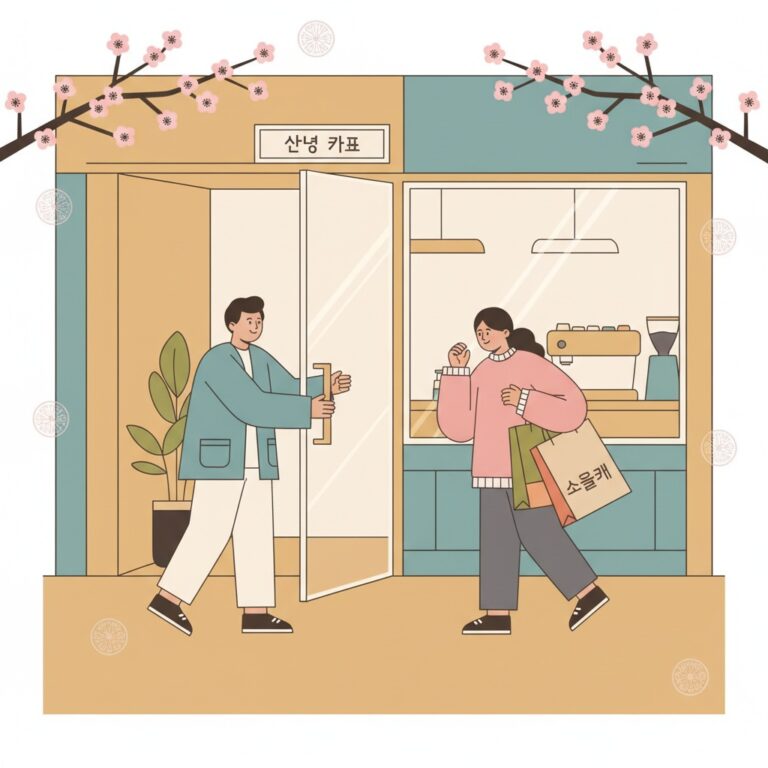
Ever found yourself juggling shopping bags, a coffee, and your phone, only to see a door swinging shut in front of you? We’ve all been there! Today, we’re going to learn a super useful and polite Korean phrase to ask someone to hold the door for you.
Lately in Korea, especially in bustling areas like Hongdae or Gangnam, life moves fast. But don’t worry! Koreans are generally very kind and helpful. Knowing this one simple phrase will not only save you from a clumsy moment but also help you connect with people in a small, friendly way. Let’s get started!
Core Expressions for Holding the Door
Here are three essential phrases to master this situation.
1. The Attention-Getter: 잠시만요!
- Korean: 잠시만요!
- Pronunciation [Romanization]: Jamsimanyo!
- English Meaning: Just a moment! / Excuse me!
- Detailed Explanation: This is your go-to phrase to politely get someone’s attention before you make a request. It literally means “just a little time,” but it works perfectly as “Excuse me, could you wait a second?” It’s polite and can be used in almost any situation.
- 💡 Pronunciation Tip: This phrase is pronounced just as it’s written! But focus on the intonation. Say it with a slightly upward, questioning tone to sound friendly: Jam-si-man-yo?
2. The Magic Request: 문 좀 잡아주시겠어요?
- Korean: 문 좀 잡아주시겠어요?
- Pronunciation [Romanization]: Mun jom jabajusigesseoyo?
- English Meaning: Could you please hold the door?
- Detailed Explanation: This is the full, polite request. Let’s break it down:
- 문 (mun): Door
- 좀 (jom): This little word is magic! It means “a little” or “for a bit,” but when used in a request, it makes the sentence sound much softer and more polite, like adding “please.”
- 잡아주시겠어요 (jabajusigesseoyo): This is a very polite verb form that means “Could you hold it for me?”
- 💡 Pronunciation Tip: The syllables can feel long, so practice saying it smoothly. Notice 잡아주 (jab-a-ju). In natural, fast speech, the sounds often blend together to sound more like [자바주 (jabaju)]. Don’t stress about pausing between each syllable.
3. The Grateful Follow-up: 감사합니다!
- Korean: 감사합니다
- Pronunciation [Romanization]: Gamsahamnida
- English Meaning: Thank you
- Detailed Explanation: After someone helps you, this is the standard, polite way to express your gratitude. It’s perfect for showing respect to strangers, elders, or in any formal setting.
- 💡 Pronunciation Tip: This is a classic pronunciation rule! The last letter in 감사합 (gamsahap) is a ‘ㅂ’ (b/p sound), and the next syllable starts with ‘ㄴ’ (n sound). When ‘ㅂ’ meets ‘ㄴ’, the ‘ㅂ’ sound changes to an ‘ㅁ’ (m sound) to make it easier to say. This is called nasal assimilation.
- So, instead of saying Gamsahap-nida, you say [Gamsahamnida]. It will make you sound much more natural!
Example Dialogue
Imagine you just bought the new album from your favorite K-pop group and your hands are full. You’re approaching the entrance to a café in Seongsu-dong.
- A: (Struggling with shopping bags) 아, 잠시만요!
- (Ah, Jamsimanyo!)
- Ah, excuse me!
- B: (Turns around and sees person A) 네.
- (Ne.)
- Yes?
- A: 죄송하지만, 문 좀 잡아주시겠어요?
- (Joesonghajiman, mun jom jabajusigesseoyo?)
- I’m sorry to bother you, but could you please hold the door?
- B: 그럼요. 천천히 들어오세요.
- (Geuromyo. Cheoncheonhi deureooseyo.)
- Of course. Take your time coming in.
- A: 정말 감사합니다!
- (Jeongmal gamsahamnida!)
- Thank you so much!
Culture Tip & Trend Deep Dive
In Korea, small acts of kindness are often related to a cultural concept called 정 (jeong). It’s a deep feeling of connection, community, and affection. Holding the door for someone is a simple, everyday expression of jeong.
You’ll see this all the time in K-dramas! The main character, loaded with groceries, is helped by their charming neighbor. It’s a small moment, but it builds a connection. When you use these polite phrases in Korea, you’re not just speaking the language; you’re participating in this culture of mutual kindness. People will appreciate your effort and your politeness, and you’ll feel more connected to the world around you. It’s a win-win!
Let’s Practice!
Great job today! You’ve learned how to handle a very common situation in Korea with politeness and confidence.
Quick Quiz:
- You see someone approaching the door behind you. You want to hold it for them. After you open it, what can you say to them as they pass? (Hint: It’s not in the list above, but think about what you might say in English!) A common phrase is “먼저 들어가세요” (Meonjeo deureogaseyo – Please go in first).
- Fill in the blank for the main request phrase:
“______ 좀 잡아주시겠어요?”
Now it’s your turn! Try making a sentence using one of today’s expressions and leave it in the comments below! We’d love to see what you come up with
Frequently Asked Questions (FAQ)
Q: What does "문" mean in Korean and how do you pronounce it?
A: In Korean, "문" is pronounced [mun] and means: Door
Q: What does "좀" mean in Korean and how do you pronounce it?
A: In Korean, "좀" is pronounced [jom] and means: This little word is magic! It means "a little" or "for a bit," but when used in a request, it makes the sentence sound much softer and more polite, like adding "please."
Q: What does "잡아주시겠어요" mean in Korean and how do you pronounce it?
A: In Korean, "잡아주시겠어요" is pronounced [jabajusigesseoyo] and means: This is a very polite verb form that means "Could you hold it for me?"
Q: What does "잡아주" mean in Korean and how do you pronounce it?
A: In Korean, "잡아주" is pronounced [jab-a-ju] and means: . In natural, fast speech, the sounds often blend together to sound more like






