

Bridging the Digital Divide: How to Propose Policy Solutions (정책 제안하기) in Korean
Hello! Welcome back to [Maeil Hangul], where we upgrade your Korean skills to the next level!
Today, we’re stepping into the world of public policy and professional discourse. Ever wanted to discuss social issues, read a Korean newspaper editorial, or even draft a policy proposal in Korean? Then this lesson is for you.
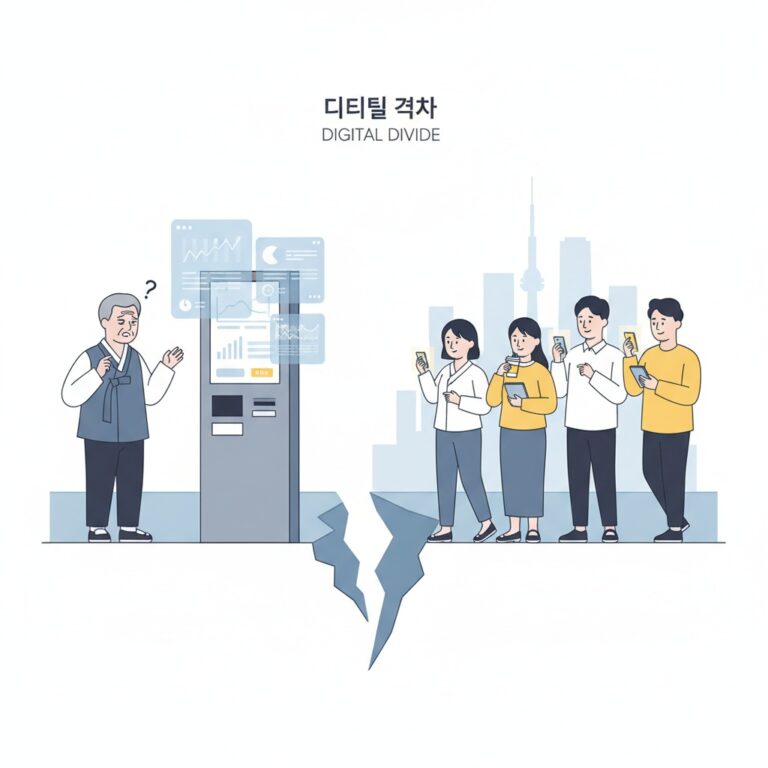
As you know, Korea is a global IT powerhouse. But ironically, this hyper-digitalization has created a serious challenge: the ‘디지털 격차’ (digital divide). The conversation around solving this issue is a hot topic in Korean society right now. We’ll learn the essential, high-level vocabulary and phrases you need to understand this debate and articulate your own solutions like a pro.
Let’s dive in!
Core Expressions for Policy Proposals
Here are four key expressions you’ll need to discuss policy solutions for the digital divide.
1. 디지털 격차를 해소하다 (dijiteol gyeokchareul haesohada)
- Pronunciation [디지털 격차를 해소하다]
- English Meaning: To resolve/bridge the digital divide.
- Detailed Explanation: This is the central phrase for our topic. ‘격차’ (gyeokcha) means ‘gap’ or ‘disparity,’ and ‘해소하다’ (haesohada) is a formal verb meaning ‘to resolve,’ ‘to eliminate,’ or ‘to solve.’ It’s often used for abstract problems like stress (스트레스를 해소하다), conflict (갈등을 해소하다), or a societal gap like this one. Using ‘해소하다’ instead of a simpler verb like ‘없애다’ (to get rid of) instantly makes your language sound more formal and academic.
- 💡 Pronunciation Tip: The ‘ㅎ’ (h) in 해소하다 is clearly aspirated. Make sure you release a puff of air. For 격차, the initial sound is ‘ㄲ’ (kk), a tense consonant. It’s a sharp, strong sound produced with no aspiration, distinct from ‘ㄱ’ (g/k).
2. 정보 소외 계층 (jeongbo sooe gyecheung)
- Pronunciation [정보 소외 계층]
- English Meaning: The information-alienated class; the digitally marginalized.
- Detailed Explanation: This is a crucial term in Korean social policy. Let’s break it down: 정보 (jeongbo) means ‘information,’ 소외 (sooe) means ‘alienation’ or ‘marginalization,’ and 계층 (gyecheung) means ‘social stratum’ or ‘class.’ Together, it refers to groups of people who are left behind by the rapid flow of digital information, such as some elderly populations, people with disabilities, or those in low-income brackets. It’s a much more nuanced and formal term than “people who can’t use the internet.”
- 💡 Pronunciation Tip: The word 소외 is two distinct syllables: [소-외 | so-oe]. Avoid blending it into one sound like “sweh.” Pronounce the ‘소’ and then the ‘외’ clearly.
3. ~는/은 시급한 과제입니다 (~neun/eun sigeupan gwajeimnida)
- Pronunciation [~는/은 시그판 과제임니다]
- English Meaning: (Something) is an urgent task/challenge.
- Detailed Explanation: This is a powerful phrase for emphasizing the importance of an issue in a proposal or presentation. ‘시급하다’ (sigeupada) means ‘to be urgent,’ and ‘과제’ (gwaje) means ‘task,’ ‘assignment,’ or ‘challenge.’ By labeling something a ‘시급한 과제,’ you are framing it as a top priority that requires immediate attention and action.
- 💡 Pronunciation Tip (Liaison): Notice the pronunciation of 과제입니다. The final consonant of the preceding block, ‘ㅂ’ (b), links with the ‘니다’ (nida) to become ‘ㅁ’ (m). So, instead of “gwaje-ib-nida,” the natural, fluid pronunciation is [과제임니다 | gwajeimnida]. This is a key feature of smooth, advanced Korean speech.
4. 구체적인 대안을 마련하다 (guchejeogin daeaneul maryeonhada)
- Pronunciation [구체저긴 대아늘 마려나다]
- English Meaning: To prepare/devise a concrete alternative/solution.
- Detailed Explanation: After identifying a problem, you need to propose a solution. This phrase is perfect for that. ‘구체적이다’ (guchejeogida) means ‘to be specific’ or ‘concrete.’ ‘대안’ (daean) means ‘alternative’ or ‘solution.’ Finally, ‘마련하다’ (maryeonhada) is a formal verb for ‘to prepare’ or ‘to arrange for,’ often used for things like funds, plans, or solutions. It implies careful thought and preparation.
- 💡 Pronunciation Tip: The particle ‘의’ (ui) in 구체적인 is often pronounced as ‘에’ (e) when it’s not at the beginning of a word, making the pronunciation [구체저긴 | guchejeogin] sound more natural. Also, the ‘ㄴ’ in 대안을 links to the next syllable, creating the sound [대아늘 | daeaneul].
Sample Dialogue: At a Policy Forum
Let’s see how these expressions work in a professional conversation between a policy researcher (A) and a government official (B).
A: 최근 노년층의 디지털 격차 문제가 심각해지고 있습니다. 이분들이야말로 정보 소외 계층의 대표적인 예입니다.
(A: Recently, the digital divide among the elderly has become severe. They are a prime example of the digitally marginalized.)
B: 동의합니다. 키오스크 주문이나 온라인 뱅킹 등에서 겪는 어려움을 생각하면, 이 문제는 우리 사회가 해결해야 할 시급한 과제입니다.
(B: I agree. Considering the difficulties they face with kiosk ordering or online banking, this issue is an urgent challenge our society must solve.)
A: 맞습니다. 따라서 정부 차원에서 이들을 위한 맞춤형 디지털 교육 프로그램을 확대하는 등 구체적인 대안을 마련해야 합니다.
(A: That’s right. Therefore, the government must devise concrete solutions, such as expanding customized digital education programs for them.)
B: 좋은 의견입니다. 그 교육 프로그램에 대해 더 자세히 논의해보고 싶군요.
(B: That’s an excellent point. I would like to discuss that educational program in more detail.)
Culture Tip & Trend Deep Dive
In Korea, the ‘digital divide’ isn’t just an abstract concept—it’s a daily reality. From ordering coffee at a mega-cafe using a kiosk to booking train tickets via a mobile app, many essential services have gone fully digital. This has created real barriers for the 정보 소외 계층.
This topic is constantly in the news and is a recurring theme in political debates. You’ll find these expressions used frequently in newspaper editorials (신문 사설) and on TV news analysis programs.
Interestingly, you can also see a linguistic “digital divide.” The slang and shortened words (줄임말) used by the Z Generation on social media can be completely unintelligible to older generations, creating a communication gap. By mastering today’s formal vocabulary, you’re not only equipped to discuss high-level policy but also to better understand the social dynamics shaping modern Korea. Knowing these terms will make you sound incredibly well-informed and fluent.
Wrap-up & Practice!
Great job today! We’ve learned four advanced expressions to professionally discuss policy solutions for the digital divide:
- 디지털 격차를 해소하다 (to bridge the digital divide)
- 정보 소외 계층 (the digitally marginalized)
- ~는/은 시급한 과제입니다 (is an urgent task)
- 구체적인 대안을 마련하다 (to devise a concrete solution)
Now, let’s put your knowledge to the test!
- Fill in the blank:
농어촌 지역의 인터넷 접근성 개선은 정부가 해결해야 할 _________.
(Improving internet accessibility in rural and fishing villages is a(n) __________ that the government must solve.) -
Make a sentence:
Using the phrase 구체적인 대안을 마련하다, write one sentence suggesting a policy to help the 정보 소외 계층.
Leave your answers in the comments below! We’d love to see your policy ideas. Keep up the amazing work
Frequently Asked Questions (FAQ)
Q: What does "'디지털 격차'" mean in Korean and how do you pronounce it?
A: In Korean, "'디지털 격차'" is pronounced [digital divide] and means: . The conversation around solving this issue is a hot topic in Korean society right now. We'll learn the essential, high-level vocabulary and phrases you need to understand this debate and articulate your own solutions like a pro.
Q: What does "'격차'" mean in Korean and how do you pronounce it?
A: In Korean, "'격차'" is pronounced [gyeokcha] and means: means 'gap' or 'disparity,' and
Q: What does "'해소하다'" mean in Korean and how do you pronounce it?
A: In Korean, "'해소하다'" is pronounced [haesohada] and means: is a formal verb meaning 'to resolve,' 'to eliminate,' or 'to solve.' It's often used for abstract problems like stress (스트레스를 해소하다), conflict (갈등을 해소하다), or a societal gap like this one. Using '해소하다' instead of a simpler verb like '없애다' (to get rid of) instantly makes your language sound more formal and academic.
Q: What does "정보" mean in Korean and how do you pronounce it?
A: In Korean, "정보" is pronounced [jeongbo] and means: means 'information,'







