

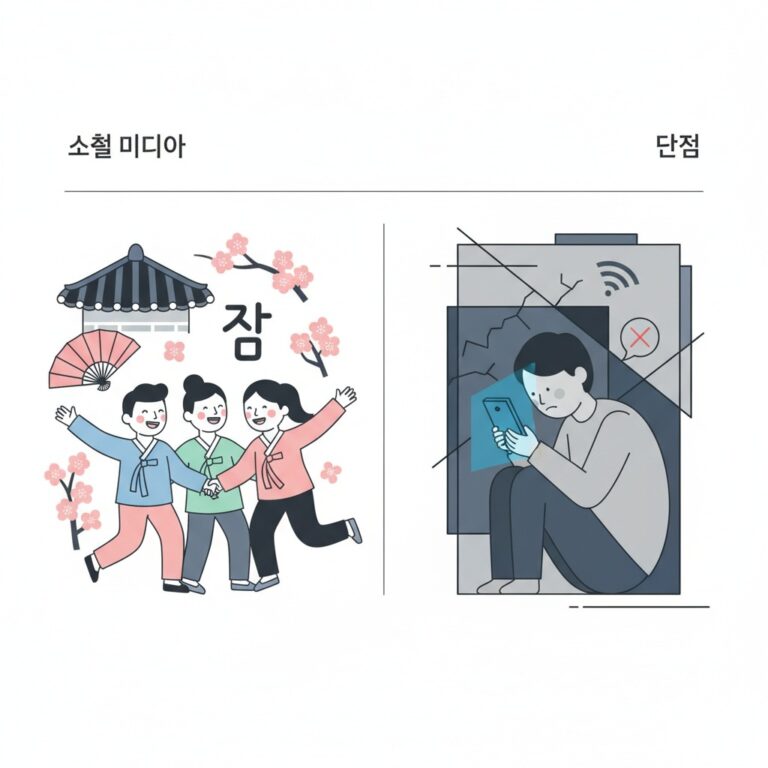
SNS: A Blessing or a Curse for Your Korean Friendships?
Hello! Welcome back to [Maeil Hangeul], your go-to place for leveling up your Korean skills!
Today, we’re diving into a topic that’s on everyone’s mind: social media! Have you ever wondered how to talk about the good, the bad, and the complicated sides of SNS in Korean? You’re in the right place! Lately in Korea, there’s a huge conversation happening, especially among younger generations, about how platforms like Instagram and KakaoTalk are changing the way people interact. Mastering today’s phrases will not only make you sound like a fluent speaker but also allow you to participate in deep, meaningful conversations with your Korean friends. Let’s get started!
Core Expressions for Your SNS Debate
Here are some essential phrases to help you express your nuanced opinions about the digital world.
1. 양날의 검 (yangnal-ui geom)
- Pronunciation [Romanization]: [yang-na-rui geom]
- English Meaning: A double-edged sword
- Detailed Explanation: This is a fantastic idiomatic expression used to describe something that has both positive and negative effects, just like a sword with two sharp edges. It’s a sophisticated phrase that shows you have a deep understanding of the language. You can use it to describe technology, social media, a new policy—anything with clear pros and cons.
- 💡 Pronunciation Tip: Notice the pronunciation of ‘의’ (ui). When used as a possessive particle like here, it’s often pronounced as [에/e]. So, while the standard is [ui], you’ll sound much more natural saying [양나레 검 / yang-na-re geom]. Also, in ‘양날의’, the final consonant ‘ㄹ(l)’ of ‘날’ links to the following vowel ‘의’, creating a smooth [narui] or [nare] sound. This is called 연음 (yeon-eum) or liaison.
2. 장단점 (jangdanjeom)
- Pronunciation [Romanization]: [jang-dan-jjeom]
- English Meaning: Pros and cons; strengths and weaknesses
- Detailed Explanation: This is a fundamental word for any discussion or debate. It’s a compound word made from 장점 (jangjeom), meaning ‘strong point’ or ‘advantage’, and 단점 (danjeom), meaning ‘weak point’ or ‘disadvantage’. It’s the most direct way to say “pros and cons.”
- 💡 Pronunciation Tip: The second part, ‘단점’, is not pronounced [dan-jeom] but [단쩜 / dan-jjeom]. This is an example of 경음화 (gyeong-eum-hwa), or tensification. When a syllable ending in a nasal sound like ‘ㄴ(n)’ is followed by ‘ㅈ(j)’, the ‘ㅈ(j)’ sound becomes tense, like ‘ㅉ(jj)’. It’s a small change that makes a big difference in sounding natural!
3. 어떻게 사용하느냐에 따라 다르다 (eotteoke sayonghaneunya-e ttara dareuda)
- Pronunciation [Romanization]: [eo-tteo-ke sa-yong-ha-neu-nya-e tta-ra da-reu-da]
- English Meaning: It depends on how you use it.
- Detailed Explanation: This is a super useful grammatical pattern! ‘~느냐에 따라 다르다’ means “it depends on…” You can attach it to verbs to express that the outcome is conditional. It’s perfect for debates because it allows you to show that something isn’t simply black or white. You can swap the verb, for example: 누구를 만나느냐에 따라 다르다 (It depends on who you meet).
- 💡 Pronunciation Tip: Let’s look at ‘어떻게’. The ‘ㅎ(h)’ sound is very weak and often gets assimilated. When followed by ‘ㄱ(g)’, it combines to create a strong aspirated sound, [ㅋ/k]. So, you pronounce it [어떠케 / eotteoke], not [eot-heot-ge].
4. 소외감을 느끼다 (soegameul neukkida)
- Pronunciation [Romanization]: [so-oe-ga-meul neu-kki-da]
- English Meaning: To feel alienated / to feel left out
- Detailed Explanation: This phrase perfectly captures one of the biggest downsides of social media. ‘소외감’ (soegam) means a ‘sense of alienation’ or ‘feeling of being isolated’, and ‘느끼다’ (neukkida) means ‘to feel’. You can use this when you see your friends posting pictures of them hanging out without you, a phenomenon often called “FOMO” (Fear Of Missing Out) in English.
- 💡 Pronunciation Tip: This is another great example of 연음 (yeon-eum). The final consonant ‘ㅁ(m)’ in ‘소외감을’ moves over to the next syllable, which starts with a vowel. So, instead of a choppy [so-oe-gam eul], it flows smoothly as [소외가믈 / soegameul].
Example Dialogue
Let’s see these expressions in action!
A: 민준이 인스타그램 봤어? 요즘 맨날 운동만 하더니 바디 프로필 찍었더라. 너무 멋있는데, 한편으로는 좀 부럽기도 하고…
(Minjun-i inseutageuraem bwasseo? Yojeum maennal undongman hadeoni badi peuropeul jjigeotdeora. Neomu meosinneunde, hanpyeoneuroneun jom bureopgido hago…)
Did you see Minjun’s Instagram? He’s been working out non-stop and just posted his “body profile” photos. It’s so cool, but on the other hand, I feel a bit envious…
B: 맞아. SNS는 정말 양날의 검인 것 같아. 친구 소식을 쉽게 알 수 있다는 장점이 있지만, 가끔은 나도 모르게 비교하게 되잖아.
(Maja. SNSneun jeongmal yangnar-ui geomin geot gata. Chingu sosigeul swipge al su itdaneun jangdanjeomi itjiman, gakkeumeun nado moreuge bigyohage dwanjana.)
I know. I really think SNS is a double-edged sword. It has the pro of easily keeping up with friends, but sometimes I find myself comparing myself without realizing it.
A: 완전 공감해. 어떻게 사용하느냐에 따라 다른 건데, 가끔은 나만 빼고 다들 행복한 것 같아서 소외감을 느끼기도 해.
(Wanjeon gonggamhae. Eotteoke sayonghaneunya-e ttara dareun geonde, gakkeumeun naman ppaego dadeul haengbokan geot gataseo soegameul neukkigido hae.)
I totally agree. I know it depends on how you use it, but sometimes I feel left out, like everyone is happy except for me.
B: 그러니까. 긍정적으로 사용하려고 노력해야지. 우리도 이번 주말에 만나서 맛있는 거 먹고 인증샷 찍을까?
(Geureonikka. Geungjeongjeogeuro sayongharyeogo noryeokaeyaji. Urido ibeon jumare mannaseo masinneun geo meokgo injeungsyat jjigeulkka?)
Exactly. We just have to try to use it positively. Hey, should we meet this weekend, eat something delicious, and take a proof shot?
Culture Tip & Trend Deep Dive
In Korea, social media isn’t just for sharing—it’s deeply integrated into social life. Here’s a deeper look:
- “인증샷” (Injeungsyat – Proof Shot) Culture: As seen in the dialogue, taking an “injeungsyat” at a trendy cafe, a popular restaurant, or a special event is almost a social requirement. It’s a way of showing “I was here, I’m part of this trend.” While fun, this culture can create pressure to always be doing something “Instagrammable.”
- The Rise of “바디 프로필” (Badi Peuropeul – Body Profile): This has been a massive trend where people undergo intense diet and exercise for several months to take professional-quality photos of their bodies. While celebrated as a mark of self-discipline, it has also sparked a debate about unrealistic body standards and the pressure to display one’s body publicly, linking back to our theme of SNS being a 양날의 검.
- KakaoTalk Profile (프사/상메): A person’s KakaoTalk profile picture (프사 – peusa) and status message (상메 – sangme) are huge! People use them to subtly express their current mood, relationship status, or what they’re up to. A change in a friend’s profile can be a major topic of conversation.
Understanding these cultural nuances will help you use today’s phrases in a context that is truly relevant to life in Korea.
Let’s Wrap It Up & Practice!
Today, we learned some incredibly useful expressions to discuss the complex world of social media. You can now talk about things being a 양날의 검 (double-edged sword), weigh the 장단점 (pros and cons), say that it 어떻게 사용하느냐에 따라 다르다 (depends on how you use it), and express the feeling of 소외감을 느끼다 (feeling left out).
Now it’s your turn to practice!
- Fill in the blank:
친구들과의 단체 채팅방은 소식을 빨리 공유할 수 있어 좋지만, 너무 많은 메시지 때문에 피곤할 때도 있어요. 정말 ______인 것 같아요.
(A group chat with friends is great for sharing news quickly, but it can also be tiring because of too many messages. It really seems like a ______.) -
Your Turn:
Using the phrases we learned today, what is your opinion on SNS?
(SNS의 장단점은 무엇이라고 생각하세요?)
Leave your answers in the comments below! We’d love to hear your thoughts. Keep up the amazing work
Frequently Asked Questions (FAQ)
Q: What does "'의'" mean in Korean and how do you pronounce it?
A: In Korean, "'의'" is pronounced [ui] and means: . When used as a possessive particle like here, it's often pronounced as
Q: What does "연음" mean in Korean and how do you pronounce it?
A: In Korean, "연음" is pronounced [yeon-eum] and means: or liaison.
Q: What does "장점" mean in Korean and how do you pronounce it?
A: In Korean, "장점" is pronounced [jangjeom] and means: , meaning 'strong point' or 'advantage', and
Q: What does "단점" mean in Korean and how do you pronounce it?
A: In Korean, "단점" is pronounced [danjeom] and means: , meaning 'weak point' or 'disadvantage'. It’s the most direct way to say "pros and cons."






