

Hello! This is [Maeil Hangeul], here to upgrade your Korean skills!
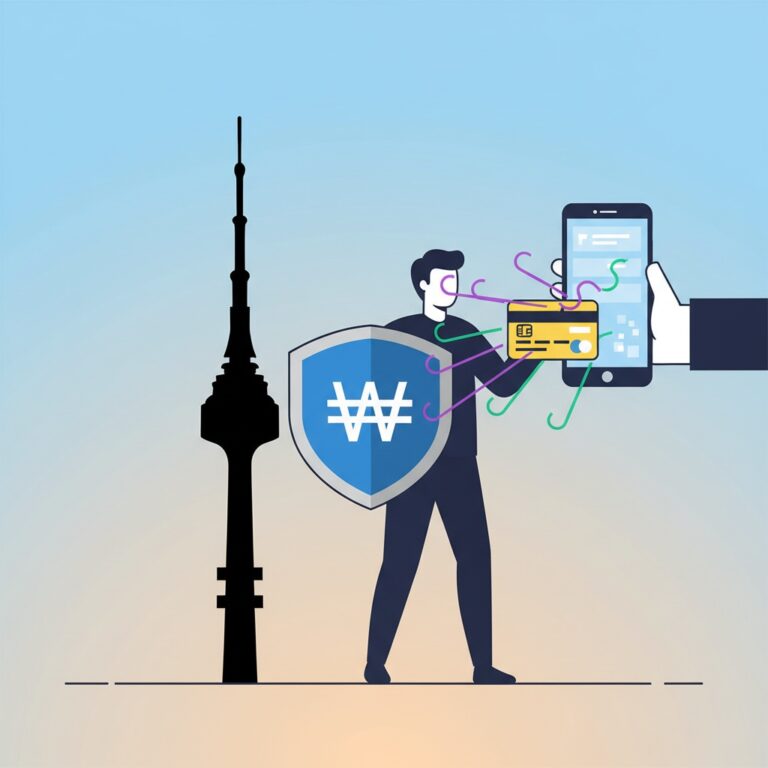
Today, we’re diving into a super practical and important topic: how to talk about cybersecurity and request a credit freeze in Korean. Why is this so important? Nowadays in Korea, with the unfortunate rise of “smishing” (스미싱 – SMS phishing) scams and news about data breaches, protecting your personal financial information is a crucial skill. Learning these phrases will not only boost your Korean but also empower you to protect yourself in real-life situations. Let’s get started!
Core Expressions You Need to Know
Here are the essential phrases to navigate a credit freeze request like a pro.
1. 신용 정보 동결 (Sinyong jeongbo donggyeol)
- Pronunciation [Sinyong jeongbo donggyeol]
- English Meaning: Credit Information Freeze
- Detailed Explanation: This is the key technical term. 신용 (Sinyong) means ‘credit’, 정보 (jeongbo) means ‘information’, and 동결 (donggyeol) means ‘freeze’ (like freezing assets or water). You use this entire phrase when you want to officially request that no one can open new credit accounts in your name. It’s a formal and specific term used with banks or credit bureaus.
2. ~을/를 신청하고 싶어요 (~eul/reul sincheonghago sipeoyo)
- Pronunciation [~eul/reul sincheonghago sipeoyo]
- English Meaning: I would like to apply for/request…
- Detailed Explanation: This is a polite and versatile pattern. 신청하다 (sincheonghada) means ‘to apply’ or ‘to request’. By attaching it to the ~고 싶어요 (~go sipeoyo) grammar, which means “I want to…”, you create a polite expression perfect for customer service situations. You attach 을 (eul) if the noun ends in a consonant and 를 (reul) if it ends in a vowel.
- Example: 신용 정보 동결을 신청하고 싶어요. (Sinyong jeongbo donggyeoreul sincheonghago sipeoyo.)
3. 개인 정보 유출 (Gaein jeongbo yuchul)
- Pronunciation [Gaein jeongbo yuchul]
- English Meaning: Personal Information Leak / Data Breach
- Detailed Explanation: This phrase is what you’ll hear in the news or what you might state as the reason for your request. 개인 정보 (Gaein jeongbo) means ‘personal information’, and 유출 (yuchul) means ‘leak’ or ‘spill’. If you’re worried that your information was compromised in a recent hack, you can say there was a “개인 정보 유출”.
4. 본인 인증 (Bonin injeung)
- Pronunciation [Bonin injeung]
- English Meaning: Identity Verification
- Detailed Explanation: This is a crucial step in any financial or official process in Korea. 본인 (Bonin) means ‘oneself’ and 인증 (injeung) means ‘verification’ or ‘authentication’. To complete your credit freeze request, you will always be asked to do this, often through your phone, a digital certificate, or another secure method.
-
💡 Pronunciation Tip:
Listen closely to the pronunciation of 본인 인증 [보닌인증 – bonin-injeung]. In Korean, when a syllable ending in a consonant is followed by a syllable starting with a vowel (specifically the silent ‘ㅇ’ character), the consonant sound “moves over” to the next syllable. This is called 연음 (yeoneum) or liaison.- Instead of saying
bon-in in-jeungwith a pause, it flows naturally as [bo-nin-in-jeung]. The final ‘ㄴ’ (n) of ‘본’ links to the ‘ㅣ’ (i) of ‘인’. This makes your pronunciation sound much smoother and more native!
- Instead of saying
Example Dialogue
Let’s see how these phrases work in a real conversation. Imagine your friend Mina is worried after getting a suspicious text.
A: 미나야, 무슨 일 있어? 표정이 안 좋아 보여.
(Minaya, museun il isseo? Pyjeongi an joa boyeo.)
Mina, what’s wrong? You don’t look so good.
B (Mina): 아, 어제 이상한 문자를 받았어. 그리고 최근에 쇼핑몰에서 개인 정보 유출 사고가 있었다는 뉴스를 봤어.
(A, eoje isanghan munjareul badasseo. Geurigo choegeune syopingmoreseo gaein jeongbo yuchul sagoga isseotdaneun nyuseureul bwasseo.)
Ah, I got a strange text message yesterday. And I saw news that there was a data breach at a shopping mall recently.
A: 정말? 그럼 빨리 신용 정보 동결을 신청하는 게 좋겠어.
(Jeongmal? Geureom ppalli sinyong jeongbo donggyeoleul sincheonghaneun ge jokesseo.)
Really? Then you should probably request a credit freeze quickly.
B (Mina): 맞아. 바로 은행 앱으로 들어가서 신용 정보 동결을 신청하고 싶어. 아마 본인 인증이 필요하겠지?
(Maja. Baro eunhaeng aebeuro deureogaseo sinyong jeongbo donggyeoreul sincheonghago sipeo. Ama bonin injeungi piryohagetji?)
Right. I want to go into my banking app right now and request a credit freeze. I’ll probably need to do an identity verification, right?
Culture Tip & Trend Deep Dive
In Korea’s highly digital society, most financial services are handled quickly online or through apps. Because of this convenience, cybersecurity is a huge topic. The concept of 본인 인증 (bonin injeung) is central to almost every online transaction, from banking to buying a concert ticket.
Pro Tip: When you request a credit freeze, you’ll likely do it through a credit bureau’s website like NICE (나이스) or KCB (올크레딧), or even directly through your primary banking app. Knowing these company names will make you sound like you’re in the know! Mentioning that you’re worried about a recent 개인 정보 유출 is a very valid and common reason that customer service will understand immediately.
Let’s Practice!
You’ve learned some powerful phrases today! Let’s check your understanding.
- Fill in the blank:
“Because I’m worried about a recent (data breach), I want to (request) a credit freeze.”최근 (__________) 때문에 신용 정보 동결을 (__________) 싶어요.
- Make a sentence:
Imagine you are on the phone with your bank. How would you politely state your request to apply for a credit freeze?
Great job today! Protecting your information is a global skill, and now you can do it in Korean.
Try using one of today’s expressions in the comments below! See you next time at [Maeil Hangeul]
Frequently Asked Questions (FAQ)
Q: What does "신용" mean in Korean and how do you pronounce it?
A: In Korean, "신용" is pronounced [Sinyong] and means: means 'credit',
Q: What does "정보" mean in Korean and how do you pronounce it?
A: In Korean, "정보" is pronounced [jeongbo] and means: means 'information', and
Q: What does "동결" mean in Korean and how do you pronounce it?
A: In Korean, "동결" is pronounced [donggyeol] and means: means 'freeze' (like freezing assets or water). You use this entire phrase when you want to officially request that no one can open new credit accounts in your name. It's a formal and specific term used with banks or credit bureaus.
Q: What does "신청하다" mean in Korean and how do you pronounce it?
A: In Korean, "신청하다" is pronounced [sincheonghada] and means: means 'to apply' or 'to request'. By attaching it to the







