

It Must Be Delicious! Guessing About K-Food Like a K-Drama Star
Hello! Welcome to Maeil Hangeul, here to upgrade your Korean skills!
Have you ever been watching a K-drama or a travel show and seen a Korean dish you’ve never tried before? You probably thought, “Wow, that looks spicy!” or “I bet that’s sweet!” Today, we’re going to learn how to express those exact thoughts in natural, fluent Korean.
Lately in Korea, “mukbang” (eating shows) and food travel vlogs are incredibly popular. You’ll see celebrities visit famous regional spots, like Jeju Island or Busan, and guess about the local food before they even take a bite. Learning today’s expressions will not only help you talk about food but will also make you sound just like your favorite Korean stars!
Let’s get started!
Core Expressions for Guessing
Here are three essential patterns you can use to make assumptions and suppositions about anything, especially delicious food!
1. -나 보다 / -은가 보다 (It seems / I guess…)
This pattern is used when you are guessing something based on an observed fact or situation. You see something, and you make an assumption based on that evidence.
- Korean Expression: 인기가 많은가 봐요.
- Pronunciation [Romanization]: In-gi-ga ma-neun-ga bwa-yo.
- English Meaning: It seems to be very popular. / I guess it’s popular.
- Detailed Explanation: You use this when you see a long line outside a restaurant and assume the food is good. Use -은가 보다 after adjectives (like 많다 -> 많은가 보다) and -나 보다 after verbs (like 오다 -> 오나 보다). It’s a casual and very common way to express an assumption.
- 💡 Pronunciation Tip: In 많은가 (ma-neun-ga), the ‘ㅎ’ (h) in the final consonant cluster ‘ㄶ’ is silent when followed by a consonant like ‘ㄱ’ (g). So, you don’t pronounce it like “man-heun-ga,” but rather a smooth [ma-neun-ga], as if the ‘ㅎ’ isn’t there at all!
2. -ㄹ/을 것 같다 (I think / It seems like…)
This is probably the most versatile and common way to express a thought, opinion, or guess in Korean. It’s a bit softer than a direct statement.
- Korean Expression: 좀 비쌀 것 같아요.
- Pronunciation [Romanization]: Jom bi-ssal geot ga-ta-yo.
- English Meaning: I think it might be a bit expensive.
- Detailed Explanation: This is your go-to phrase for expressing almost any guess. Is it going to rain? 비가 올 것 같아요. Is the movie fun? 재미있을 것 같아요. It’s polite and can be used in almost any situation, from casual chats with friends to more formal settings. Use -ㄹ 것 같다 after a vowel and -을 것 같다 after a consonant.
- 💡 Pronunciation Tip: The pronunciation of 같아요 is tricky! Instead of ‘gat-a-yo’, it’s pronounced as [ga-ta-yo]. The 받침 ‘ㅌ’ (t) sound moves over to the next syllable, a process called 연음 (liaison). It makes the flow of the words much smoother. Practice saying “ga-ta-yo” to sound more natural.
3. -겠- (It must be / It probably is…)
This expresses a strong guess or supposition, often based on your own judgment or a clear sign. It’s also famously used to react to food!
- Korean Expression: 와, 맛있겠어요!
- Pronunciation [Romanization]: Wa, ma-sit-ge-sseo-yo!
- English Meaning: Wow, that must be delicious!
- Detailed Explanation: This is the ultimate reaction phrase for food in Korea! When you see a beautifully presented dish, this is the first thing you should say. While it technically means “it must be,” in this context, it carries the excited energy of “that looks so good!” It shows your immediate, strong feeling about something.
- 💡 Pronunciation Tip: For 맛있겠어요 (ma-sit-ge-sseo-yo), the final ‘ㅅ’ (s) sound from ‘맛’ moves over to the ‘있’, making it sound like [마싣 (ma-shid)]. Then, the double ‘ㅆ’ in ‘겠’ creates a tense sound, like the ‘ss’ in “miss”. So, it’s not “ma-sit-get-seo-yo,” but a connected [ma-shit-get-sseo-yo]. This linking of sounds is key to sounding fluent!
Example Dialogue
Let’s see how these phrases work in a real conversation. Two friends, A and B, are watching a TV show about a famous restaurant on Jeju Island.
A: Look at that! It’s the famous Jeju black pork barbecue! So many people are waiting outside.
(저것 봐! 제주 흑돼지 갈비인가 봐! 밖에 사람들이 엄청 많아.)
B: Wow, the grill marks on that meat are perfect. 와, 정말 맛있겠어요!
(우와, 고기에 그릴 자국이 완벽해. Wa, jeongmal ma-sit-ge-sseo-yo!)
A: Right? Since there’s such a long line, 인기가 진짜 많은가 봐요.
(그치? 줄이 저렇게 기니까 In-gi-ga jin-jja ma-neun-ga bwa-yo.)
B: I wonder how much it is. It’s a famous tourist spot, so 좀 비쌀 것 같아요.
(얼마일까? 유명한 관광지니까 Jom bi-ssal geot ga-ta-yo.)
Culture Tip & Trend Deep Dive
In Korea, food is more than just sustenance; it’s a shared experience. That’s why reacting with enthusiasm is so important!
When you watch Korean variety shows like 2 Days & 1 Night or YouTubers doing food tours, you’ll notice their first reaction to seeing food is almost always “와, 맛있겠다!” (The casual form of 맛있겠어요). Using -겠- isn’t just a grammatical choice; it’s a cultural expression of excitement and anticipation.
If you say this when your Korean friend shows you a picture of their dinner, or when a dish arrives at your table in a restaurant, you’ll look like a true local! It shows you appreciate the food and are excited to be part of the experience.
Let’s Practice!
Time to wrap up and test your skills! We learned three ways to guess in Korean: -나/은가 보다, -ㄹ/을 것 같다, and -겠-.
Quick Quiz:
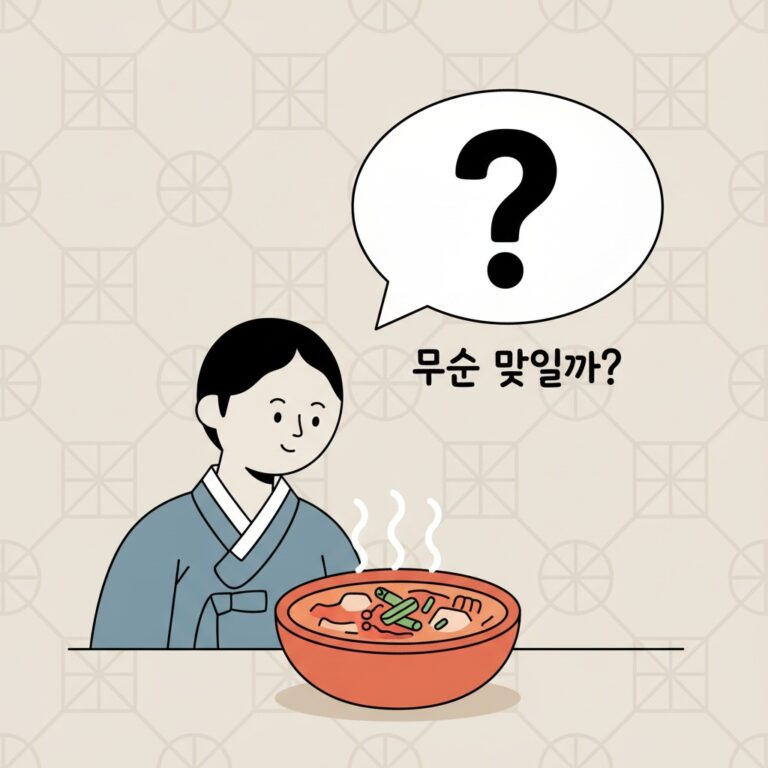
You see a picture of bright red, bubbling kimchi-jjigae (kimchi stew). You’ve never tried it, but you want to guess what it tastes like. Fill in the blank!
- “It looks spicy!” -> “저 김치찌개는 ___________!”
(What could you put in the blank? There might be more than one right answer!)
Let us know your answer in the comments! And tell us, what Korean food do you think 맛있겠어요 (must be delicious)? We can’t wait to read your sentences! Happy learning
Frequently Asked Questions (FAQ)
Q: What does "많은가" mean in Korean and how do you pronounce it?
A: In Korean, "많은가" is pronounced [ma-neun-ga] and means: , the 'ㅎ' (h) in the final consonant cluster 'ㄶ' is silent when followed by a consonant like 'ㄱ' (g). So, you don't pronounce it like "man-heun-ga," but rather a smooth
Q: What does "연음" mean in Korean and how do you pronounce it?
A: In Korean, "연음" is pronounced [liaison] and means: . It makes the flow of the words much smoother. Practice saying "ga-ta-yo" to sound more natural.
Q: What does "맛있겠어요" mean in Korean and how do you pronounce it?
A: In Korean, "맛있겠어요" is pronounced [ma-sit-ge-sseo-yo] and means: , the final 'ㅅ' (s) sound from '맛' moves over to the '있', making it sound like
Q: What does "맛있겠어요" mean in Korean and how do you pronounce it?
A: In Korean, "맛있겠어요" is pronounced [must be delicious] and means: ? We can't wait to read your sentences! Happy learning







