

Pandemic Lessons: Bridging Korea’s Educational Gap
Hello! It’s Daily Hangul, here to upgrade your advanced Korean skills!
Today, we’re diving into a crucial and sophisticated topic: the long-term impact of the global pandemic on education in Korea. Specifically, we’ll be exploring the challenges of the digital divide and educational inequality. This isn’t just a news headline; it’s a real, ongoing conversation in Korea. Recently, Korean news outlets and policy forums have been intensely discussing the “learning loss” observed in students after years of remote classes. By mastering the vocabulary in this post, you’ll be able to understand these high-level discussions and express your own opinions on this complex social issue with confidence and precision.
Let’s get started!
Core Expressions for In-Depth Discussion 🎓
Here are four key terms you absolutely need to know to discuss the educational landscape in post-pandemic Korea.
1. 디지털 격차 (Digital Divide)
- Pronunciation [Romaja]: Dijiteol gyeokcha
- English Meaning: Digital divide
- Detailed Explanation: This is a direct loanword “디지털 (digital)” combined with the Sino-Korean word “격차 (gyeolcha),” which means ‘gap’ or ‘disparity.’ It refers to the gap between those who have access to modern information and communication technology and those who do not. In the context of the pandemic, it specifically highlights the disparity in students’ access to devices (laptops, tablets) and stable internet connections, which directly impacts their ability to participate in online learning. This term is standard in news reports, academic papers, and policy discussions.
-
💡 Pronunciation Tip: The key is the sound ‘격차’ [gyeokcha]. The final consonant ‘ㄱ’ (k) in ‘격’ is an unreleased stop, meaning you form the ‘k’ sound but don’t release the puff of air. It’s immediately followed by ‘차’ (cha), which is an aspirated sound. Practice making a clear, breathy ‘ch’ sound, distinct from the simple ‘ㅈ’ (j) sound. Think of the ‘ch’ in “chart.”
2. 교육 불평등 (Educational Inequality)
- Pronunciation [Romaja]: Gyoyuk bulpyeongdeung
- English Meaning: Educational inequality
-
Detailed Explanation: This is a compound of “교육” (gyoyuk – education) and “불평등” (bulpyeongdeung – inequality/injustice). It describes a situation where social and economic factors lead to unequal educational outcomes. The concern in Korea is that the “디지털 격차” has exacerbated pre-existing “교육 불평등,” as students from lower-income families faced greater challenges with remote learning. This is a formal and powerful term used to frame the social justice dimension of the issue.
-
💡 Pronunciation Tip: This long word is all about rhythm and clear articulation. Pay special attention to the tense consonants ‘ㅃ’ (pp) and ‘ㄸ’ (tt) in ‘불평등’. These are pronounced with more tension in your vocal cords and no aspiration, making them sound harder and sharper than ‘ㅂ’ (b/p) and ‘ㄷ’ (d/t). Practice saying “평” and “등” with a strong, deliberate emphasis.
3. 원격 수업 (Remote Learning)
- Pronunciation [Romaja]: Wongyeok sueop
- English Meaning: Remote learning / Online classes
-
Detailed Explanation: “원격” (wongyeok) means ‘remote’ or ‘distant,’ and “수업” (sueop) means ‘class.’ This term became a part of everyday vocabulary for every student and parent in Korea during the pandemic. It’s a neutral, descriptive term for any form of instruction happening online, whether through live video calls (like Zoom) or pre-recorded lectures.
-
💡 Pronunciation Tip: Let’s focus on liaison (연음). While there’s no liaison in this specific phrase, it’s a critical rule. If “수업” were followed by a particle like ‘이’, as in “수업이” (sueobi), the final ‘ㅂ’ (b) sound from ‘수업’ would move over to the next syllable, making the pronunciation [수어비] (sueobi), not [sueop-i]. Remembering this will make your spoken Korean flow much more naturally.
4. 학습 결손 (Learning Loss)
- Pronunciation [Romaja]: Hakseup gyeolson
- English Meaning: Learning loss
-
Detailed Explanation: This is a highly specific, advanced term. “학습” (hakseup) means ‘learning,’ and “결손” (gyeolson) means ‘deficit’ or ‘loss.’ It refers to the loss of knowledge and skills, or the slowed academic progress, that students experience due to extended gaps in their education. Experts in Korea use this term to quantify and analyze the negative academic consequences of prolonged “원격 수업.” Using this term will show you have a deep understanding of the educational debate.
-
💡 Pronunciation Tip: Let’s look at the final consonants (받침). The ‘ㅂ’ in ‘학습’ [hakseup] is unreleased, pronounced as a [p̚] sound. You close your lips for the ‘p’ but don’t release the air. Similarly, the ‘ㄴ’ in ‘결손’ [gyeolson] is a clear ‘n’ sound. Avoid adding an extra vowel sound at the end (like “hakseup-uh”). Crisp, clean endings for these consonants are a hallmark of clear Korean pronunciation.
Example Dialogue 💻
Here’s how you might hear these terms used in a conversation between two university students discussing a recent news report.
A: 최신 교육 정책 보고서 봤어? 팬데믹 이후의 학습 결손 문제가 생각보다 심각하더라.
(Bwasseo? Paendemic ihu-ui hakseup gyeolson munjega saenggakboda simgakadeora.)
A: Have you seen the latest education policy report? The learning loss issue after the pandemic is more serious than I thought.
B: 맞아. 장기적인 원격 수업이 결국 디지털 격차를 심화시킨 것 같아.
(Maja. Jang-gijeogin wongyeok sueop-i gyeolguk dijiteol gyeokcha-reul simhwasikin geot gata.)
B: I know. It seems like long-term remote learning ultimately deepened the digital divide.
A: 이대로 가다간 교육 불평등이 더 고착화될 텐데, 정부의 대책이 시급해 보여.
(Idaero gadan-gan gyoyuk bulpyeongdeung-i deo gochakwadoel tende, jeongbu-ui daechaegi sigeupae boyeo.)
A: If things continue like this, educational inequality will become even more entrenched. The government needs to take urgent measures.
Cultural Tip & Trend Analysis 🇰🇷
The “In-gang” Legacy and the Pandemic Shift
Before the pandemic, online learning in Korea was dominated by a massive private industry called “인강” (in-gang), short for “인터넷 강의” (inteonet gangui – internet lecture). This was primarily used by middle and high school students as a supplement to regular school to prepare for the hyper-competitive university entrance exam (수능).
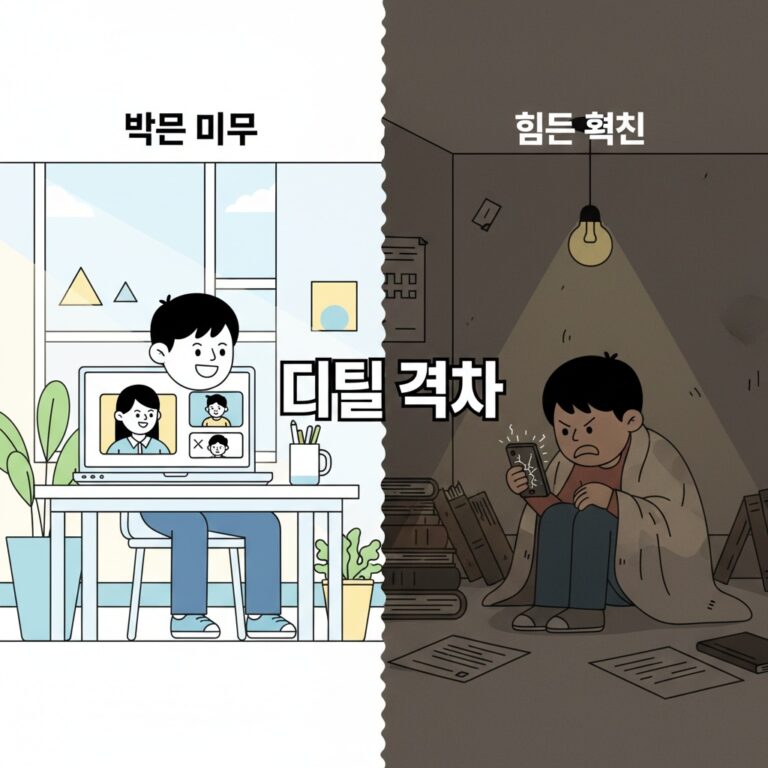
The pandemic forced this “in-gang” model onto the public education system, but with a crucial difference: it was no longer a supplement but the main form of instruction. This highlighted the 디지털 격차 in a way the private market never did. While some students had quiet rooms and high-spec laptops perfect for online classes, others had to share a single smartphone with siblings in a noisy apartment.
The Korean government responded with initiatives like providing free tablets (“스마트패드”) and data plans to students from low-income families (저소득층 학생). However, the debate continues: Is providing devices enough to solve the fundamental 교육 불평등 that stems from differences in the home learning environment? This remains a hot-button social issue in Korea today.
Let’s Practice!
Ready to test your knowledge? Fill in the blanks below with the most appropriate expressions from today’s lesson.
- Lack of access to personal computers for online classes is a primary example of the ____________.
(온라인 수업을 위한 개인용 컴퓨터 접근성 부족은 ____________의 대표적인 예시입니다.) -
Many experts are concerned that the long period of remote learning has led to significant ____________ among younger students.
(많은 전문가들은 장기화된 원격 수업이 저학년 학생들 사이에서 심각한 ____________을 초래했다고 우려합니다.)
Think you know the answers?
Share your answers and your own thoughts on this topic in the comments below using the expressions you learned today. How has the pandemic affected education in your country? I can’t wait to read your insights
Frequently Asked Questions (FAQ)
Q: What does "[수어비]" mean in Korean and how do you pronounce it?
A: In Korean, "[수어비]" is pronounced [sueobi] and means: , not [sueop-i]. Remembering this will make your spoken Korean flow much more naturally.
Q: What does ""인강"" mean in Korean and how do you pronounce it?
A: In Korean, ""인강"" is pronounced [in-gang] and means: , short for
Q: What does ""인터넷 강의"" mean in Korean and how do you pronounce it?
A: In Korean, ""인터넷 강의"" is pronounced [inteonet gangui - internet lecture] and means: . This was primarily used by middle and high school students as a supplement to regular school to prepare for the hyper-competitive university entrance exam (수능).






