

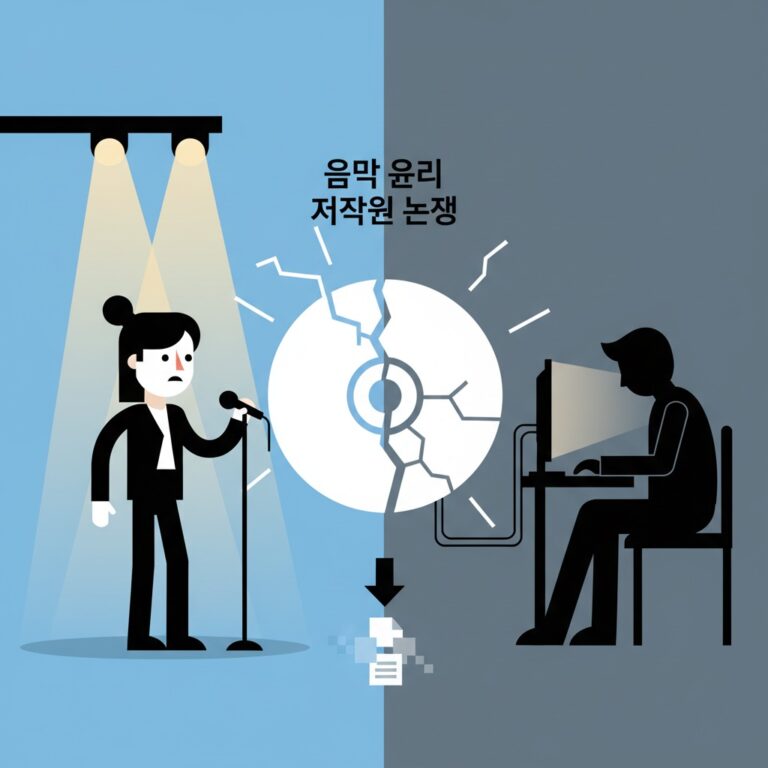
Korean Debate Club: The Ethics of Music Piracy
Hello! Welcome to Maeil Hangeul, the place to upgrade your Korean skills to the next level!
Today, we’re diving into a challenging but fascinating topic: the ethical dilemmas of music copyright and piracy. With K-Pop’s global domination, conversations about how artists are compensated and the ethics of music consumption are more relevant than ever. In Korea, this is a hot-button issue discussed everywhere from online forums to news programs. Learning how to articulate your opinion on this complex subject will not only boost your vocabulary but also allow you to participate in deep, meaningful conversations. Let’s get started!
Core Expressions for Your Debate
Here are some key phrases you’ll need to discuss music copyright like a pro.
1. 저작권 침해 (jeojakgwon chimhae)
- Pronunciation [jeojakgwon chimhae]
- English Meaning: Copyright infringement.
- Detailed Explanation: This is the formal, legal term for violating a copyright. It’s composed of 저작권 (jeojakgwon), meaning “copyright,” and 침해 (chimhae), meaning “infringement” or “violation.” You would use this term in more formal or serious discussions, news reports, or when you want to be precise.
- 💡 Pronunciation Tip: The
ㅈ(j) sound in Korean is softer than the English “j.” It’s produced without the strong vibration you feel in words like “jungle.” For 침해 (chimhae), theㅎ(h) sound slightly aspirates theㅊ(ch), making it a breathy “ch” sound.
2. 양날의 검 (yangnarui geom)
- Pronunciation [yangnarui geom]
- English Meaning: A double-edged sword.
- Detailed Explanation: This is a fantastic idiom that literally means “a sword with two blades.” It’s used to describe a situation that has both positive and negative consequences, which is perfect for discussing technology’s role in music. For example, the internet makes music accessible to everyone, but it also makes illegal sharing easy.
- 💡 Pronunciation Tip: The pronunciation here is quite straightforward and follows the spelling. Focus on pronouncing each syllable clearly: 양 (yang) – 날 (nal) – 의 (ui) – 검 (geom).
3. 창작자의 권리 (changjakjaui gwolli)
- Pronunciation [changjakjaui gwolli]
- English Meaning: The creator’s rights.
- Detailed Explanation: This phrase is essential for framing the ethical side of the argument. It consists of 창작자 (changjakja), meaning “creator,” the possessive particle 의 (ui), and 권리 (gwolli), meaning “rights.” It emphasizes the moral and legal right of artists to be compensated for their work.
- 💡 Pronunciation Tip: The particle 의 (ui) is a pronunciation chameleon! While its official pronunciation is [ui], in everyday speech when used as a possessive marker, it’s almost always pronounced as 에 [e]. So, you’ll most often hear this phrase as [changjakjae gwolli]. This is a key tip to sound more natural!
4. 불가피한 측면이 있다 (bulgapihan cheungmyeoni itda)
- Pronunciation [bulgapihan cheungmyeoni itda]
- English Meaning: There is an unavoidable aspect to… / It’s somewhat inevitable that…
- Detailed Explanation: This is a sophisticated structure used to acknowledge a counter-argument or a reality of a situation without necessarily agreeing with it. It combines the adjective 불가피하다 (bulgapihada), “to be unavoidable,” with 측면 (cheungmyeon), “aspect/side.” For instance, you could say, “With the development of technology, illegal sharing has an unavoidable aspect.”
- 💡 Pronunciation Tip: Pay attention to the linking sound rule (연음 – yeoneum). The final consonant
ㄴ(n) from 측면 (cheungmyeon) moves over to the next syllable, so 측면이 (cheungmyeon-i) is pronounced smoothly as [cheungmyeoni].
Example Dialogue
Let’s see these expressions in a real conversation between two friends, Minjun and Sora.
A: 민준 (Minjun): 새로 나온 아이돌 앨범 들어봤어? 노래 정말 좋던데. 그냥 인터넷에서 다운받을까 봐.
(Have you heard the new idol album? The songs are so good. I think I’ll just download it from the internet.)
B: 소라 (Sora): 그건 저작권 침해야. 스트리밍 서비스도 많은데 왜 굳이?
(That’s copyright infringement. There are so many streaming services, why would you do that?)
A: 민준 (Minjun): 스트리밍은 아티스트한테 돈이 거의 안 간다고 들었어. 기술 발전이 양날의 검인 것 같아. 음악을 쉽게 접할 수 있게 됐지만, 정당한 대가를 지불하는 시스템은 아직 부족하잖아.
(I heard artists get almost no money from streaming. I guess technological advancement is a double-edged sword. It made music more accessible, but the system for fair payment is still lacking.)
B: 소라 (Sora): 그래도 그게 창작자의 권리를 무시할 이유는 안 돼. 그리고 불법 다운로드가 늘어나는 건 불가피한 측면이 있다고 해도, 팬이라면 공식적인 방법으로 응원해야 한다고 생각해.
(Still, that’s no reason to ignore the creator’s rights. And even if you say there’s an unavoidable aspect to the rise of illegal downloads, I think if you’re a fan, you should support them through official channels.)
Culture Tip & Trend Deep Dive
In Korea, the debate over “creator’s rights” is deeply intertwined with fan culture. While piracy is an issue, there’s also a massive, organized movement to support artists legally. You’ve probably heard of ‘스밍 총공’ (seuming chonggong), which translates to a “mass streaming attack.”
This is when a fandom organizes to stream their favorite artist’s new song or album simultaneously on platforms like Melon, Genie, and Bugs. The goal is to get the song to the top of the real-time charts, which brings immense publicity and music show wins. This phenomenon shows how seriously Korean fans take their role in an artist’s success and actively fight to ensure their work is valued—at least on the charts. It’s a powerful, collective action that stands in stark contrast to the individual act of illegal downloading.
Let’s Practice!
Ready to test your new skills?
- Fill in the blank:
Technology that makes music sharing easy but also facilitates piracy can be described as a ______________.
(A) 저작권 침해 (B) 양날의 검 -
Your Turn:
Imagine your friend says, “Paying for every single song is just too expensive for me.” How could you respectfully argue for the artist’s side using the phrase 창작자의 권리 (the creator’s rights)?
Great job today! Tackling complex topics like this is a sign of a truly advanced learner.
Now, share your opinion! Do you think mass streaming culture is the best way to support artists? Leave a comment below using one of the expressions we learned today!
Frequently Asked Questions (FAQ)
Q: What does "저작권" mean in Korean and how do you pronounce it?
A: In Korean, "저작권" is pronounced [jeojakgwon] and means: , meaning "copyright," and
Q: What does "침해" mean in Korean and how do you pronounce it?
A: In Korean, "침해" is pronounced [chimhae] and means: , meaning "infringement" or "violation." You would use this term in more formal or serious discussions, news reports, or when you want to be precise.
Q: What does "침해" mean in Korean and how do you pronounce it?
A: In Korean, "침해" is pronounced [chimhae] and means: , the
Q: What does "창작자" mean in Korean and how do you pronounce it?
A: In Korean, "창작자" is pronounced [changjakja] and means: , meaning "creator," the possessive particle






