

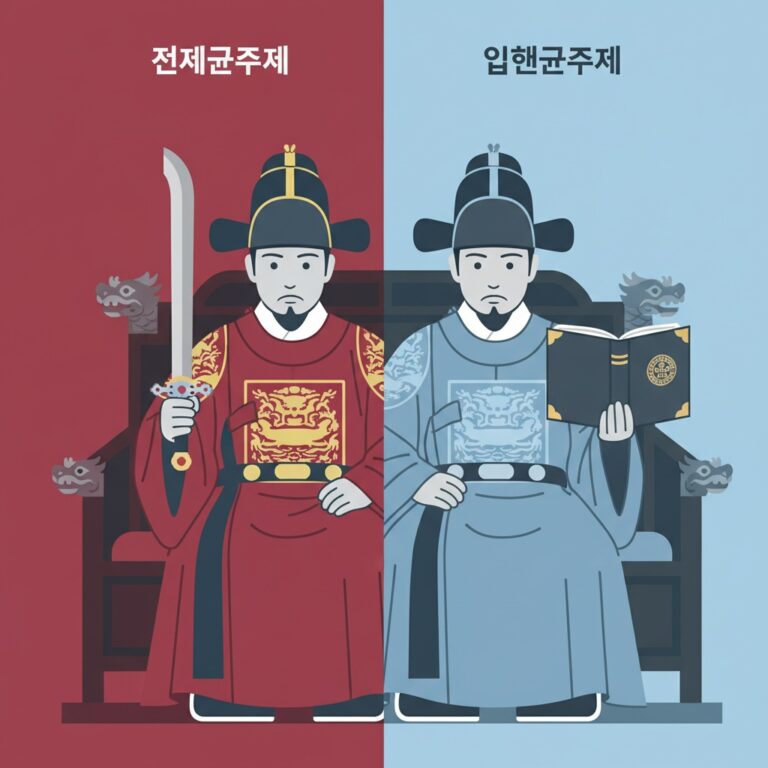
Rule Like a K-Drama King: Monarchy in Korean
Hello! This is Maeil Hangeul (매일한글), here to upgrade your Korean skills! 😊
Have you ever been captivated by the powerful kings and queens in Korean historical dramas (사극)? From absolute rulers making life-or-death decisions to modern monarchs navigating complex politics, these stories are thrilling! Nowadays in Korea, dramas featuring royalty, like The King: Eternal Monarch or The Red Sleeve, are incredibly popular.
Today, we’re going to dive into the Korean vocabulary you need to discuss these dramas and real-world political systems like a pro. We’ll learn how to talk about the difference between an absolute monarchy and a constitutional monarchy. Let’s get started!
Core Expressions You Need to Know
Here are the key terms to distinguish between different types of monarchies.
1. 입헌군주제 (Ipheon-gunjuje) – Constitutional Monarchy
- Pronunciation [이펀군주제]: [I-peon-gun-ju-je]
- English Meaning: Constitutional Monarchy
- Detailed Explanation: This term combines 입헌 (ipheon), meaning ‘constitutional’, and 군주제 (gunjuje), meaning ‘monarchy’. It refers to a system where the monarch (군주) is the head of state, but their power is limited and defined by a constitution (헌법). This is the system in countries like the UK, Japan, and Spain.
-
💡 Pronunciation Tip:
The magic of sound changes! When the final consonant ‘ㅂ’ (b) in 입 (ip) is followed by ‘ㅎ’ (h) in 헌 (heon), they combine to create a ‘ㅍ’ (p) sound. So, instead of saying ip-heon separately, it flows together as [이펀 / i-peon]. It’s a small change that makes you sound much more natural!
2. 절대군주제 (Jeoldae-gunjuje) – Absolute Monarchy
- Pronunciation [절때군주제]: [Jeol-ttae-gun-ju-je]
- English Meaning: Absolute Monarchy
-
Detailed Explanation: This term uses 절대 (jeoldae), which means ‘absolute’ or ‘unconditional’. In an 절대군주제, the monarch holds supreme, absolute power, and their decisions are not restricted by any laws or a constitution. This is the type of powerful king you often see in epic historical K-dramas!
-
💡 Pronunciation Tip:
Listen closely! When a final consonant ‘ㄹ’ (l) in a syllable like 절 (jeol) is followed by ‘ㄷ’ (d) in 대 (dae), the ‘ㄷ’ sound becomes tense. It’s pronounced as the strong ‘ㄸ’ (tt) sound. So, instead of a soft jeol-dae, you say [절때 / jeol-ttae]. This is called ‘tensification’ and it’s super common in Korean.
3. 권력 (Gwollyeok) – Power / Authority
- Pronunciation [궐력]: [Gwol-lyeok]
- English Meaning: Power, authority, influence
-
Detailed Explanation: This is a crucial word for any political discussion. It refers to the right or ability to control people or things. You can talk about a king’s 권력 (power) or a government’s 권력 (authority).
-
💡 Pronunciation Tip:
This is a classic example of ‘assimilation’. When the consonant ‘ㄴ’ (n) in 권 (gwon) meets the ‘ㄹ’ (r/l) in 력 (ryeok), the ‘ㄴ’ sound changes to match the ‘ㄹ’. So, you don’t pronounce it as gwon-ryeok, but rather as the smooth, flowing [궐력 / gwol-lyeok]. Try saying it out loud—it feels much easier, right?
4. 헌법 (Heonbeop) – Constitution
- Pronunciation [헌법]: [Heon-beop]
- English Meaning: Constitution
-
Detailed Explanation: The 헌법 is the supreme law of a country, outlining the fundamental principles of the government and the rights of the people. It’s the key document that limits a monarch’s power in a constitutional monarchy.
-
💡 Pronunciation Tip:
The final ‘ㅂ’ (b) sound in 법 (beop) is an ‘unreleased’ stop. This means you close your lips to make the ‘b’ sound, but you don’t release a puff of air afterwards. It sounds more like a soft ‘p’. So, it’s not heon-beo-buh, but a clean [헌법 / heon-beop].
Example Dialogue: K-Drama Chat
Let’s see how these words are used in a real conversation between two friends discussing a new drama.
A: 요즘 새로 시작한 사극 ‘제국의 그림자’ 봐? 왕의 권력이 정말 대단하더라.
(Y즘 saero sijakan sageuk ‘Jegugui geurimja’ bwa? Wang-ui gwollyeogi jeongmal daedanhadeora.)
A: Are you watching that new historical drama, ‘Shadow of the Empire’? The king’s power is incredible.
B: 응, 완전 절대군주제 시대 이야기잖아. 왕의 말이 곧 법이지.
(Eung, wanjeon jeoldae-gunjuje sidae iyagijana. Wang-ui mari got beobiji.)
B: Yeah, it’s set in the era of an absolute monarchy. The king’s word is the law.
A: 맞아. 현대의 입헌군주제랑은 완전히 다르네. 헌법으로 권력이 제한되지 않으니까.
(Maja. Hyeondae-ui ipheon-gunjuje-rang-eun wanjeonhi dareune. Heonbeob-euro gwollyeogi jehandoeji aneunikka.)
A: Right. It’s completely different from a modern constitutional monarchy, where power isn’t limited by a constitution.
B: 그래서 더 긴장감 넘치는 것 같아!
(Geuraeseo deo ginjanggam neomchineun geot gata!)
B: That’s why I think it’s so much more intense!
Culture Tip: Kings in Modern Korea
While South Korea is a democratic republic (대한민국은 민주공화국이다), not a monarchy, historical dramas (사극, sageuk) are one of the most beloved genres. Why?
These dramas aren’t just about fancy costumes and palaces. They often explore deep themes of leadership, justice, and sacrifice that resonate with modern viewers. When a new drama airs, you’ll see Koreans on social media passionately debating whether the king is a “성군” (Seong-gun, a wise and virtuous king) or a “폭군” (Pok-gun, a tyrant).
By understanding terms like 절대군주제 and 권력, you’re not just learning vocabulary; you’re gaining a deeper insight into the stories and conversations that are a huge part of modern Korean culture!
Let’s Practice!
Time to check your understanding. Let’s see what you’ve learned!
1. Fill in the Blank:
In a/an _______, the monarch’s power is limited by the 헌법.
(Hint: Look for the word for ‘constitutional monarchy’!)
2. Create a Sentence:
Imagine you are explaining the main character of a K-drama. Using the word 절대 권력 (jeoldae gwollyeok – absolute power), write a short sentence in Korean describing a powerful king.
Great job today! You’ve unlocked a new level of conversation about Korean dramas and politics.
Now it’s your turn! Leave a comment below with your answers to the practice questions. Or, tell us about your favorite K-drama king and whether he was an absolute or constitutional monarch! 👍
Frequently Asked Questions (FAQ)
Q: What does "입헌" mean in Korean and how do you pronounce it?
A: In Korean, "입헌" is pronounced [ipheon] and means: , meaning 'constitutional', and
Q: What does "군주제" mean in Korean and how do you pronounce it?
A: In Korean, "군주제" is pronounced [gunjuje] and means: , meaning 'monarchy'. It refers to a system where the monarch (군주) is the head of state, but their power is limited and defined by a constitution (헌법). This is the system in countries like the UK, Japan, and Spain.
Q: What does "입" mean in Korean and how do you pronounce it?
A: In Korean, "입" is pronounced [ip] and means: is followed by 'ㅎ' (h) in
Q: What does "헌" mean in Korean and how do you pronounce it?
A: In Korean, "헌" is pronounced [heon] and means: , they combine to create a 'ㅍ' (p) sound. So, instead of saying







