

From ‘Wow!’ to Words: Talk About Korean Museums Like a Pro!
Hello! It’s [Maeil Hangeul], here to upgrade your Korean skills!
Have you ever visited an amazing museum or a cool art gallery and wanted to share your experience with your Korean friends, but couldn’t find the right words? You’re in luck! Today, we’re going to learn how to talk about your past experiences, specifically visiting museums and art galleries.
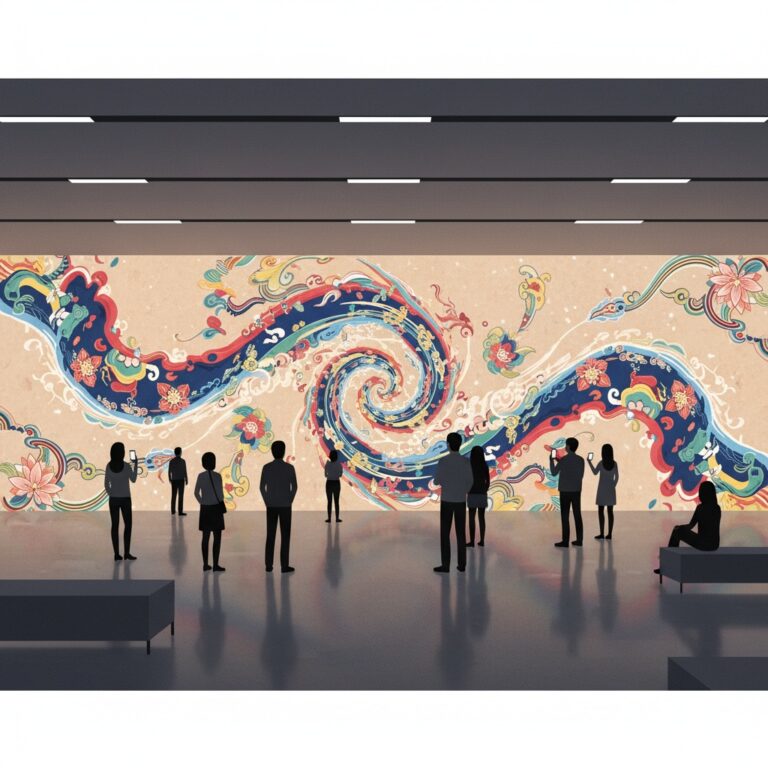
Lately in Korea, unique and immersive media art exhibitions are a huge trend! Everyone is posting incredible photos on Instagram from these places. This lesson will help you join that conversation and share your own cool stories!
Core Expressions You Need to Know
Let’s dive into three essential expressions that will make you sound like a natural.
1. ~에 가 봤어요 (e ga bwasseoyo)
- Romanization: [e ga bwas-seo-yo]
- English Meaning: I have been to… / I have tried going to…
- Detailed Explanation: This is the magic grammar pattern -아/어 보다 (a/eo boda) used in the past tense. It expresses that you have experienced doing something. You attach it to a location to say you’ve been there before. It’s a perfect way to start your story!
- 박물관에 가 봤어요. (Bangmulgwane ga bwasseoyo.) – I have been to a museum.
- 미술관에 가 봤어요. (Misulgwane ga bwasseoyo.) – I have been to an art gallery.
- 💡 Pronunciation Tip:
The final ㅆ (ss) in 봤어요 (bwasseoyo) is a strong, tense sound. Imagine making a hissing “sss” sound, but with more tension in your tongue. It’s not a soft ‘s’ but a sharp [ss]. This tense consonant is common in Korean and makes your pronunciation much more authentic!
2. 인상 깊었어요 (insang gipeosseoyo)
- Romanization: [in-sang gi-peos-seo-yo]
- English Meaning: It was impressive / It left a deep impression.
- Detailed Explanation: This is the perfect phrase to express how you felt about an exhibition or a specific piece of art. 인상 (insang) means ‘impression’ and 깊다 (gipda) means ‘deep’. So, you’re literally saying “the impression was deep.” It’s a fantastic compliment that shows you were genuinely moved.
- 💡 Pronunciation Tip:
Notice the word 깊었어요 (gipeosseoyo). The letter is ㅍ (p), but when it’s a 받침 (batchim, the final consonant in a syllable) like in 깊 (gip), it’s pronounced as a [p] sound, like the ‘p’ in ‘stop’. It doesn’t release a puff of air. So, it’s [gip], not [gip-huh].
3. 작품이 정말 멋있었어요 (Jakpumi jeongmal meosisseosseoyo)
- Romanization: [jak-pu-mi jeong-mal meo-sis-seos-seo-yo]
- English Meaning: The artwork was really cool/amazing.
- Detailed Explanation: Let’s break it down! 작품 (jakpum) means ‘artwork’ or ‘piece’. 이 (i) is a subject marker. 정말 (jeongmal) means ‘really’. And 멋있었어요 (meosisseosseoyo) is the past tense of 멋있다 (meositda), which means ‘to be cool,’ ‘stylish,’ or ‘amazing.’ Use this to talk about a specific piece you loved!
- 💡 Pronunciation Tip:
This is a classic pronunciation rule! The word 멋있었어요 is written asmeos-is-seoss-eo-yo, but we pronounce it as [meo-sis-seos-seo-yo]. The 받침 ㅅ(s) in 멋 (meot) moves over to the next syllable that starts with a vowel (ㅣ). This is called 연음 (yeoneum) or ‘liaison’. It makes the pronunciation flow smoothly. Instead of a choppy “meot-is-seos-seo-yo,” it becomes a fluid [meosisseosseoyo]!
Example Dialogue
Let’s see these expressions in a real conversation!
A: 주말에 뭐 했어요? (Jumare mwo haesseoyo?)
What did you do on the weekend?
B: 친구랑 미디어 아트 전시회에 가 봤어요. (Chingurang midieo ateu jeonsihoe-e ga bwasseoyo.)
I went to a media art exhibition with a friend.
A: 와, 어땠어요? (Wa, eottaesseoyo?)
Wow, how was it?
B: 정말 인상 깊었어요! 빛으로 만든 작품이 정말 멋있었어요. (Jeongmal insang gipeosseoyo! Bicheuro mandeun jakpumi jeongmal meosisseosseoyo.)
It was so impressive! The artwork made of light was really amazing.
Culture Tip & Trend Deep Dive
As I mentioned, media art exhibitions like ARTE MUSEUM are incredibly popular in Korea right now, especially among the younger generation (the Z세대). Why? Because they are perfect for taking amazing pictures for social media!
When Koreans go to these places, they are on a mission to get an “인생샷 (insaengsyat)”. This is a combination of 인생 (insaeng – life) and 샷 (syat – shot/photo). It literally means a “photo of a lifetime” – that one perfect, beautiful picture you’ll treasure forever.
So, if your friend shows you a stunning photo from an exhibition, you can say:
“와, 인생샷이다!” (Wa, insaengsyasida!) – “Wow, that’s a photo of a lifetime!”
Knowing this term will definitely make you sound like you’re in the know about Korean trends!
Let’s Practice!
Ready to check your understanding?
1. Fill in the blank:
You want to say you have been to the National Museum of Korea (국립중앙박물관).
저는 국립중앙박물관____ ____ ______.
(Jeoneun Gungnipjungangbangmulgwan____ ____ ______.)
2. Make a sentence:
How would you say “The exhibition (전시회) was very impressive”? Use one of the expressions we learned today!
Great job today! Learning to share your experiences is a huge step in becoming a confident Korean speaker. Now you’re ready to talk about all the amazing art you’ve seen!
Why not try it now? Leave a comment below telling us about a museum or gallery you have been to, using the expressions you learned today!
Frequently Asked Questions (FAQ)
Q: What does "-아/어 보다" mean in Korean and how do you pronounce it?
A: In Korean, "-아/어 보다" is pronounced [a/eo boda] and means: used in the past tense. It expresses that you have
Q: What does "봤어요" mean in Korean and how do you pronounce it?
A: In Korean, "봤어요" is pronounced [bwasseoyo] and means: is a strong, tense sound. Imagine making a hissing "sss" sound, but with more tension in your tongue. It's not a soft 's' but a sharp
Q: What does "인상" mean in Korean and how do you pronounce it?
A: In Korean, "인상" is pronounced [insang] and means: means 'impression' and
Q: What does "깊다" mean in Korean and how do you pronounce it?
A: In Korean, "깊다" is pronounced [gipda] and means: means 'deep'. So, you're literally saying "the impression was deep." It’s a fantastic compliment that shows you were genuinely moved.







