

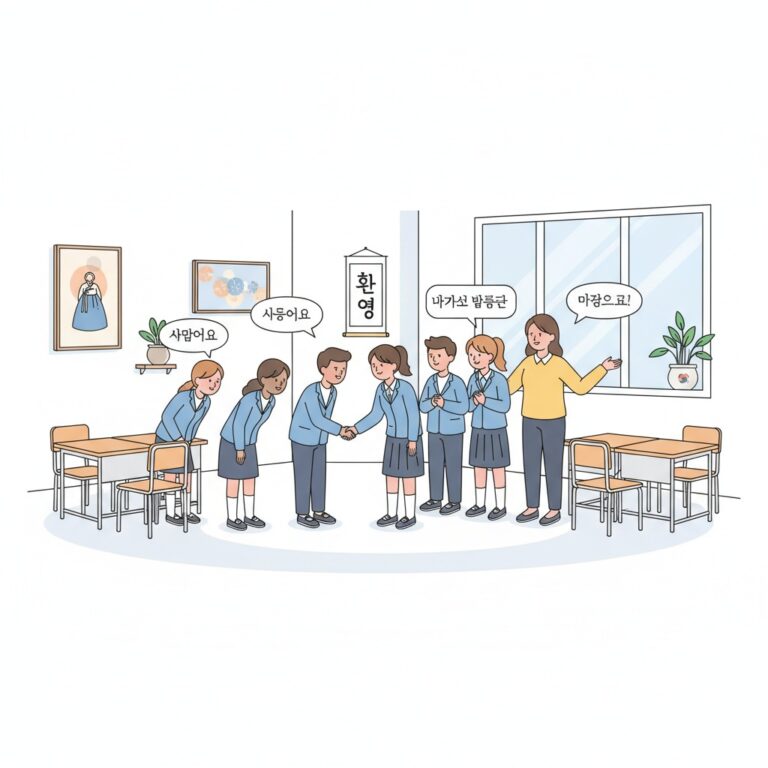
Your First Korean Class? Ace Your Introduction!
Hello! It’s Maeil Hangeul here to level up your Korean!
Are you ready to tackle one of the most exciting (and maybe a little scary) situations? The first day of class! Today, we’re going to learn how to introduce yourself confidently in Korean. A great first impression is key to making new friends.
These days in Korea, it’s super popular for foreigners to join all kinds of fun classes, not just for language, but also for K-pop dancing, cooking, or even pottery! These phrases will be your secret weapon to sound friendly and natural from day one. Let’s get started!
Core Expressions for a Perfect Introduction
Here are three essential phrases you absolutely need to know.
1. 안녕하세요, 저는 [이름]입니다. (Annyeonghaseyo, jeoneun [ireum]imnida.)
- Romanization: Annyeonghaseyo, jeoneun [ireum]imnida.
- English Meaning: Hello, I am [Name].
- Detailed Explanation: This is the classic, polite, and perfect way to state your name.
안녕하세요(Annyeonghaseyo) is your go-to formal “Hello.”저는(jeoneun) means “I” (with a topic-marking particle), and입니다(imnida) is the formal way to say “am/is/are.” You can use this with your teacher, classmates, and anyone you’ve just met. -
💡 Pronunciation Tip:
The magic is in입니다! It’s written asim-ni-da, but why? The final consonantㅂ(b) in입comes before aㄴ(n) sound. In Korean, this causes theㅂ(b) sound to naturally change into a softerㅁ(m) sound to make it easier to say. This rule is called ‘nasalization.’ So instead of a choppy “ip-ni-da,” you say a smooth [im-ni-da]. It’s a small change that makes you sound much more natural!
2. 만나서 반갑습니다. (Mannaseo bangapseumnida.)
- Romanization: Mannaseo bangapseumnida.
- English Meaning: It’s nice to meet you.
-
Detailed Explanation: After someone introduces themselves, this is the perfect response!
만나서(mannaseo) means “because we meet” or “to meet,” and반갑습니다(bangapseumnida) means “it is nice/I am glad.” It’s polite, warm, and everyone will appreciate it. -
💡 Pronunciation Tip:
Look, our friend nasalization is back! In반갑습니다(bangapseumnida), the final consonantㅂ(b) in습comes right beforeㄴ(n). Just like before, theㅂ(b) sound changes to anㅁ(m) sound. So don’t say “bangap-seup-ni-da.” Instead, let it flow smoothly as [ban-gap-seum-ni-da]. You’re already mastering a key Korean pronunciation rule!
3. 잘 부탁드립니다. (Jal butakdeurimnida.)
- Romanization: Jal butakdeurimnida.
- English Meaning: Please take good care of me / I look forward to working with you.
-
Detailed Explanation: This phrase is pure Korean culture! There’s no perfect one-to-one translation in English. You say it to show you have a good attitude and hope for a positive relationship. It’s like saying, “Let’s have a great semester together!” or “I’m excited to learn with you all.” It’s incredibly polite and shows respect to both your teacher and new classmates.
-
💡 Pronunciation Tip:
Let’s focus on the rhythm. Say it slowly: Jal / bu-tak / deu-rim-ni-da. Theㄷ(d) in드립니다is a soft ‘d’ sound. The final part,립니다, also uses the nasalization rule we learned (ㅂ+ㄴ=ㅁsound), so it’s pronounced [rim-ni-da]. Practice it a few times to get the friendly and positive feeling right!
Example Dialogue: First Day of K-Pop Dance Class!
Let’s see these phrases in action. Imagine you (A) just walked into your new dance class and meet a classmate (B).
A (You): 안녕하세요, 저는 소피아입니다.
(Annyeonghaseyo, jeoneun Sofia-imnida.)
Hello, I am Sofia.B (Minjun): 와, 안녕하세요! 저는 민준입니다. 만나서 반갑습니다.
(Wa, annyeonghaseyo! Jeoneun Minjun-imnida. Mannaseo bangapseumnida.)
Wow, hello! I’m Minjun. It’s nice to meet you.A (You): 저도 만나서 반갑습니다. 잘 부탁드립니다!
(Jeodo mannaseo bangapseumnida. Jal butakdeurimnida!)
It’s nice to meet you, too. I look forward to this class with you!B (Minjun): 네, 저도 잘 부탁드립니다!
(Ne, jeodo jal butakdeurimnida!)
Yes, me too!
See how smooth and friendly that sounds?
Culture Tip: The Magic of “잘 부탁드립니다”
In Korea, 잘 부탁드립니다 (Jal butakdeurimnida) is a social superpower. You’ll hear it everywhere:
- K-Pop Idols: When an idol joins a new TV show, they will bow and say it to the cast and crew.
- First Day of Work: A new employee will say it to their team.
- Joining a Club: You’ll say it to the other members.
Using this phrase shows you are humble, respectful, and ready to be a positive part of the group. When you say this on your first day of class, your teacher and classmates will instantly see you as a friendly and serious student. It’s a small phrase with a huge, positive impact!
Let’s Wrap It Up & Practice!
Amazing work today! You’ve learned how to introduce yourself, respond politely, and even use a key cultural phrase to make a fantastic first impression.
Now, let’s check your skills!
1. Fill in the Blank: You want to introduce yourself as “Chris.” How would you say it?
안녕하세요, 저는 _______________입니다.
2. Quick Quiz: Your new teacher introduces themself. What is the most polite and natural thing to say after you introduce yourself?
a) 감사합니다. (Gamsahamnida – Thank you.)
b) 잘 부탁드립니다. (Jal butakdeurimnida.)
c) 아니요. (Aniyo – No.)
Now it’s your turn! Introduce yourself in the comments using the phrases we learned today. We can’t wait to meet you! 잘 부탁드립니다







