

Hello! Welcome back to Maeil Hangeul, the place to upgrade your Korean skills!
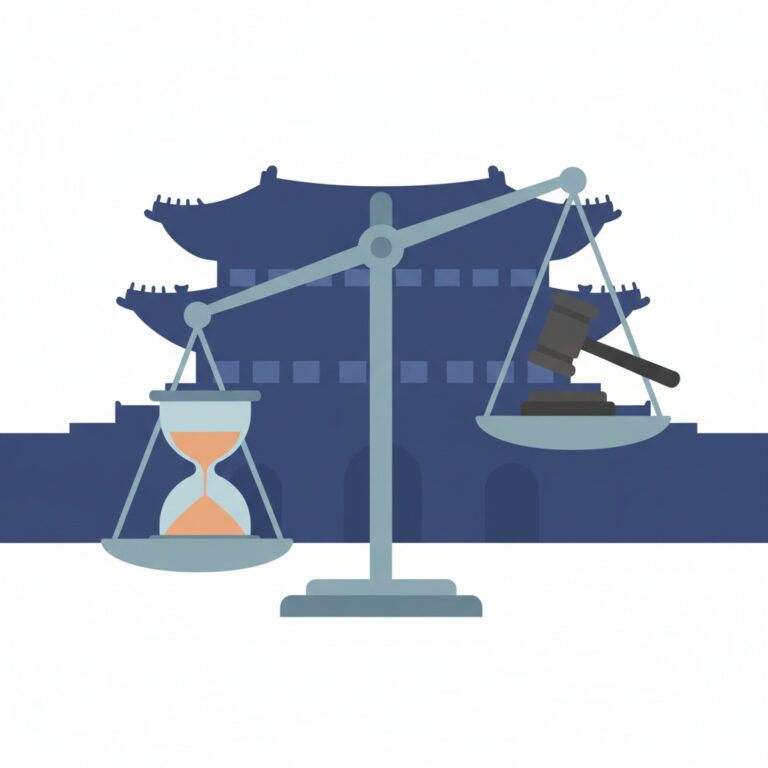
Today, we’re moving beyond everyday conversation and into the heart of a complex and fascinating topic often seen in Korean dramas and news: the justice system. We’ll be exploring the concept of 공소시효 (Gongso-sihyo), the statute of limitations. Why does a time limit for justice exist, and why is it so controversial? Recently in Korea, discussions around cold cases and the pursuit of long-delayed justice have reignited this debate, making it a highly relevant and compelling topic for any advanced learner. Let’s dive in!
Core Expressions You Need to Know
Here are the key terms to master this sophisticated discussion.
1. 공소시효 (Gongso-sihyo)
- Pronunciation [Romanization]: Gong-so-si-hyo
- English Meaning: Statute of Limitations (for prosecution)
- Detailed Explanation: This is a critical legal term that defines the period during which the state can prosecute someone for a crime. It’s composed of Hanja characters: 공(公) for “public,” 소(訴) for “prosecution,” and 시효(時效) for “prescription” or “time limit.” The rationale behind this system includes preventing the hardship of defending against stale claims and promoting legal stability. However, it becomes highly controversial in cases of heinous crimes, where the public believes justice should be pursued regardless of how much time has passed.
-
💡 Pronunciation Tip:
The pronunciation is quite straightforward and follows the spelling. However, pay attention to the aspirated ‘소(so)’. It should have a stronger puff of air than the English ‘s’. Think of it as ‘s’ followed by a soft ‘h’. Each syllable is pronounced clearly and evenly: Gong-so-si-hyo.
2. 영구미제사건 (Yeonggu-mije-sageon)
- Pronunciation [Romanization]: Yeong-gu-mi-je-sa-geon
- English Meaning: Permanent Cold Case / Unsolved Case
-
Detailed Explanation: This term refers to a criminal case that remains unsolved permanently because the statute of limitations has expired. Breaking it down: 영구(永久) means “permanent,” 미제(未濟) means “unresolved,” and 사건(事件) means “case” or “incident.” This phrase carries a heavy, tragic connotation, representing a failure of the justice system and a source of enduring pain for victims’ families. It’s the outcome that opponents of the statute of limitations fear most.
-
💡 Pronunciation Tip:
The key here is the initial nasal sound ‘영(yeong)’. Ensure the back of your tongue touches your soft palate to produce the ‘ng’ sound correctly. The rest of the word flows smoothly, with each syllable given equal stress.
3. 국민적 공분 (Gungminjeok gongbun)
- Pronunciation [Romanization]: Gung-min-jeok gong-bun
- English Meaning: Public Outrage / National Indignation
-
Detailed Explanation: This phrase describes a powerful, collective anger felt by the public, often in response to a crime where the perpetrator might escape punishment due to a legal loophole like the statute of limitations. 국민적(國民的) means “national” or “of the people,” and 공분(公憤) means “public indignation.” This concept is a powerful social force in Korea and can influence media coverage and even legislative changes.
-
💡 Pronunciation Tip:
This phrase demonstrates a common Korean pronunciation rule called nasal assimilation. When the final consonant ‘ㄱ(g)’ in ‘국(guk)’ is followed by the nasal consonant ‘ㅁ(m)’ in ‘민(min)’, the ‘ㄱ’ sound changes to the nasal ‘ㅇ(ng)’. Therefore, it is pronounced [궁민적 (Gungminjeok)], not [Guk-min-jeok]. This small change will make you sound much more like a native speaker!
4. 법감정 (Beopgamjeong)
- Pronunciation [Romanization]: Beop-gam-jeong
- English Meaning: Public Sentiment Toward the Law / Legal Sentiment
-
Detailed Explanation: This is a nuanced and essential concept for understanding Korean legal culture. It’s not just “feelings about the law” but refers to the public’s intuitive sense of what is just and fair, which can often be at odds with the written law (실정법, siljeongbeop). The debate over 공소시효 is a perfect example of a clash between the logic of the legal system and the powerful pull of 법감정.
-
💡 Pronunciation Tip:
The final ‘ㅂ(b)’ in ‘법(beop)’ is an “unreleased stop.” This means you form the ‘b’ sound with your lips but don’t release the puff of air. It’s a very soft, almost silent stop before you move on to ‘감정(gamjeong)’. It sounds less like “beop-gamjeong” and more like a single, connected “beopgamjeong.”
Example Dialogue
Let’s see how these terms play out in a conversation between two friends discussing a crime documentary.
A: 어제 그알에서 다룬 연쇄살인사건 봤어? 범인을 특정할 만한 단서가 나왔는데도 공소시효가 지나서 처벌을 못 한다니 너무 답답해.
(Eoje geu-al-eseo darun yeonswaesalinsageon bwasseo? Beomin-eul teukjeonghal manhan danseo-ga nawatneundedo gongso-sihyo-ga jinaseo cheobeor-eul mot handani neomu dapdaphae.)
A: Did you watch the documentary yesterday about that serial murder case? It’s so frustrating that they can’t prosecute even though they found a crucial clue identifying the culprit, all because the statute of limitations expired.
B: 맞아. 결국 영구미제사건으로 남게 되는 거잖아. 이런 사건들을 볼 때마다 국민적 공분이 왜 생기는지 알 것 같아.
(Maja. Gyeolguk yeonggu-mije-sageon-euro namge doeneun geojana. Ireon sageon-deureul bol ttaemada gungminjeok gongbun-i wae saenggineunji al geot gata.)
B: I know. It’s just going to end up as a permanent cold case. Whenever I see cases like this, I understand why there’s so much public outrage.
A: 법과 현실의 괴리가 너무 큰 것 같아. 사람들의 법감정은 정의가 실현되길 바라는데 말이야.
(Beop-gwa hyeonsil-ui goeriga neomu keun geot gata. Saramdeur-ui beopgamjeong-eun jeong-ui-ga silhyeon-doegil baraneunde mariya.)
A: The gap between the law and reality seems too wide. The public’s legal sentiment is that they just want to see justice served.
B: 그래서 살인죄 같은 중범죄에 대한 공소시효 폐지 논의가 계속 나오는 거겠지.
(Geuraeseo sarinjoe gateun jungbeomjoe-e daehan gongso-sihyo pyeji nonuiga gyesok naoneun geogetji.)
B: That’s why the debate over abolishing the statute of limitations for serious crimes like murder keeps coming up.
Cultural Tip & Trend Analysis
If you’re a fan of Korean media, you’ve already seen this debate play out. The famous film “Memories of Murder” (살인의 추억) and the hit drama “Signal” (시그널) are both based on real-life cold cases and masterfully explore the anguish caused by the ticking clock of the 공소시효.
These works of fiction did more than just entertain; they amplified the 국민적 공분 and brought the issue to the forefront of national conversation. This public pressure had real-world consequences. In 2015, the “Tae-wan Law” (태완이법) was passed, which abolished the 25-year statute of limitations for first-degree murder. The law was named after a young victim of an unsolved acid attack, showcasing how powerful 법감정 can be in shaping actual legislation in Korea. Understanding this context shows you’re not just learning words, but the culture behind them.
Let’s Review and Practice!
We’ve delved into a complex but vital topic today, exploring the debate around the 공소시효 using advanced terms like 영구미제사건, 국민적 공분, and 법감정.
Now, it’s your turn to practice!
- Fill-in-the-blank: When a heinous crime might go unpunished due to an expired statute of limitations, it often triggers widespread __________.
- Short Answer: In your opinion, should justice have a time limit? Briefly explain your thoughts using the term 법감정.
What are your thoughts on this challenging issue? Share your opinions and practice sentences in the comments below! We’d love to hear from you.
Frequently Asked Questions (FAQ)
Q: What does "공소시효" mean in Korean and how do you pronounce it?
A: In Korean, "공소시효" is pronounced [Gongso-sihyo] and means: , the statute of limitations. Why does a time limit for justice exist, and why is it so controversial? Recently in Korea, discussions around cold cases and the pursuit of long-delayed justice have reignited this debate, making it a highly relevant and compelling topic for any advanced learner. Let's dive in!
Q: What does "공" mean in Korean and how do you pronounce it?
A: In Korean, "공" is pronounced [公] and means: for "public,"
Q: What does "소" mean in Korean and how do you pronounce it?
A: In Korean, "소" is pronounced [訴] and means: for "prosecution," and
Q: What does "시효" mean in Korean and how do you pronounce it?
A: In Korean, "시효" is pronounced [時效] and means: for "prescription" or "time limit." The rationale behind this system includes preventing the hardship of defending against stale claims and promoting legal stability. However, it becomes highly controversial in cases of heinous crimes, where the public believes justice should be pursued regardless of how much time has passed.







