

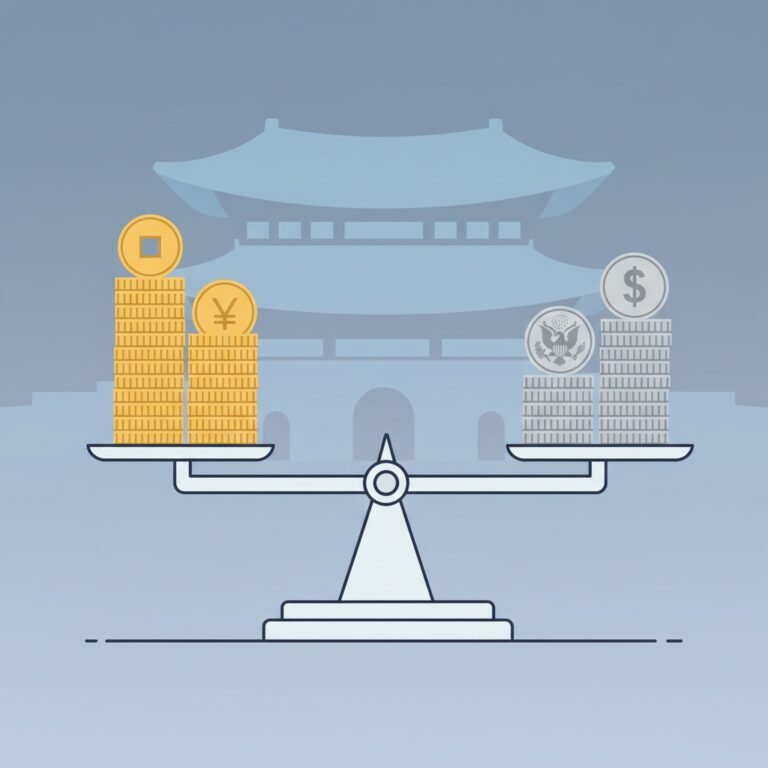
The Yuan’s Rise: Talking Global Finance Like a Pro in Korean
Hello! It’s your favorite Korean upgrade kit, Maeil Hangeul (매일한글), here to level up your language skills!
Ready to move beyond everyday conversation and into the world of expert-level discussions? Today, we’re tackling a major topic you’ll hear in Korean news, academic circles, and economic forums: the internationalization of the Chinese Yuan (or Renminbi). This is the kind of advanced vocabulary that will empower you to understand and participate in high-level conversations about the global economy.
Lately in Korea, as the world navigates complex economic shifts, the debate around the Yuan’s potential to challenge the US dollar is a frequent and fascinating subject. Let’s learn the key terms you need to join the discussion!
Core Expressions for Your Economic Toolkit
Here are the essential terms to discuss the Yuan’s global journey.
1. 기축통화 (基軸通貨)
- Pronunciation [Romanization]: Gichuktonghwa
- English Meaning: Key Currency / Reserve Currency
- Detailed Explanation: This is a crucial term for any economic discussion. It refers to a currency, like the US Dollar, that is used internationally for trade and held in large quantities as foreign exchange reserves by central banks. It’s a formal, academic term derived from Hanja characters: 基 (gi) meaning ‘base’, 軸 (chuk) meaning ‘axis’, and 通貨 (tonghwa) meaning ‘currency’. Think of it as the “base-axis currency” around which the global economy revolves.
-
💡 Pronunciation Tip: In 기축통화 [gichuktonghwa], pay attention to the three different ‘g/k’ sounds. The first, ‘기 (gi)’, is a soft, unaspirated ‘g’. The second, ‘축 (chuk)’, is an aspirated ‘k’ sound, meaning you should feel a strong puff of air. The third, ‘통 (tong)’, starts with ‘ㅌ’, a tense consonant that is stronger and sharper than ‘ㄷ(d)’ but has less aspiration than ‘ㅋ(k)’. Mastering these distinctions is key to a native-like accent.
2. 위안화 국제화 (人民幣 國際化)
- Pronunciation [Romanization]: Wianhwa gukjehwa
- English Meaning: The Internationalization of the Yuan (RMB)
-
Detailed Explanation: This phrase literally translates to “Yuan’s internationalization.” It describes the ongoing process of increasing the Yuan’s use outside of China for trade, investment, and as a reserve currency. 위안화 (wianhwa) is the Korean name for the Yuan, and 국제화 (gukjehwa) means ‘internationalization’. You’ll see this phrase constantly in news headlines and reports on the topic.
-
💡 Pronunciation Tip: The word 국제화 is pronounced [gukjjehwa], not [gukjehwa]. This is an example of consonant tensification. When a syllable ending in a stop consonant like ‘ㄱ (k)’ is followed by a syllable starting with ‘ㅈ (j)’, the ‘ㅈ’ sound becomes tense, like ‘ㅉ (jj)’. It’s a subtle but important rule that makes your Korean sound much more fluid.
3. 환율 변동성 (換率 變動性)
- Pronunciation [Romanization]: Hwanyul byeondongseong
- English Meaning: Exchange Rate Volatility
-
Detailed Explanation: This term refers to the degree of variation or fluctuation in the exchange rate between currencies over time. High volatility is often seen as a major hurdle for a currency aspiring to become a key currency, as it creates uncertainty for international trade and investment. 환율 (hwanyul) is ‘exchange rate’ and 변동성 (byeondongseong) means ‘volatility’ or ‘variability’.
-
💡 Pronunciation Tip: In 환율 [hwanyul], the ‘ㄴ(n)’ sound in ‘환’ influences the ‘ㄹ(r/l)’ in ‘율’, causing the ‘ㄹ’ to sound more like an ‘l’. The rule is that after a consonant like ‘ㄴ’, ‘ㄹ’ is pronounced as [l]. For 변동성, you’ll often hear it pronounced [변동썽/byeondongseong], with a tensed ‘ㅆ(ss)’ sound at the end. This is another example of tensification that occurs naturally in compound words.
4. 무역 결제 (貿易 決濟)
- Pronunciation [Romanization]: Muyeok gyeolje
- English Meaning: Trade Settlement
-
Detailed Explanation: This refers to the final step in a trade transaction, where payment is made for goods or services. A key goal of 위안화 국제화 is to have more international trade settled directly in Yuan, bypassing the US dollar. 무역 (muyeok) means ‘trade’ and 결제 (gyeolje) means ‘settlement’ or ‘payment’.
-
💡 Pronunciation Tip: The word 결제 is pronounced [결쩨/gyeoljje]. Similar to our earlier example, the ‘ㄹ(l)’ sound in the preceding syllable block causes the following ‘ㅈ(j)’ to become a tense ‘ㅉ(jj)’. This is a common sound change rule that you’ll encounter frequently.
Example Dialogue
Let’s see how these terms play out in a conversation between two university students discussing an economics article.
- A: 요즘 뉴스에서 위안화 국제화에 대한 분석이 많이 나오네요.
(A: There’s a lot of analysis about the internationalization of the Yuan in the news lately.) - B: 맞아요. 중국이 무역 결제에서 달러 비중을 줄이려는 의도가 명확하죠.
(B: Right. China’s intention to reduce the dollar’s share in trade settlements is clear.) - A: 하지만 달러를 대체하는 기축통화가 되기에는 아직 넘어야 할 산이 많아 보여요. 특히 환율 변동성 문제가 크잖아요.
(A: But it seems there are still many hurdles to overcome for it to become a key currency that replaces the dollar. The exchange rate volatility issue is particularly significant.) - B: 동의해요. 글로벌 금융 시스템의 신뢰를 얻는 데는 상당한 시간이 걸릴 거예요.
(B: I agree. It will take a considerable amount of time to gain the trust of the global financial system.)
Culture & Trend Deep Dive
In Korea, a nation whose economy is deeply intertwined with both the US and China, the discussion around the Yuan is not just academic—it’s a matter of direct national interest. You will frequently see op-eds (사설, saseol) in major Korean newspapers debating the potential impact on the Korean Won (원화, wonhwa) and the country’s export-driven economy.
Pro Tip: To sound like a true expert, connect this topic to the broader geopolitical context by using the term 미중 패권 경쟁 (美中 覇權 競爭, Mijung paegwon gyeongjaeng), which means the “US-China Hegemony Competition.” Framing the currency issue as one part of this larger power struggle will instantly demonstrate your deep understanding of how this topic is perceived and discussed in Korea.
Let’s Recap & Practice!
Today, we’ve armed you with four powerful, advanced Korean terms to discuss the complex topic of the Yuan’s internationalization and its impact on global finance. You’ve learned about 기축통화, 위안화 국제화, 환율 변동성, and 무역 결제.
Now, time to test your knowledge!
- Fill in the blank: The US dollar has long been the world’s primary __________.
- Challenge: Using the term 미중 패권 경쟁 (US-China Hegemony Competition), try to write one sentence in Korean explaining its connection to the 위안화 국제화.
What are your thoughts on this topic? Try using one of the expressions we learned today and leave your opinion in the comments below! We’d love to see you put your new skills to use
Frequently Asked Questions (FAQ)
Q: What does "기축통화" mean in Korean and how do you pronounce it?
A: In Korean, "기축통화" is pronounced [gichuktonghwa] and means: , pay attention to the three different 'g/k' sounds. The first,
Q: What does "위안화" mean in Korean and how do you pronounce it?
A: In Korean, "위안화" is pronounced [wianhwa] and means: is the Korean name for the Yuan, and
Q: What does "국제화" mean in Korean and how do you pronounce it?
A: In Korean, "국제화" is pronounced [gukjehwa] and means: means 'internationalization'. You'll see this phrase constantly in news headlines and reports on the topic.
Q: What does "환율" mean in Korean and how do you pronounce it?
A: In Korean, "환율" is pronounced [hwanyul] and means: is 'exchange rate' and







