

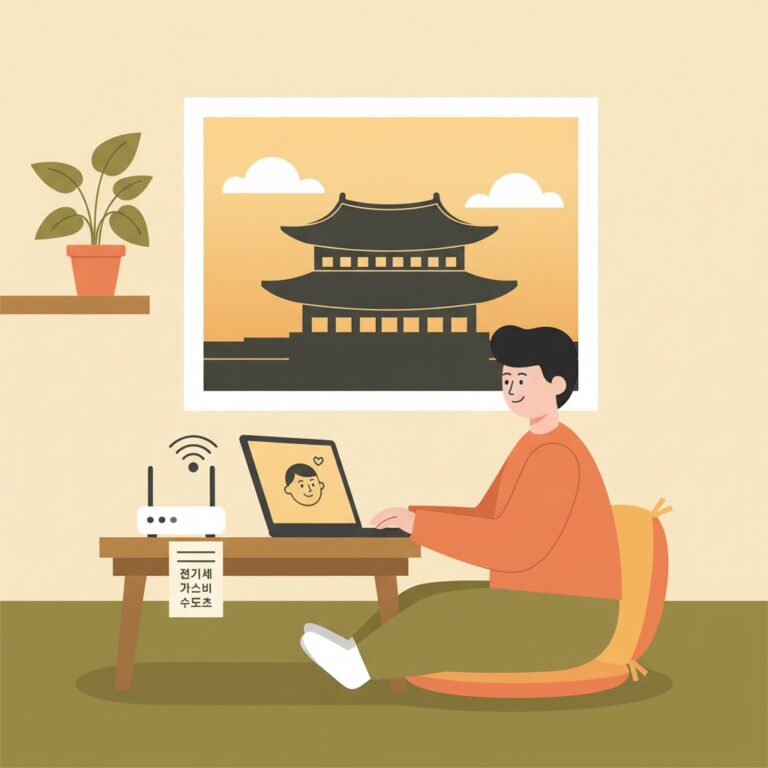
Your K-Drama Life Starts Now: Conquering Utilities in Korea!
Hello! This is Maeil Hangul (매일한글), here to upgrade your Korean skills!
Have you ever watched a K-drama and dreamed of having your own cozy apartment, or ‘자취방’ (jacchwibang), in Korea? Recently in Korea, it’s a huge trend for young people to decorate their own space and share it on social media, just like in the dramas! But before you can binge-watch your favorite shows and chill in your new home, you need one crucial thing: Wi-Fi!
Today, we’re going to learn the essential Korean phrases to apply for internet and handle your utility bills (공과금). Mastering these will make you feel super confident and ready to start your life in Korea. Let’s get you connected!
Core Expressions You Need to Know
Here are three key expressions that will help you set up your new home like a pro.
1. 인터넷 신청하고 싶어요 (Inteonet sincheonghago sipeoyo)
- Pronunciation [인터넷 신청하고 시퍼요]: [in-teo-net sin-cheong-ha-go si-peo-yo]
- English Meaning: I’d like to apply for the internet.
- Detailed Explanation:
신청하다 (sincheonghada) means “to apply” or “to request.” It’s a formal and polite verb you can use for almost any official application, like getting a phone plan, a bank account, or, in this case, internet service. The grammar pattern -고 싶어요 (-go sipeoyo) means “I want to…” and is a polite way to express your desire. This phrase is the perfect way to start the conversation. - 💡 Pronunciation Tip:
The key sound here is 신청 (sincheong). The final consonant ‘ㅇ’ (ng) at the end of a syllable is a nasal sound, just like the “-ng” in the English word “sing.” Make sure you don’t pronounce it with a hard ‘g’ sound. It’s a soft, smooth [sin-cheong].
2. 언제 설치 가능할까요? (Eonje seolchi ganeunghalkkayo?)
- Pronunciation [언제 설치 가능할까요?]: [eon-je seol-chi ga-neung-hal-kka-yo?]
- English Meaning: When is installation possible?
- Detailed Explanation:
설치하다 (seolchihada) means “to install.” This is what you say when you want to know when the technician can come to your house. 언제 (eonje) means “when,” and 가능할까요? (ganeunghalkkayo?) is a very polite and slightly indirect way of asking “Is it possible?” It sounds much softer and more considerate than just asking “When can you do it?” - 💡 Pronunciation Tip:
Let’s look at 설치 (seolchi). The consonant ‘ㅊ’ (ch) is an “aspirated” sound. This means you need to release a strong puff of air when you say it. It’s like the ‘ch’ in “ch-ch-choose!” not the ‘j’ in “judge.” Hold your hand in front of your mouth. You should feel a burst of air when you say [seol-chi] correctly!
3. 공과금은 어떻게 내요? (Gonggwageumeun eotteoke naeyo?)
- Pronunciation [공과그믄 어떠케 내요?]: [gong-gwa-geu-meun eo-tteo-ke nae-yo?]
- English Meaning: How do I pay the utility bills?
- Detailed Explanation:
공과금 (gonggwageum) is the super useful umbrella term for all your utility bills—gas, electricity, water, etc. 어떻게 (eotteoke) means “how,” and 내요 (naeyo) comes from the verb 내다 (naeda), which means “to pay.” This is a simple and direct question to ask your landlord or a friend about how to handle your monthly bills. - 💡 Pronunciation Tip:
The word 어떻게 (eotteoke) has a tricky pronunciation rule. Although it’s written with a ‘ㅎ’ (h), the ‘h’ sound often merges with the next consonant, making it stronger. So, instead of sounding like [eot-heo-ke], it sounds like [어떠케 / eo-tteo-ke]. This is very common in spoken Korean and will make you sound much more natural!
Example Dialogue
Here’s how these phrases might be used in a real conversation between a student (B) and an internet company employee (A).
A: 안녕하세요, 고객님. 무엇을 도와드릴까요?
(Annyeonghaseyo, gogaengnim. Mueoseul dowadeurilkkayo?)
Hello, customer. How may I help you?
B: 네, 안녕하세요. 유학생인데, 인터넷 신청하고 싶어요.
(Ne, annyeonghaseyo. Yuhaksaeng-inde, inteonet sincheonghago sipeoyo.)
Yes, hello. I’m an international student, and I’d like to apply for the internet.
A: 네, 알겠습니다. 주소가 어떻게 되시나요?
(Ne, algesseumnida. Jusoga eotteoke doesinayo?)
Okay, I understand. What is your address?
B: 서울시 마포구 연남동 123-45 입니다. 혹시 가장 빠른 인터넷으로 가능한가요? K-드라마를 끊김 없이 보고 싶어서요.
(Seoul-si Mapo-gu Yeonnam-dong il-i-sam-e-sa-o imnida. Hoksi gajang ppareun inteoneseuro ganeunghangayo? K-deuramareul kkeunkim eopsi bogo sipeoseoyo.)
It’s 123-45 Yeonnam-dong, Mapo-gu, Seoul. Is it possible to get the fastest internet? I want to watch K-dramas without any buffering.
A: 그럼요! 기가 인터넷으로 신청 도와드리겠습니다. 언제 설치 가능할까요?
(Geureomyo! Giga inteoneseuro sincheong dowadeurigesseumnida. Eonje seolchi ganeunghalkkayo?)
Of course! I’ll help you apply for the Giga Internet. When would installation be possible for you?
B: 내일 오후 괜찮아요!
(Naeil ohu gwaenchanayo!)
Tomorrow afternoon is fine!
Cultural Tip & Trend Deep Dive
In the dialogue, the student asks for the “fastest internet” to watch K-dramas. This is a perfect example of modern life in Korea!
One of the first things you’ll notice is Korea’s “빨리빨리 (ppalli-ppalli)” or “hurry, hurry” culture. This applies directly to services like internet installation. While in many countries you might wait a week, in Korea, it’s common to get a technician to your house the same day or the very next day!
Furthermore, asking for “기가 인터넷 (Giga Internet)” is standard. Korea has one of the fastest average internet speeds in the world, and this powerful connection is the engine behind K-pop streaming, competitive online gaming, and, of course, flawless high-definition K-drama marathons. So when you successfully use “인터넷 신청하고 싶어요,” you’re not just getting Wi-Fi; you’re plugging into a key part of dynamic, modern Korean culture!
Let’s Practice!
You did an amazing job today! Let’s quickly review what you’ve learned.
1. Fill in the blank:
You want to apply for a new gym membership. You say to the staff:
“헬스장 회원권 ______ 싶어요.” (helseujang hoewongwon ______ sipeoyo.)
(Answer: 신청하고)
2. Quick Quiz:
You’ve moved into your new apartment. Which word would you use to ask your landlord about your gas, electricity, and water bills all at once?
a) 인터넷 (inteonet)
b) 설치 (seolchi)
c) 공과금 (gonggwageum)
(Answer: c) 공과금)
Now it’s your turn! Try making a sentence using one of today’s expressions and leave it in the comments below. We’d love to see what you come up with.
Fighting! (화이팅!)
Frequently Asked Questions (FAQ)
Q: What does "신청하다" mean in Korean and how do you pronounce it?
A: In Korean, "신청하다" is pronounced [sincheonghada] and means: means "to apply" or "to request." It's a formal and polite verb you can use for almost any official application, like getting a phone plan, a bank account, or, in this case, internet service. The grammar pattern
Q: What does "-고 싶어요" mean in Korean and how do you pronounce it?
A: In Korean, "-고 싶어요" is pronounced [-go sipeoyo] and means: means "I want to..." and is a polite way to express your desire. This phrase is the perfect way to start the conversation.
Q: What does "신청" mean in Korean and how do you pronounce it?
A: In Korean, "신청" is pronounced [sincheong] and means: . The final consonant
Q: What does "설치하다" mean in Korean and how do you pronounce it?
A: In Korean, "설치하다" is pronounced [seolchihada] and means: means "to install." This is what you say when you want to know when the technician can come to your house.







