

K-Drama Hair? Thank Your Korean Stylist Like a Pro!
Hello! This is Maeil Hangeul (Daily Korean), here to upgrade your Korean skills!
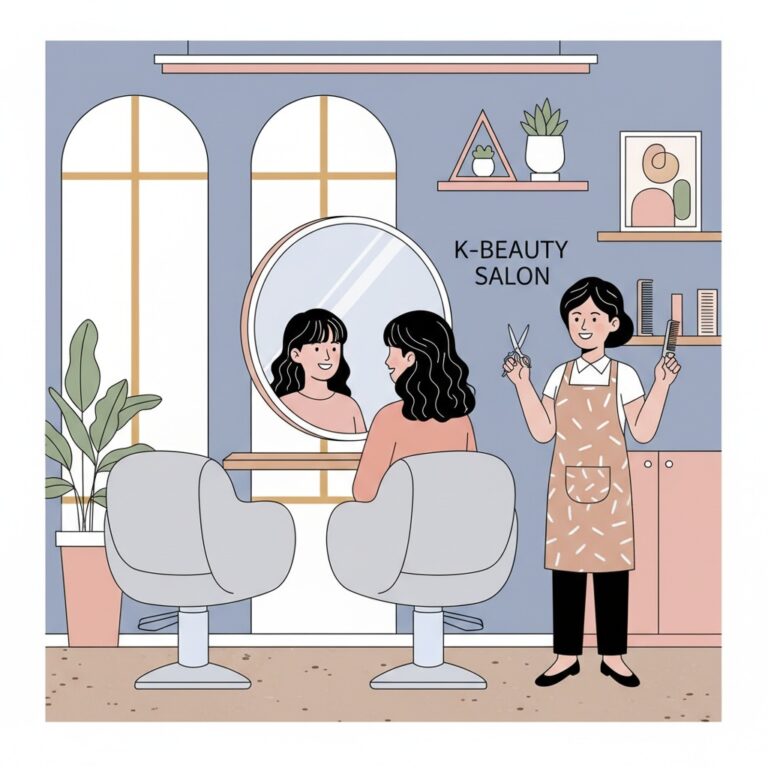
Have you ever dreamed of walking into a salon in Seoul and walking out with a hairstyle straight out of a K-drama? It’s an exciting experience! But what do you say when the designer spins you around in the chair for the final reveal? Today, we’ll learn how to thank your hairstylist like a native Korean speaker.
Lately in Korea, the “Hush Cut” (허쉬컷) from the popular drama Seoul Love Story is all the rage. Imagine you just got this trendy haircut. Let’s learn the perfect phrases to express your happiness and appreciation!
Core Expressions You Need to Know
Here are three essential phrases to use at a Korean hair salon.
1. I love my hair! – 머리 마음에 들어요.
- Pronunciation [Romanization]: Meori ma-eume deureoyo.
- English Meaning: I like my hair. (Literally: The hair enters my heart/mind.)
- Detailed Explanation: This is the most direct and common way to say you are satisfied with your new hairstyle. “마음에 들다” (ma-eume deulda) is a super useful expression for when you like anything, from a new shirt to a cup of coffee. It’s friendly, polite, and clearly expresses your happiness.
-
💡 Pronunciation Tip:
Listen closely to 마음에 (ma-eum-e). Koreans don’t pronounce it as two separate syllables, “ma-eum” and “e”. The final ‘ㅁ’ (m) consonant from ‘마음’ links to the next syllable ‘에’ (e), so it sounds like [ma-eume]. Practice saying it smoothly!
2. Thank you for your hard work. – 수고하셨습니다.
- Pronunciation [Romanization]: Sugohasyeotseumnida.
- English Meaning: You worked hard / Thank you for your effort.
-
Detailed Explanation: While “감사합니다” (gamsahamnida) means “thank you,” “수고하셨습니다” is a special phrase used to acknowledge someone’s labor and effort. You say this to taxi drivers, restaurant staff, and definitely to your hairstylist who just spent an hour perfecting your look. It’s a very respectful and common courtesy in Korea.
-
💡 Pronunciation Tip:
The final part, -습니다 (-seumnida), has a tricky sound change. Even though it’s written with a ‘ㅂ’ (b/p) sound, it is pronounced with an ‘ㅁ’ (m) sound. This is because the ‘ㅂ’ sound changes to ‘ㅁ’ when it comes before ‘ㄴ’ (n). So, don’t say “seup-ni-da,” say [seum-ni-da]. This is a very common rule, so mastering it will make you sound much more natural!
3. I’ll come again next time. – 다음에 또 올게요.
- Pronunciation [Romanization]: Da-eume tto olgeyo.
- English Meaning: I’ll come again next time.
-
Detailed Explanation: This is the ultimate compliment! It tells the designer that you were so happy with their service that you plan to become a regular customer. It’s a polite and friendly way to end your visit, leaving a great impression.
-
💡 Pronunciation Tip:
Notice the word 또 (tto). It’s written with ‘ㄸ’ (tt), a double consonant. This means you need to make a tense, strong “tt” sound, with no puff of air. It’s not a soft “to” like in “tomato,” but a sharp “tto” like the ‘t’ in the word “stop.”
Example Dialogue at the Salon
Let’s see how these phrases work in a real conversation!
- Hair Designer (B): 손님, 머리 다 됐습니다. 거울 한번 보세요. (Son-nim, meori da dwaetseumnida. Geoul hanbeon boseyo.)
- Customer, your hair is all done. Please take a look in the mirror.
- You (A): 와! 딱 제가 원하던 Seoul Love Story 스타일이에요! 머리 정말 마음에 들어요!
- Wow! This is exactly the “Seoul Love Story” style I wanted! I really love my hair!
- Hair Designer (B): 다행이네요. 마음에 드신다니 기뻐요. (Dahaeng-ineyo. Ma-eume deushindani gippeoyo.)
- That’s a relief. I’m happy you like it.
- You (A): 정말 수고하셨습니다. 다음에 또 올게요!
- Thank you so much for your hard work. I’ll come again next time!
Culture Tip & Trend Deep Dive
In Korea, service is a two-way street of respect. While you are the paying customer, acknowledging the hard work of the service provider with a phrase like “수고하셨습니다” is considered basic etiquette. It shows that you see them as a skilled professional, not just a service worker.
Also, the K-drama trend is real! Many Koreans bring photos of their favorite actors or idols to the salon. If you say, “I want the hairstyle from Seoul Love Story,” your designer will know exactly what you mean. Using these phrases after getting your trendy K-drama haircut will make you seem not just like a fan, but like someone who truly understands Korean culture.
Let’s Practice!
Ready to check your understanding?
- Fill in the blank: You just got a fantastic new haircut and you want to tell the stylist you love it.
머리 정말 ______ 들어요! (Meori jeongmal ______ deureoyo!)
- What would you say? The hairstylist has finished, and you are about to pay. What is a polite and natural phrase to say to acknowledge their effort?
Great job today! Now you’re ready to visit a Korean salon with confidence.
Why not try leaving a comment below using one of the phrases we learned today? I’d love to see you practice! 다음에 또 봐요! (See you next time!)
Frequently Asked Questions (FAQ)
Q: What does "마음에" mean in Korean and how do you pronounce it?
A: In Korean, "마음에" is pronounced [ma-eum-e] and means: . Koreans don't pronounce it as two separate syllables, "ma-eum" and "e". The final 'ㅁ' (m) consonant from '마음' links to the next syllable '에' (e), so it sounds like
Q: What does "-습니다" mean in Korean and how do you pronounce it?
A: In Korean, "-습니다" is pronounced [-seumnida] and means: , has a tricky sound change. Even though it's written with a 'ㅂ' (b/p) sound, it is pronounced with an 'ㅁ' (m) sound. This is because the 'ㅂ' sound changes to 'ㅁ' when it comes before 'ㄴ' (n). So, don't say "seup-ni-da," say
Q: What does "또" mean in Korean and how do you pronounce it?
A: In Korean, "또" is pronounced [tto] and means: . It's written with 'ㄸ' (tt), a double consonant. This means you need to make a tense, strong "tt" sound, with no puff of air. It's not a soft "to" like in "tomato," but a sharp "tto" like the 't' in the word "stop."






