

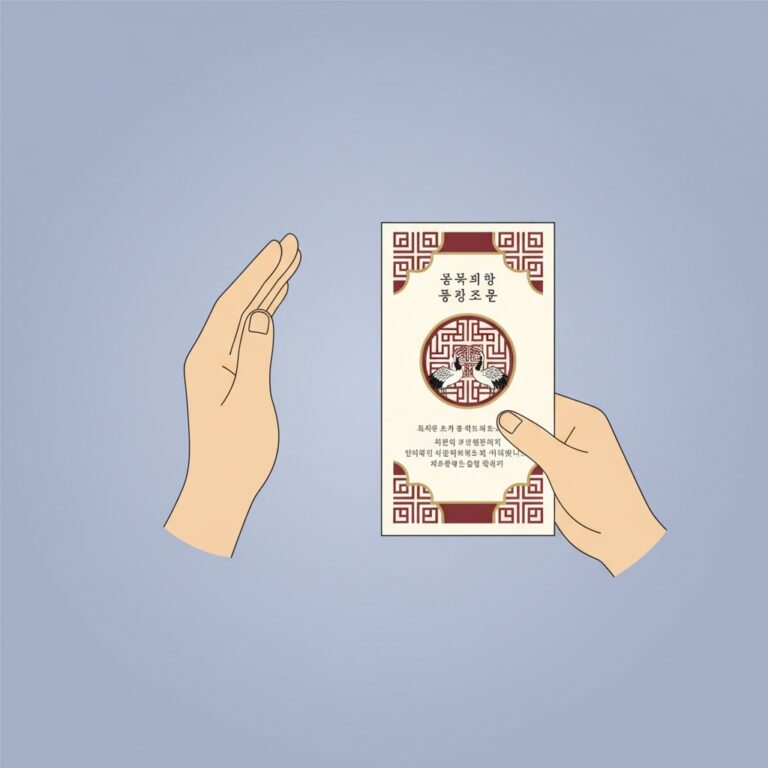
Sorry, I Can’t Go! How to Politely Decline a Korean Wedding Invitation
Hello! This is Maeil Hangul (Daily Korean), here to upgrade your Korean skills! 😊
Have you ever received an invitation to an event you couldn’t attend? It can be tricky to say “no” without sounding rude, especially in a different language. Well, you’re in luck! It’s currently peak wedding season in Korea, so you might get an invitation from a Korean friend sooner than you think. Today, we’ll learn how to politely decline an invitation, so you can handle the situation with grace and keep your friendships strong.
Let’s get started!
Core Expressions You Must Know!
Here are three essential phrases for politely saying you can’t make it. The key is to show you’re happy for them and sad you’ll miss it!
1. 정말 축하해요! (Jeongmal chukahaeyo!)
- Pronunciation [Romanization]: Jeong-mal chu-ka-hae-yo!
- English Meaning: Congratulations! / I sincerely congratulate you!
- Detailed Explanation: This is the most important phrase. Before you say anything else, you must congratulate the person! It shows that your happiness for their big news comes first.
정말 (jeongmal)means “really” or “sincerely,” which adds a heartfelt touch. -
💡 Pronunciation Tip:
When the Korean letters ‘ㄱ’ (g/k) and ‘ㅎ’ (h) meet, they often combine to make a strong, airy ‘ㅋ’ (k) sound. So, even though it’s written as 축하 (chuk-ha), it sounds more like [추카 / chuka]. This process is called “aspiration.” Try exhaling a puff of air as you say it!
2. 아쉽지만 못 갈 것 같아요. (Aswipjiman mot gal geot gatayo.)
- Pronunciation [Romanization]: A-swip-ji-man mot gal geot ga-ta-yo.
- English Meaning: Unfortunately, I don’t think I can make it.
-
Detailed Explanation: This is a soft and polite way to deliver the bad news.
아쉽지만 (aswipjiman)means “It’s a shame, but…” or “Unfortunately…” It immediately shows your regret.못 가다 (mot gada)means “to be unable to go.”-ㄹ 것 같아요 (-l geot gatayo)is a gentle way to say “I think…” or “It seems like…”
By combining them, you are saying, “It’s such a shame, but it looks like I won’t be able to go.”
- 💡 Pronunciation Tip:
The final consonant ‘ㅅ’ in 못 (mot) is pronounced like a ‘ㄷ’ [d] sound when it’s at the end of a syllable. So, you don’t pronounce the ‘s’ sound. It’s pronounced [몯 / mot]. Listen carefully, it’s a subtle but important difference!
3. 그날은 선약이 있어요. (Geunareun seonyagi isseoyo.)
- Pronunciation [Romanization]: Geu-na-reun seon-ya-gi i-sseo-yo.
- English Meaning: I have a prior engagement on that day.
-
Detailed Explanation: This is a classic and respectful excuse.
선약 (seonyak)is a formal word for a “previous promise” or “prior engagement.” Using this phrase shows that you have a legitimate reason for not being able to attend, and you don’t need to give any other details. -
💡 Pronunciation Tip:
Notice how 있어요 (isseoyo) is pronounced? The final ‘ㅆ’ (ss) from있links to the next syllable, which starts with ‘ㅇ’. This is a very common Korean pronunciation rule called linking (연음 – yeoneum). So, instead of saying [it-eo-yo], you say [이써요 / isseoyo] smoothly.
Example Dialogue
Let’s see how these expressions work in a real conversation! Imagine your friend, Minjun, sends you a mobile wedding invitation.
- A (Minjun): Hey! I’m getting married next month! I sent you the mobile invitation.
- (나 다음 달에 결혼해! 모바일 청첩장 보냈어.)
- B (You): Wow, really? Congratulations!
- (와, 정말? 정말 축하해!)
- A (Minjun): Thanks! Please come and celebrate with us.
- (고마워! 꼭 와서 축하해 줘.)
- B (You): Oh, I’d love to, but I have a prior engagement on that day. Unfortunately, I don’t think I can make it. I’m so sorry.
- (정말 가고 싶은데, 그날은 선약이 있어. 아쉽지만 못 갈 것 같아. 정말 미안해.)
- A (Minjun): It’s okay! Thank you just for the thought.
- (괜찮아. 마음만으로도 고마워!)
See? By congratulating first and then politely explaining, you can decline without hurting any feelings.
Culture Tip & Trend Analysis
The Culture of “Congratulatory Money” (축의금 – Chugui-geum)
Here’s a pro tip to sound like a true Korean insider! Even if you say “못 갈 것 같아요” (I can’t go), it is customary in Korea to give a gift of money, called 축의금 (chugui-geum), to congratulate the couple.
This shows your support and celebrates their new beginning. Traditionally, you put cash in a white envelope and give it at the wedding reception. But here’s the modern trend: Korean Z-generation often sends 축의금 through mobile banking! Most mobile wedding invitations now include the couple’s bank account numbers, making it super easy to send your gift with a congratulatory message, even from another country.
So, if you can’t attend, you can say, “아쉽지만 못 갈 것 같아. 대신 마음을 담아 축의금 보낼게!” (I’m sad I can’t go. I’ll send a gift to show my support instead!). Your friend will be very touched!
Let’s Practice!
Time to review what you’ve learned.
1. Fill in the blank: Your friend tells you they are getting married. What is the very FIRST thing you should say?
“와! ______! 너무 기쁘다!” (Wow! ______! I’m so happy!)
2. Challenge: How would you write a short, polite message declining a wedding invitation using at least two phrases from today?
Great job today! Learning how to handle social situations like this is a huge step in your Korean journey.
Why not try making your own sentence in the comments below? We’d love to see you practice! See you next time at Maeil Hangul! 👋
Frequently Asked Questions (FAQ)
Q: What does "축하" mean in Korean and how do you pronounce it?
A: In Korean, "축하" is pronounced [chuk-ha] and means: , it sounds more like
Q: What does "못" mean in Korean and how do you pronounce it?
A: In Korean, "못" is pronounced [mot] and means: is pronounced like a 'ㄷ' [d] sound when it's at the end of a syllable. So, you don't pronounce the 's' sound. It's pronounced
Q: What does "있어요" mean in Korean and how do you pronounce it?
A: In Korean, "있어요" is pronounced [isseoyo] and means: is pronounced? The final 'ㅆ' (ss) from
Q: What does "축의금" mean in Korean and how do you pronounce it?
A: In Korean, "축의금" is pronounced [chugui-geum] and means: , to congratulate the couple.







