

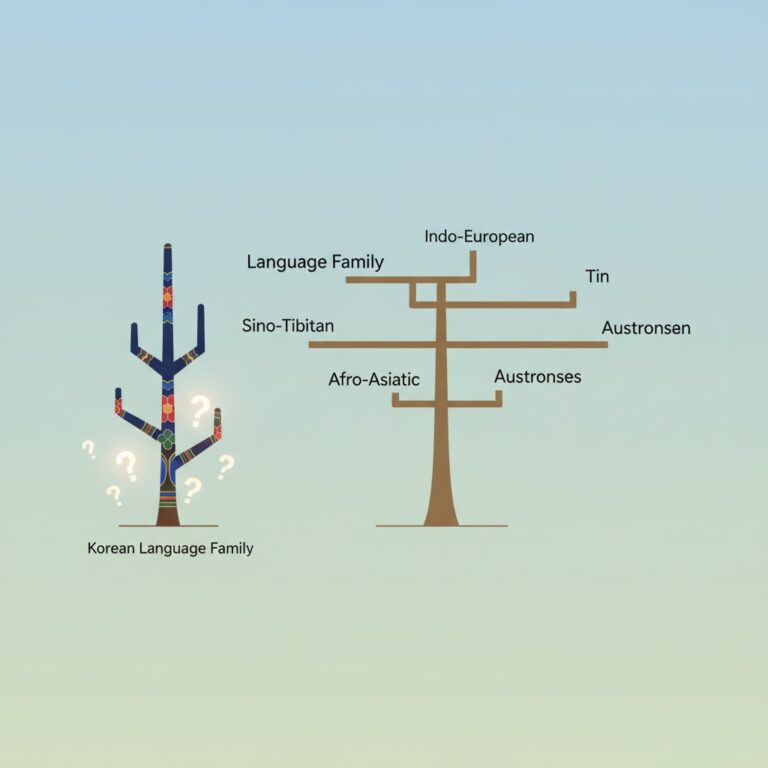
Korean’s Linguistic Family Tree: A Deep Dive
Hello! Welcome back to [Maeil Hangul], your guide to upgrading your Korean skills to a truly masterful level!
Today, we’re stepping away from daily conversation and venturing into the fascinating academic field of historical linguistics. Have you ever wondered where the Korean language truly comes from? What are its relatives? We’ll be linguistic detectives, exploring how experts trace the ancestry of languages and try to place Korean on the world’s linguistic map. Recently, as Korean culture has gained global prominence, the academic debate about the language’s origins has also seen renewed interest. Let’s dive into the very methods used to answer this profound question!
Core Concepts for Linguistic Detectives
Here are the essential terms you’ll need to understand the principles of reconstructing language history.
1. 어족 (Eojok)
- Pronunciation [Romanization]: Eojok
- English Meaning: Language Family
- Detailed Explanation: An
어족is a group of languages that have descended from a common ancestor, known as a “proto-language.” Think of it like a family tree: English, German, and Hindi are all “children” within the vast Indo-European language family. The classification of the Korean language is a major topic of debate. While some scholars argue it’s a language isolate (고립어, gorib-eo) with no living relatives, others have historically linked it to the proposed (and controversial) Altaic language family. - 💡 Pronunciation Tip: The final consonant ‘ㄱ’ in ‘족 (jok)’ is an unreleased stop. This means you form the ‘k’ sound at the back of your throat but don’t release the puff of air that you would in English words like “book.” It’s a clipped, sharp ending.
2. 비교언어학 (Bigyo-eoneohak)
- Pronunciation [Romanization]: Bigyo-eoneohak
- English Meaning: Comparative Linguistics
- Detailed Explanation: This is the primary methodology used to establish a language family.
비교언어학is the science of comparing languages to identify systematic and regular correspondences in their phonology (sounds), morphology (word structure), and lexicon (vocabulary). It’s through this rigorous comparison that linguists can prove a genetic relationship, rather than one based on mere coincidence or borrowing. - 💡 Pronunciation Tip: The vowel ‘어 (eo)’ is one of the trickiest for English speakers. It’s similar to the ‘o’ sound in the English word “song” or “thought,” but your lips should be relaxed and unrounded. Practice saying “uh” and then slightly lowering your jaw to find the sound.
3. 동계어 (Donggye-eo)
- Pronunciation [Romanization]: Donggye-eo
- English Meaning: Cognates
- Detailed Explanation: Cognates are the golden pieces of evidence in comparative linguistics. A
동계어is a word that shares the same etymological origin as a word in another language. For example, the English word “mother” and the German “Mutter” are cognates from a common Proto-Germanic ancestor. It’s crucial to distinguish cognates, which prove a genetic link, from loanwords (차용어, chayong-eo). For instance, the Korean word빵 (ppang)comes from the Portuguese “pão,” making it a loanword, not a cognate. - 💡 Pronunciation Tip: The syllable ‘계 (gye)’ involves a glide. It’s not pronounced ‘ge-ye’ as two separate sounds. Start with the ‘g’ sound and immediately slide into the ‘ye’ vowel, making it one smooth syllable: [gye].
4. 재구하다 (Jaeguhada)
- Pronunciation [Romanization]: Jaeguhada
- English Meaning: To reconstruct
- Detailed Explanation: This is the ultimate goal of the comparative method. By analyzing the systematic sound changes between cognates across related languages, linguists can
재구하다, or reconstruct, the probable form of a word in the parent proto-language. These hypothetical, reconstructed forms are always marked with an asterisk (*). For example, by comparing words for “fish” in Japanese, Korean, and other languages, some linguists have reconstructed the Proto-Altaic form as ***p[i]āĺi*. - 💡 Pronunciation Tip: The vowel ‘ㅐ (ae)’ in ‘재 (jae)’ is pronounced like the ‘a’ in the English word “cat.” It’s a bright, open front vowel.
Example Dialogue: Linguistics Class Discussion
Let’s see how these terms might appear in a natural conversation between two university students.
A: 교수님의 비교언어학 강의, 정말 흥미롭지 않았어? 원시 언어를 재구한다는 발상 자체가 대단한 것 같아.
[Gyosunim-ui bigyo-eoneohak gang-ui, jeongmal heungmiropji anass-eo? Wonsi eon-eo-reul jaeguhanda-neun balsang jache-ga daedanhan geot gat-a.]
Wasn’t the professor’s lecture on comparative linguistics fascinating? The very idea of reconstructing a proto-language seems incredible.
B: 맞아. 진짜 동계어랑 단순한 차용어를 구분해서 어족 계통도를 만드는 과정이 아직도 좀 헷갈려.
[Maja. Jinjja donggye-eo-rang dansunhan chayong-eo-reul gubunhaeseo eojok gyetongdo-reul mandeuneun gwajeong-i ajikdo jom hetgallyeo.]
I agree. I’m still a bit confused about the process of distinguishing true cognates from simple loanwords to create a language family tree.
A: 특히 한국어의 위치에 대한 논쟁은 생각할 거리를 많이 주더라. 고립어일까, 아니면 더 큰 어족의 일부일까?
[Teukhi han-gugeo-ui wichi-e daehan nonjaeng-eun saenggakhal geori-reul mani judeora. Gorib-eo-ilkka, animyeon deo keun eojok-ui ilbu-ilkka?]
The debate over the position of Korean especially gave me a lot to think about. Is it a language isolate, or part of a larger language family?
Cultural Tip & Deeper Analysis
The debate over the Korean language family is not just a dry academic exercise; it touches upon profound questions of Korean history, migration, and national identity. For decades, the Altaic Hypothesis was a prominent theory that grouped Korean with Turkic, Mongolic, and Tungusic languages based on shared grammatical features like agglutination and vowel harmony.
However, modern linguists are largely skeptical of this theory. Why? The core issue is a lack of convincing and systematic 동계어 (cognates) in basic vocabulary. Many of the similarities can be better explained as a result of prolonged language contact in a “Sprachbund” (a linguistic area) rather than a shared genetic origin.
Understanding this academic shift is key to appreciating the modern view of Korean as a language with a remarkably unique and deep heritage, possibly as a language isolate. This linguistic distinctiveness is a subtle but significant source of cultural pride for many Koreans.
Let’s Review!
You’ve just taken a deep dive into the world of historical linguistics! We learned how linguists use 비교언어학 (comparative linguistics) to find 동계어 (cognates) and group languages into an 어족 (language family), and even 재구하다 (reconstruct) ancient proto-languages.
Quick Quiz:
- Fill in the blank: Words in different languages that share a common origin, like English “three” and Latin “tres,” are called _______________. (A. 어족, B. 동계어, C. 차용어)
-
Short Answer: In your own words, what is the primary goal of the comparative method (
비교언어학)?
Ready to test your knowledge? Leave your answers and any thoughts on the fascinating origins of the Korean language in the comments below
Frequently Asked Questions (FAQ)
Q: What does "동계어" mean in Korean and how do you pronounce it?
A: In Korean, "동계어" is pronounced [cognates] and means: in basic vocabulary. Many of the similarities can be better explained as a result of prolonged language contact in a "Sprachbund" (a linguistic area) rather than a shared genetic origin.
Q: What does "비교언어학" mean in Korean and how do you pronounce it?
A: In Korean, "비교언어학" is pronounced [comparative linguistics] and means: to find
Q: What does "동계어" mean in Korean and how do you pronounce it?
A: In Korean, "동계어" is pronounced [cognates] and means: and group languages into an
Q: What does "어족" mean in Korean and how do you pronounce it?
A: In Korean, "어족" is pronounced [language family] and means: , and even







