

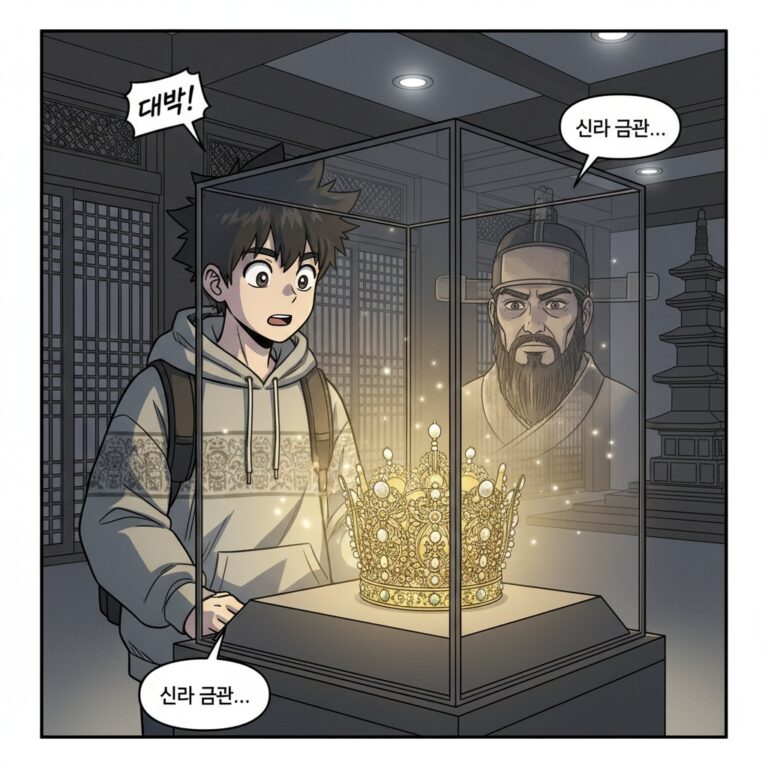
Hello! This is Daily Hangul, here to upgrade your Korean skills!
Have you ever been captivated by a historical K-drama, with its beautiful palaces and epic stories? Have you wanted to visit a Korean museum and understand the stories behind the ancient artifacts? Today, we’re going to time-travel with language! We’ll learn how to talk about ancient civilizations and historical events in Korean. It’s a fantastic way to deepen your appreciation for Korean culture and impress your friends with your knowledge. Especially since so many popular K-dramas are set in ancient kingdoms, knowing these words will make your viewing experience even more immersive!
Let’s get started!
Core Expressions You Need to Know
Here are some essential words and phrases to talk about history like a pro.
1. 왕조 (Wangjo)
- Pronunciation [Romanization]: Wang-jo
- English Meaning: Dynasty
- Detailed Explanation: This is a fundamental word for discussing history. It refers to a period of rule by a single family or line of rulers. You’ll hear this word constantly when people talk about famous periods like the Joseon or Silla Dynasty. It’s a neutral, factual term used in both casual and formal settings.
- 💡 Pronunciation Tip: The first syllable ‘왕’ (wang) ends with the ‘ㅇ’ consonant, which is pronounced like the “-ng” in the English word “sing.” Make sure you don’t pronounce it as “wan-g” with a hard ‘g’ sound. It’s a smooth, nasal sound that stays in the back of your throat.
2. 유물 (Yumul)
- Pronunciation [Romanization]: Yu-mul
- English Meaning: Relic, artifact
- Detailed Explanation: This word refers to an object of historical or cultural significance that has survived from the past. When you visit a museum in Korea, like the National Museum of Korea in Seoul, you will see ‘유물’ everywhere! It can refer to anything from ancient pottery to golden crowns.
- 💡 Pronunciation Tip: The vowel ‘ㅠ’ (yu) can be tricky. It’s a combination of ‘ㅣ’ (i) and ‘ㅜ’ (u). Start by saying “ee” and quickly glide into an “oo” sound, like the “u” in the word “you.” So, it’s not “yoo-mool,” but a smoother [yumul].
3. ~에 세워졌다 (~e sewojyeotda)
- Pronunciation [Romanization]: ~e se-wo-jyeot-da
- English Meaning: Was founded in/on…
- Detailed Explanation: This is a crucial passive verb phrase used to say that something (like a kingdom, a city, or a building) “was founded” or “was established.” You place the time or location before it. For example, “조선은 1392년에 세워졌다” (Joseon was founded in the year 1392). The base verb is 세우다 (seuda), meaning “to found” or “to erect.”
- 💡 Pronunciation Tip: Notice the ‘ㅆ’ in ‘졌다’ (jyeotda). Double consonants like ‘ㅆ’ (ss) are called doen-sori (된소리) or “tense sounds.” You need to pronounce it with more tension in your throat, without any puff of air. It’s stronger and sharper than a single ‘ㅅ’ (s). Think of the difference between “sea” and “ssea” – it’s a tight, crisp sound.
4. 전성기 (Jeonseonggi)
- Pronunciation [Romanization]: Jeon-seong-gi
- English Meaning: Golden age, peak period
- Detailed Explanation: This word describes the most successful and prosperous period of a kingdom, an artist’s career, or even a K-pop group’s popularity! It literally means “peak prosperous period.” It’s a great word to use to sound more fluent and descriptive.
- 💡 Pronunciation Tip: In Korean, the consonant ‘ㄱ’ sounds like a ‘k’ at the beginning of a word but softens to a ‘g’ sound when it’s between two vowels or voiced sounds. In ‘전성기’, the final ‘기’ (gi) comes after the vowel sound ‘ㅣ’ (i). Therefore, it’s not pronounced [jeonseongki], but rather a softer [jeonseonggi]. This is a very common rule that will make your pronunciation sound much more natural!
Example Dialogue
Let’s see how these expressions work in a real conversation. Friends A and B are talking after watching a popular historical drama.
A: I just finished watching a drama about the Silla 왕조! It was amazing.
(나 방금 신라 왕조에 대한 드라마 다 봤어! 진짜 멋있었어.)
(Na banggeum Silla wangjo-e daehan deurama da bwasseo! Jinjja meosisseosseo.)
B: Oh, the Silla Dynasty! Their golden crowns are a famous 유물, right?
(아, 신라! 황금 왕관이 유명한 유물이잖아, 맞지?)
(A, Silla! Hwanggeum wanggwani yumyeonghan yumulijana, matji?)
A: Exactly! I learned that the Silla kingdom 기원전 57년에 세워졌다. That’s so long ago!
(맞아! 신라는 기원전 57년에 세워졌다고 배웠어. 정말 오래전이야!)
(Maja! Sillaneun giwonjeon 57nyeone sewojyeotdago baewosseo. Jeongmal oraejeoniya!)
B: Wow. King Gwanggaeto’s era was the 전성기 for the Goguryeo Dynasty, but Silla’s cultural peak was incredible, too.
(와. 고구려는 광개토대왕 시절이 전성기였는데, 신라도 문화적으로는 정말 대단했지.)
(Wa. Goguryeoneun gwanggaetodaewang sijeori jeonseonggiyeonneunde, Sillado munhwajeogeuroneun jeongmal daedanhaetji.)
Culture Tip & Trend Deep Dive: K-Dramas as History Teachers!
You might have noticed that historical dramas, called 사극 (sageuk) in Korean, are a huge genre in Korea. From “Kingdom” (set in the Joseon Dynasty) to “Hwarang” (set in the Silla Dynasty), these shows bring history to life.
While they often add fictional elements for dramatic effect, they are a fantastic entry point into Korean history. When you watch a sageuk and hear a character mention the 왕조 (wangjo) they live in or see a stunning 유물 (yumul), you’ll feel a thrill of understanding! Knowing these words allows you to connect with the story on a deeper level. The next time you watch a historical drama, listen for these words. You’ll be surprised how often they pop up, and you’ll feel like a true insider!
Let’s Practice!
Ready to test your knowledge? Try these simple exercises.
- Fill in the Blank:
The Joseon ________ (dynasty) is one of the most famous periods in Korean history.
(조선 ________은/는 한국 역사에서 가장 유명한 시대 중 하나예요.) -
Make a Sentence:
Using the word 전성기 (jeonseonggi), try to write a short sentence about your favorite K-pop group’s “golden age.” (Example: For me, BTS’s golden age was during the “Love Yourself” era.)
Great job today! You’ve learned some key vocabulary for talking about Korea’s rich history. Now you can watch your favorite sageuk with new ears or confidently walk into a museum.
Why not try using one of today’s expressions in the comments below? Tell us about a historical period you find interesting!
Frequently Asked Questions (FAQ)
Q: What does "사극" mean in Korean and how do you pronounce it?
A: In Korean, "사극" is pronounced [sageuk] and means: in Korean, are a huge genre in Korea. From "Kingdom" (set in the Joseon Dynasty) to "Hwarang" (set in the Silla Dynasty), these shows bring history to life.
Q: What does "왕조" mean in Korean and how do you pronounce it?
A: In Korean, "왕조" is pronounced [wangjo] and means: they live in or see a stunning
Q: What does "유물" mean in Korean and how do you pronounce it?
A: In Korean, "유물" is pronounced [yumul] and means: , you'll feel a thrill of understanding! Knowing these words allows you to connect with the story on a deeper level. The next time you watch a historical drama, listen for these words. You'll be surprised how often they pop up, and you'll feel like a true insider!
Q: What does "전성기" mean in Korean and how do you pronounce it?
A: In Korean, "전성기" is pronounced [jeonseonggi] and means: , try to write a short sentence about your favorite K-pop group's "golden age." (Example: For me, BTS's golden age was during the "Love Yourself" era.)







