

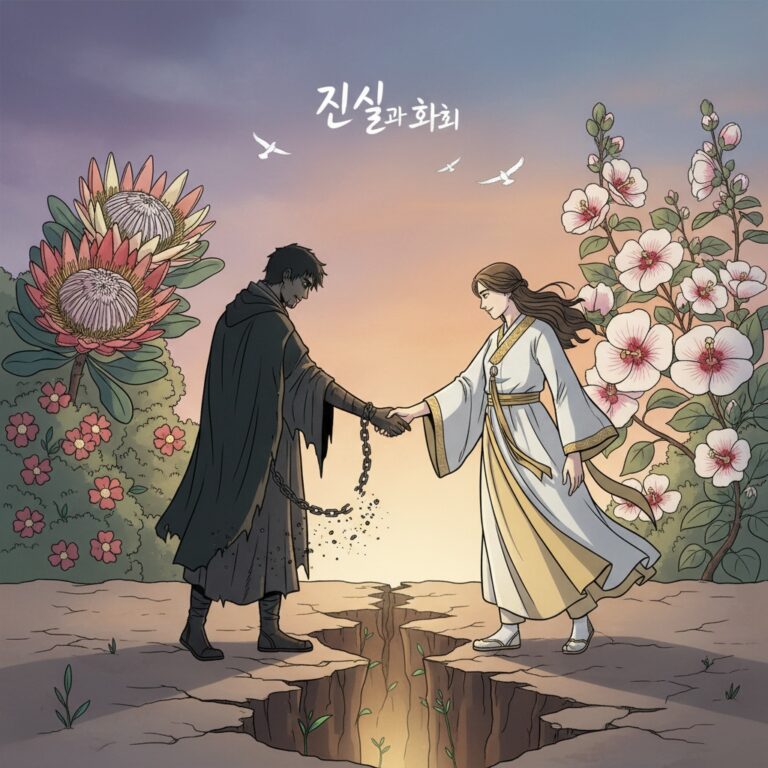
Unpacking History: South Africa’s TRC in Korean
Hello! Welcome to [Maeil Hangeul], your go-to blog for leveling up your Korean skills!
Today, we’re diving deep into a serious but incredibly important topic: Peace Studies and the lessons from South Africa’s Truth and Reconciliation Commission. You might wonder, “Why this topic?” Well, recently, there’s been a growing global and domestic conversation in Korea about how nations confront painful pasts. Understanding the vocabulary used in these discussions will not only allow you to engage with high-level news, academic articles, and films in Korean but also offer a profound insight into the Korean perspective on history, justice, and healing.
Let’s explore the powerful language used to navigate these complex issues.
Core Expressions for a Deeper Discussion
Here are some key terms that are essential for discussing transitional justice in Korean.
1. 진실화해위원회 (Jinshilhahwaewiwonhoe)
- English Meaning: Truth and Reconciliation Commission
- Detailed Explanation: This is the direct term for the TRC. It’s a compound noun made of three crucial words: 진실 (jinshil) meaning ‘truth’, 화해 (hahwae) meaning ‘reconciliation’ or ‘rapprochement’, and 위원회 (wiwonhoe) meaning ‘committee’ or ‘commission’. This term is the starting point for any discussion about post-conflict justice models in Korean.
- 💡 Pronunciation Tip:
This long word is pronounced by clearly articulating each component: [진실화해위원회 | jin-sil-hwa-hae-wi-won-hoe]. The key is to not rush it. Notice the ‘ㅎ(h)’ sound in ‘화해’. It should be a light, airy sound, not a strong, guttural one.
2. 과거사 청산 (Gwageosa cheongsan)
- English Meaning: Rectification of past affairs; settling past wrongdoings.
- Detailed Explanation: This is a vital concept in Korean public discourse. 과거사 (gwageosa) means ‘past history’ or ‘past affairs’, and 청산 (cheongsan) literally means ‘liquidation’ or ‘clearing off’. Together, the phrase refers to the process of a nation officially investigating, acknowledging, and resolving historical injustices, such as massacres, human rights abuses, or colonial-era crimes. It implies a definitive and clean break from a painful past.
- 💡 Pronunciation Tip:
The pronunciation is [과거사 청산 | gwa-geo-sa cheong-san]. Pay attention to the first syllable ‘과 (gwa)’. It’s a single, smooth sound, not ‘gu-a’. For ‘청산 (cheongsan)’, the ‘ㅊ (ch)’ is an aspirated sound, meaning you should release a puff of air, like the ‘ch’ in “chart.”
3. 회복적 정의 (Hoebokjeok jeong-ui)
- English Meaning: Restorative Justice
- Detailed Explanation: This term stands in contrast to ‘retributive justice’ (사법적 정의 – sabeopjeok jeong-ui), which focuses on punishment. 회복적 (hoebokjeok) means ‘restorative’, from the verb 회복하다 (hoebokhada), ‘to recover’. 정의 (jeong-ui) means ‘justice’. This concept, central to the South African TRC, emphasizes repairing harm, healing victims, and reintegrating offenders into the community rather than simply punishing them.
- 💡 Pronunciation Tip:
The pronunciation is [회복쩍 정의 | hoe-bok-jjeok jeong-ui]. The final consonant of ‘적(jeok)’ often becomes tensed when followed by ‘ㅈ(j)’, making the ‘정의’ sound more like [쩡의 | jjeong-ui]. Also, the diphthong ‘의(ui)’ can be tricky. When it’s not the first syllable of a word, it’s often simplified to an [ㅣ | i] sound. So, you’ll sound more natural pronouncing it as [회복쩍 정이 | hoe-bok-jjeok jeong-i].
4. 피해자 중심주의 (Pihaeja jungsimjuui)
- English Meaning: Victim-centered approach / Victim-centrism
- Detailed Explanation: This principle argues that the process of justice and reconciliation must prioritize the needs, experiences, and voices of the victims. It’s composed of 피해자 (pihaeja) ‘victim’, 중심 (jungsim) ‘center’, and 주의 (juui) ‘-ism’. This term is frequently used in Korean debates about historical tragedies, ensuring that the focus remains on those who suffered most.
- 💡 Pronunciation Tip:
The pronunciation is [피해자 중심주의 | pi-hae-ja jung-sim-ju-ui]. Again, let’s look at ‘주의(juui)’. While the standard pronunciation is [주의 | ju-ui], in everyday speech, it is very often pronounced as [주이 | ju-i]. Mastering this small change will make your Korean sound much more fluid and natural.
Example Dialogue
Two university students, Min-jun (A) and Sora (B), are discussing their international politics class.
A: 오늘 수업에서 다룬 남아공의 진실화해위원회 모델은 정말 흥미로웠어. 용서와 처벌 사이의 균형을 찾는 게 얼마나 어려운지 알겠더라.
(Oneul sueobeseo darun namagong-ui Jinshilhahwaewiwonhoe model-eun jeongmal heungmirowosseo. Yongseo-wa cheobeol sai-ui gyunhyeong-eul chatneun ge eolmana eoryeounji algetdeora.)
A: The South African Truth and Reconciliation Commission model we covered in class today was fascinating. I get how difficult it is to find a balance between forgiveness and punishment.
B: 맞아. 특히 회복적 정의라는 개념이 인상 깊었어. 단순한 처벌을 넘어 공동체의 치유를 목표로 한다는 점이 말이야.
(Maja. Teuki hoebokjeok jeong-ui-raneun gaenyeom-i insang gipeosseo. Dansunhan cheobeol-eul neomeo gongdongche-ui chiyu-reul mokpyoro handa-neun jeom-i mariya.)
B: I agree. The concept of restorative justice was especially impressive. The fact that it aims for communal healing beyond simple punishment.
A: 한국의 과거사 청산 과정과 비교하게 되더라. 우리도 여전히 해결해야 할 역사적 문제들이 많잖아.
(Hangug-ui gwageosa cheongsan gwajeong-gwa bigyohage doedeora. Urido yeojeonhi haegyeolhaeya hal yeoksajeok munjedeuri manchana.)
A: It made me compare it to Korea’s own process of settling past wrongdoings. We still have so many historical issues to resolve.
B: 그래서 피해자 중심주의 원칙이 더 중요하게 느껴지는 것 같아. 그들의 목소리가 가장 먼저 고려되어야 하니까.
(Geuraeseo pihaeja jungsimjuui wonchig-i deo jung-yohage neukkyeojineun geot gata. Geudeurui moksoriga gajang meonjeo goryeodoeeoya hanikka.)
B: That’s why the principle of a victim-centered approach feels even more important. Their voices must be considered first and foremost.
Culture Tip: Korea’s Own Path to Reconciliation
You might be surprised to learn that South Korea has its own version: the ‘Truth and Reconciliation Commission, Republic of Korea’ (진실·화해를위한과거사정리위원회). Established to investigate incidents of human rights abuses during Korea’s turbulent modern history, it reflects the ongoing national effort toward 과거사 청산 (gwageosa cheongsan).
Discussions around this topic in Korea are not merely academic. They are deeply connected to unresolved historical events like the Jeju 4.3 Uprising (제주 4·3 사건), the Gwangju Democratization Movement (5·18 광주 민주화 운동), and the ongoing fight for justice for the “comfort women” (위안부 피해자). When you hear these terms used in Korean news or media, you’ll now understand that they are part of a deep, continuous struggle to define justice, memory, and national identity. Using these terms correctly shows a sophisticated understanding of not just the language, but the very soul of modern Korean society.
Let’s Review and Practice!
We’ve learned some powerful, high-level vocabulary today:
* 진실화해위원회 (Jinshilhahwaewiwonhoe): Truth and Reconciliation Commission
* 과거사 청산 (Gwageosa cheongsan): Settling past wrongdoings
* 회복적 정의 (Hoebokjeok jeong-ui): Restorative justice
* 피해자 중심주의 (Pihaeja jungsimjuui): Victim-centered approach
Now, it’s your turn to try!
- Fill in the blank:
많은 학자들은 가해자에 대한 처벌만큼이나 공동체의 치유를 강조하는 ___________의 중요성을 주장한다.
(Many scholars argue for the importance of ___________, which emphasizes community healing as much as punishing perpetrators.) -
Sentence Building:
Using the term 과거사 청산 (gwageosa cheongsan), write one sentence in Korean explaining why it is a necessary process for a country’s future.
Leave your answers in the comments below! We’d love to see how you use these profound expressions. Keep up the fantastic work
Frequently Asked Questions (FAQ)
Q: What does "진실" mean in Korean and how do you pronounce it?
A: In Korean, "진실" is pronounced [jinshil] and means: meaning 'truth',
Q: What does "화해" mean in Korean and how do you pronounce it?
A: In Korean, "화해" is pronounced [hahwae] and means: meaning 'reconciliation' or 'rapprochement', and
Q: What does "위원회" mean in Korean and how do you pronounce it?
A: In Korean, "위원회" is pronounced [wiwonhoe] and means: meaning 'committee' or 'commission'. This term is the starting point for any discussion about post-conflict justice models in Korean.
Q: What does "과거사" mean in Korean and how do you pronounce it?
A: In Korean, "과거사" is pronounced [gwageosa] and means: means 'past history' or 'past affairs', and







