

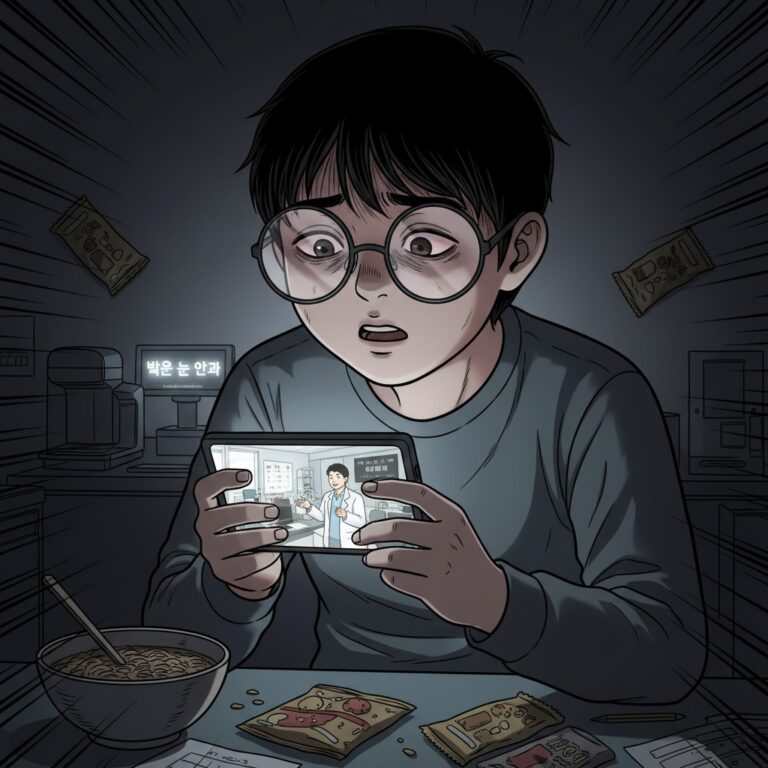
Too Much K-Drama? Korean Phrases for the Eye Doctor!
Hello! This is Daily Hangul, here to upgrade your Korean skills!
Have you ever been binge-watching a K-drama or scrolling through webtoons for hours, only to realize your eyes are tired and sore? It happens to the best of us! Today, we’re going to learn some essential Korean phrases to describe your symptoms at the angwa (안과), the eye doctor’s office.
Nowadays in Korea, digital life is everything, and long hours on smartphones are super common. So, knowing how to talk about eye strain is more useful than ever. Let’s learn how to express your discomfort clearly and confidently!
Core Expressions You Need to Know
Here are three key phrases to help you explain what’s wrong.
1. My eyes hurt.
- Korean: 눈이 아파요.
- Pronunciation [Romanization]: Nuni apayo.
- English Meaning: My eyes hurt.
- Detailed Explanation: This is the most basic and important phrase. 눈 (nun) means “eye,” and 아파요 (apayo) is the polite form of “to be sick” or “to be painful.” You can use 아파요 for any part of your body! For example, “머리가 아파요 (Meori-ga apayo)” means “I have a headache.”
- 💡 Pronunciation Tip:
The particle 이 (i) is used here because the noun ‘눈 (nun)’ ends with a consonant. When you say it, the ‘ㄴ (n)’ sound from ‘눈’ links smoothly to the ‘이 (i)’, making it sound like one word: [nuni]. Avoid pausing between ‘nun’ and ‘i’. This sound-linking rule is called 연음 (yeon-eum) and is key to sounding natural!
2. My vision is blurry.
- Korean: 눈앞이 흐려요.
- Pronunciation [Romanization]: Nunapi heuryeoyo.
- English Meaning: My vision is blurry. (Literally: “The space in front of my eyes is blurry.”)
- Detailed Explanation: This is a very native-sounding expression. 눈앞 (nunap) literally means “in front of the eyes,” and 흐려요 (heuryeoyo) means “to be blurry, cloudy, or overcast.” It perfectly describes that feeling when things aren’t in focus.
- 💡 Pronunciation Tip:
Here’s that yeon-eum rule again! The final consonant ‘ㅍ (p)’ in ‘앞 (ap)’ moves over to the next syllable ‘이 (i)’. So, you don’t pronounce it as ‘nun-ap-i’. Instead, the ‘p’ sound jumps, making the pronunciation [nunapi]. It’s the same principle that makes ‘음악 (eum-ak)’ + ‘이 (i)’ sound like [eumagi].
3. My eyes feel dry and stiff.
- Korean: 눈이 뻑뻑해요.
- Pronunciation [Romanization]: Nuni ppeokppeokaeyo.
- English Meaning: My eyes feel dry/stiff.
- Detailed Explanation: 뻑뻑하다 (ppeokppeokada) is a fantastic descriptive word. It mimics the feeling of something being stiff, not well-lubricated, or rough. It’s the perfect word to describe that tired, sandy feeling in your eyes after staring at a screen for too long.
- 💡 Pronunciation Tip:
The double consonants ‘ㅃ (pp)’ and ‘ㄲ (kk)’ are called tense consonants. To make this sound correctly, you need to tighten the muscles in your throat and release a short, tight puff of air, without the aspiration you’d use for ‘ㅍ (p)’ or ‘ㅋ (k)’. Think of the ‘p’ in “spin” or the ‘k’ in “sky.” Practice saying [ppeok-ppeo-kae-yo] with tension for a native-like sound!
Example Dialogue at the Clinic
Let’s see how these phrases work in a real conversation between a doctor (의사) and a patient (민준).
- 의사 (Doctor): 안녕하세요. 어디가 불편하세요?
- (Annyeonghaseyo. Eodi-ga bulpyeonhaseyo?)
- Hello. What seems to be the problem?
- 민준 (Minjun): 눈이 아파요. 그리고 가끔 눈앞이 흐려요.
- (Nuni apayo. Geurigo gakkeum nunapi heuryeoyo.)
- My eyes hurt. And sometimes my vision gets blurry.
- 의사 (Doctor): 그렇군요. 눈이 건조한 느낌도 있으세요?
- (Geureokunyo. Nuni geonjohan neukkimdo isseuseyo?)
- I see. Do your eyes feel dry as well?
- 민준 (Minjun): 네, 요즘 새로 나온 드라마를 밤새 보느라… 눈이 뻑뻑해요.
- (Ne, yojeum saero naon deuramareul bamsae boneura… nuni ppeokppeokaeyo.)
- Yes, because I’ve been staying up all night watching a new drama… my eyes feel very dry.
Culture Tip: “Digital Eye Strain” in Korea
In Korea, where people are hyper-connected, complaining about tired eyes is a common bonding topic! From students studying for exams to office workers and K-pop fans streaming videos, everyone experiences it.
You’ll often hear young Koreans jokingly say something like, “폰 보다가 눈 빠지겠어!” (Pon bodaga nun ppajigesseo!), which humorously translates to, “My eyes are going to fall out from looking at my phone!” While this is an exaggeration you’d use with friends, knowing a phrase like 눈이 뻑뻑해요 shows that you understand this very modern, everyday aspect of Korean life. Using it will make you sound instantly relatable!
Let’s Review and Practice!
Amazing work today! You’ve learned three essential phrases for the eye doctor:
- 눈이 아파요 (My eyes hurt)
- 눈앞이 흐려요 (My vision is blurry)
- 눈이 뻑뻑해요 (My eyes feel dry/stiff)
Now, let’s put your knowledge to the test!
- Fill in the blank: After reading a webtoon on your tiny phone screen for two hours, your eyes feel very stiff. You would say: “아, 눈이 ______.”
- Make a sentence: How would you say “My stomach hurts”? (Hint: “stomach” is 배 (bae)).
Leave your answers in the comments below using the phrases we learned today! We can’t wait to see you practice
Frequently Asked Questions (FAQ)
Q: What does "눈" mean in Korean and how do you pronounce it?
A: In Korean, "눈" is pronounced [nun] and means: means "eye," and
Q: What does "아파요" mean in Korean and how do you pronounce it?
A: In Korean, "아파요" is pronounced [apayo] and means: is the polite form of "to be sick" or "to be painful." You can use
Q: What does "이" mean in Korean and how do you pronounce it?
A: In Korean, "이" is pronounced [i] and means: is used here because the noun '눈 (nun)' ends with a consonant. When you say it, the 'ㄴ (n)' sound from '눈' links smoothly to the '이 (i)', making it sound like one word:
Q: What does "연음" mean in Korean and how do you pronounce it?
A: In Korean, "연음" is pronounced [yeon-eum] and means: and is key to sounding natural!







