

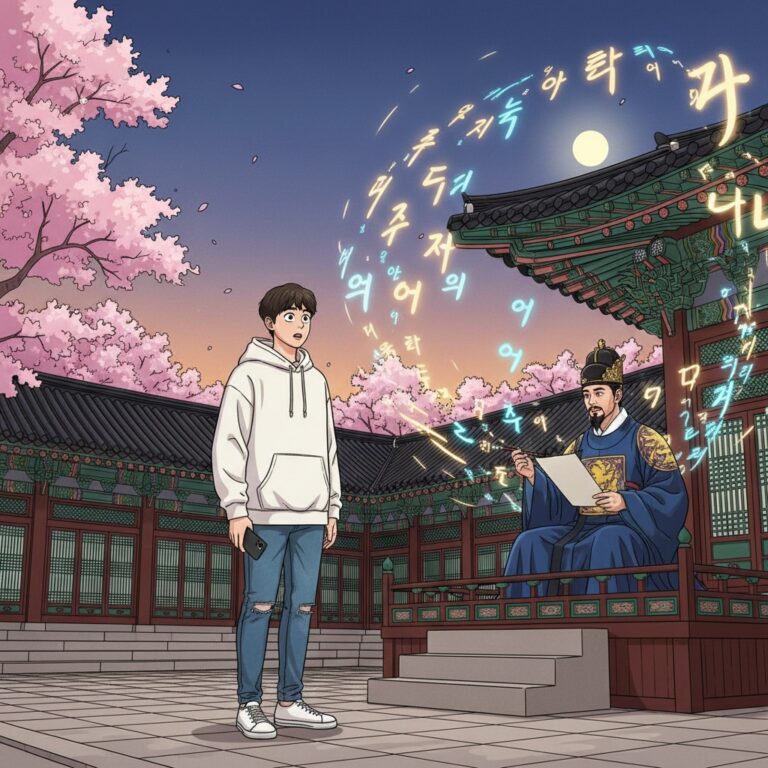
Time Travel in Korean: What Historical Event Would You Witness?
Hello! This is Maeil Hangeul (매일한글), here to upgrade your Korean skills!
Have you ever watched a historical K-drama and thought, “Wow, I wish I could have been there”? Lately in Korea, historical dramas (known as 사극, Sageuk) are more popular than ever, making everyone imagine what it would have been like to live in a different era. Today, we’re going to learn how to express that exact feeling! Get ready to talk about which historical events you’d love to time travel to and witness firsthand. This is a fantastic way to have deeper conversations and show your interest in Korean culture!
Key Expressions for Your Time-Traveling Imagination
Here are three essential expressions you’ll need to talk about hypothetical historical events.
1. ~을/를 목격하다 (eul/reul mokgyeokada)
- Pronunciation [Romanization]: [mo-kkyeo-ka-da]
- English Meaning: to witness (an event)
- Detailed Explanation: While
보다 (boda)simply means “to see,”목격하다 (mokgyeokada)has a stronger meaning of “to witness” a specific event or incident with your own eyes. It’s perfect for talking about significant historical moments. You use을after a noun ending in a consonant and를after a noun ending in a vowel. - 💡 Pronunciation Tip: The first syllable ‘목’ ends with a
ㄱ(k)sound, and the next syllable ‘격’ also starts withㄱ(k). When these two sounds meet, the secondㄱbecomes a strong, tense sound, almost like ‘ㄲ(kk)’. So, you pronounce it as [목껴카다, mok-kkyeo-ka-da], not [mok-gyeo-ka-da]. This process is called ‘tensing’ (경음화, gyeong-eum-hwa).
2. 만약 ~(ㄴ/는)다면 (manyag ~(n/neun)damyeon)
- Pronunciation [Romanization]: [ma-nyak ~da-myeon]
- English Meaning: If… (hypothetically)
- Detailed Explanation: This is your go-to grammar for creating hypothetical situations. “If I were a king…” or “If I could go back in time…”.
만약 (manyag)is optional but adds emphasis, making it clear you’re talking about something unreal.- Use ~ㄴ/는다면 with action verbs. (e.g., 간다면 – if I go)
- Use ~(이)라면 with nouns. (e.g., 왕이라면 – if I were a king)
- 💡 Pronunciation Tip: The word
만약is written asman-yak, but theㄴ(n)sound influences the followingㅇ(y)sound, making it sound like [마냑, ma-nyak]. This is a common nasal assimilation rule that makes your pronunciation sound much more natural.
3. ~았/었을 텐데 (~ass/eoss-eul tende)
- Pronunciation [Romanization]: [a-sseul / eo-sseul ten-de]
- English Meaning: would have been… / should have been…
- Detailed Explanation: This expression is perfect for looking back on a hypothetical past. It conveys a sense of wonder, imagination, or sometimes slight regret about something that didn’t happen. It’s the perfect way to finish your thought after using
~(ㄴ/는)다면. - 💡 Pronunciation Tip: The final consonant of
었links to the next vowel을. So,었을is not pronouncedeot-eul, but smoothly as [었을, eosseul]. This is a fundamental linking rule (연음, yeoneum) in Korean that you should master!
Example Dialogue
Let’s see how these expressions work in a real conversation about a popular historical figure!
A: 요즘 한국 역사에 관심이 많아졌어요. 만약 조선 시대로 돌아갈 수있다면 뭘 하고 싶어요?
(Y즘 han-guk yeoksa-e gwansim-i manajyeosseoyo. Manyag Joseon sidaero doragal su itdamyeon mwol hago sipeoyo?)
I’ve become really interested in Korean history lately. If you could go back to the Joseon Dynasty, what would you want to do?
B: 음… 저는 세종대왕이 한글을 만드는 과정을 목격하고 싶어요. 정말 감동적이었을 텐데!
(Eum… jeoneun Sejongdaewang-i Hangeul-eul mandeuneun gwajeong-eul mokgyeokago sipeoyo. Jeongmal gamdongjeogieosseul tende!)
Hmm… I’d want to witness the process of King Sejong creating Hangeul. It would have been so moving!
A: 와, 좋은 생각이에요! 저도 그 순간을 봤다면 정말 신기했을 거예요.
(Wa, joeun saenggagieyo! Jeodo geu sungan-eul bwatdamyeon jeongmal singihaesseul geoyeyo.)
Wow, that’s a great idea! If I had seen that moment, I would have been amazed too.
Culture Tip: The Power of “Sageuk” (사극)
Why are historical dramas, or 사극 (Sageuk), so popular in Korea?
Koreans have immense pride in their long and rich history. Dramas often feature revered national heroes like King Sejong the Great (세종대왕), who created the Korean alphabet, or Admiral Yi Sun-sin (이순신 장군), a legendary naval commander.
These stories aren’t just entertainment; they are a way for modern Koreans to connect with their national identity and values. So, when you use today’s phrases to talk about wanting to witness the creation of Hangeul or see Admiral Yi’s famous turtle ships, you’re not just practicing Korean—you’re connecting with the heart of Korean culture. Mentioning this in a conversation will surely impress your Korean friends!
Wrap-up & Practice Time!
Great job today! You’ve learned how to time travel with your words. Let’s quickly review:
- 목격하다: To witness a significant event.
- 만약 ~(ㄴ/는)다면: To say “If…” hypothetically.
- ~았/었을 텐데: To say something “would have been…”
Now, let’s test your knowledge!
1. Fill in the blank:
만약 제가 15세기에 살았다면, 거북선이 싸우는 것을 ___________ 싶었을 거예요.
(If I had lived in the 15th century, I would have wanted to ___________ the turtle ships fight.)
Hint: Use the “witness” verb.
2. Make your own sentence!
Using 만약 ~(ㄴ/는)다면 and ~았/었을 텐데, create a sentence about a historical event (from any country!) you would have liked to see.
Now it’s your turn! Leave a comment below using the expressions you learned today. 만약 당신이 한국의 역사적 사건 하나를 목격할 수 있다면, 무엇을 보고 싶어요? (If you could witness one historical event in Korea, what would you want to see?)
We can’t wait to read your amazing answers
Frequently Asked Questions (FAQ)
Q: What does "사극" mean in Korean and how do you pronounce it?
A: In Korean, "사극" is pronounced [Sageuk] and means: , so popular in Korea?
Q: What does "만약 당신이 한국의 역사적 사건 하나를 목격할 수 있다면, 무엇을 보고 싶어요?" mean in Korean and how do you pronounce it?
A: In Korean, "만약 당신이 한국의 역사적 사건 하나를 목격할 수 있다면, 무엇을 보고 싶어요?" is pronounced [If you could witness one historical event in Korea, what would you want to see?] and means: We can't wait to read your amazing answers







