

학습 블로그 내용
Ride Like a Local: Asking Bus Directions!
Introduction
Hello! This is [Daily Hangul], here to upgrade your Korean skills to the next level! 👋
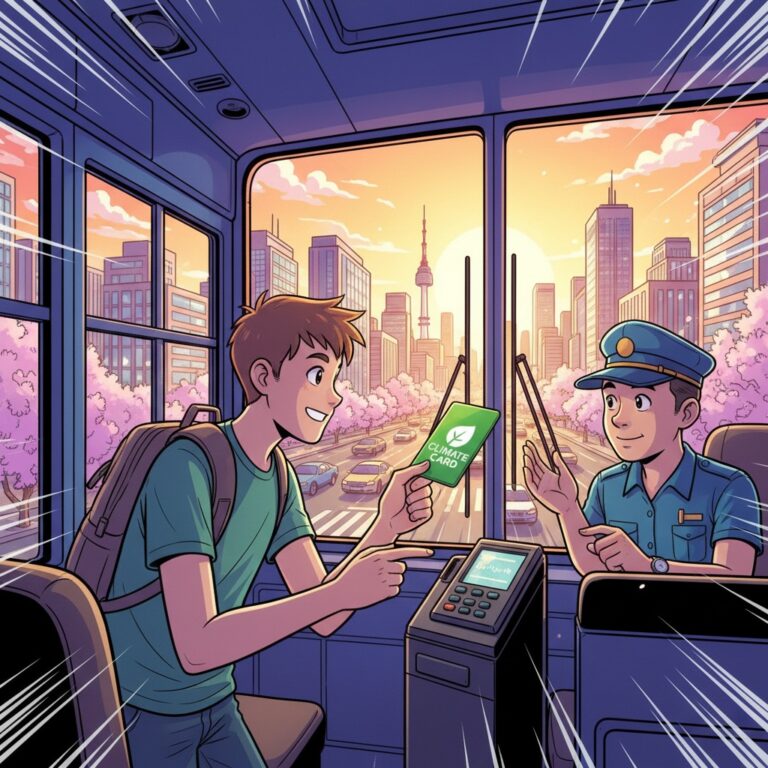
Today, we are going to learn how to check the destination with a bus driver.
Have you heard about the “Climate Card” (Gi-hu Dong-haeng Card) that recently became a huge trend in Seoul? It’s an unlimited transit pass that many locals and tourists are using right now! With more people taking buses to visit hot spots like Seongsu-dong or Hongdae, knowing how to ask the driver about the route is essential.
Korean buses are famous for being fast and efficient, but that sometimes means they stop very briefly. You need to ask your question quickly and accurately before boarding. Don’t worry! I’ll teach you exactly what to say so you can hop on with confidence! 🚌💨
Key Expressions
Here are the 3 most useful expressions you need when talking to a bus driver.
1. 기사님, 이 버스 [Place] 가요?
- Pronunciation: [Gisanim, i beoseu [Place] gayo?]
- English Meaning: Driver, does this bus go to [Place]?
- Detailed Explanation:
- Instead of calling the driver “Ajusshi” (Mister), it is much more polite and respectful to use “Gisa-nim” (Driver/Captain).
- Simply put your destination in the bracket. Example: “Hongdae gayo?” (Does it go to Hongdae?)
- 💡 Pronunciation Tip:
- Let’s look at ‘가요 (gayo)’. When ‘ㄱ (g)’ appears at the beginning of a word, it sounds slightly harder, almost like a soft ‘k’.
- However, the most important part is the intonation. Since it is a question, you must raise your pitch at the end: “Gayo↗?” If you lower it, it sounds like a statement (“I am going”).
2. [Place] 지나가요?
- Pronunciation: [[Place] jinagayo?]
- English Meaning: Does it pass by [Place]?
- Detailed Explanation:
- Use this when you aren’t sure if the bus stops exactly at a specific spot, but you want to know if it goes through that neighborhood or passes near a landmark.
- It is a very natural way to ask for directions without needing to know the exact bus stop name.
- 💡 Pronunciation Tip:
- ‘지나요 (jinayo)’ vs ‘지나가요 (jinagayo)’: Both are okay, but ‘jinagayo’ is more common in spoken Korean.
- Pronounce ‘ji’ clearly like the ‘jee’ in ‘jeep’. The ‘g’ in the middle is very soft.
3. [Place] 가면 알려 주세요.
- Pronunciation: [[Place] gamyeon allyeo juseyo.]
- English Meaning: Please let me know when we get to [Place].
- Detailed Explanation:
- This is a B1 level phrase! If you are worried about missing your stop, you can ask the driver for help.
- “Gamyeon” means “if/when we go,” and “Allyeo juseyo” means “please inform me.”
- 💡 Pronunciation Tip (Liaison):
- Look at ‘알려 (allyeo)’. Because of the double ‘ㄹ (ll)’, you must hold your tongue against the roof of your mouth a bit longer. It sounds like the ‘l’ in “yellow.”
- Look at ‘이 버스 (i beoseu)’ vs ‘입어서 (ibeoseo – to wear)’. Be careful not to connect the sounds too much here. Pause slightly after ‘i’.
Real-Life Dialogue
Let’s see how these expressions are used in real life.
(Context: A is a tourist trying to visit a trendy cafe in Seongsu-dong, and B is the busy bus driver.)
A: 안녕하세요! 기사님, 이 버스 성수동 가요?
(Hello! Driver, does this bus go to Seongsu-dong?)B: 네, 가요. 빨리 타세요!
(Yes, it does. Please get on quickly!)A: 혹시 서울숲도 지나가요?
(By any chance, does it pass by Seoul Forest too?)B: 네, 지나갑니다. 카드 찍어 주세요.
(Yes, it passes by. Please tap your card.)A: 네, 감사합니다!
(Okay, thank you!)
Culture Tip & Trend Analysis 🇰🇷
“Prepare your card BEFORE the bus stops!”
In Korea, the “Ppalli-ppalli” (Hurry-hurry) culture is very strong, especially during commute hours.
1. Mobile Maps are Essential: Young Koreans (MZ Generation) rarely ask drivers for directions anymore because apps like Naver Map or KakaoMap are so accurate. They show exactly when the bus arrives.
2. Boarding Etiquette: However, if you do need to ask, have your T-money card or Climate Card in your hand before you ask. Drivers appreciate it when you ask quickly and tap your card immediately so the bus can move.
3. Getting Off: Don’t forget to press the stop button (red button) before the bus reaches the station, and stand near the door (safely!) as it slows down.
Wrap-up & Practice
Today, we learned how to confirm your destination with a bus driver using polite Korean. Remember, a confident “Gisa-nim!” is the best way to start the conversation.
📝 Mini Quiz:
Fill in the blank to complete the sentence!
“Driver, does this bus go to Gangnam?”
Korean: __________, 이 버스 강남 가요?
- 아저씨 (Ajusshi)
- 기사님 (Gisa-nim)
Answer: (Check the comment section for the answer!)
If you plan to visit Korea, where is the first place you want to go by bus? Leave a comment below using today’s expression! (e.g., “기사님, 이 버스 [Myeongdong] 가요?”)
See you in the next lesson! Annyeong! 👋







