

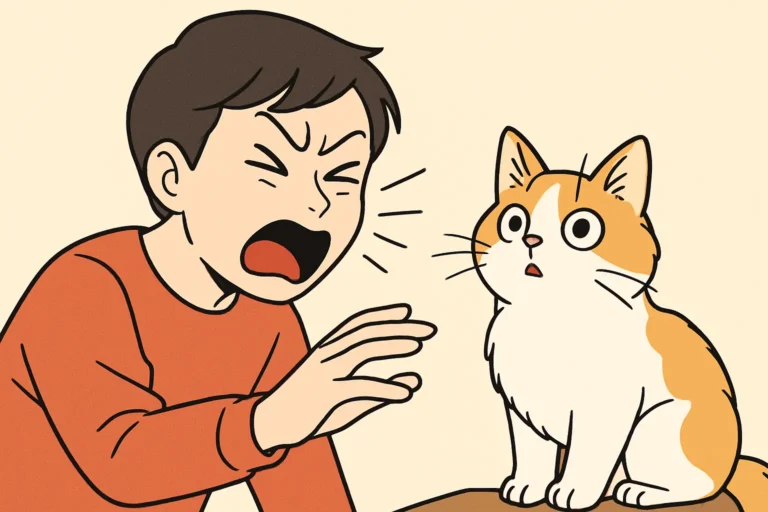
Achoo! How to Talk About Pet Allergies in Korean
Hello! It’s your favorite Korean guide, [Everyday Hangul], here to upgrade your language skills!
Do you love animals but start sneezing the moment a furry friend comes near? You’re not alone! These days in Korea, having a pet is more popular than ever, with millions of people sharing their homes with adorable dogs and cats. This means you’re more likely to visit a friend who has a pet. So, what do you do if your nose starts tingling? Today, we’ll learn how to talk about pet allergies politely and naturally in Korean. Let’s get started!
Core Expressions You Need to Know
Here are some essential phrases to help you navigate conversations about pet allergies.
1. 알레르기 있어요 (Allereugi isseoyo)
- Korean Expression: 저 강아지/고양이 알레르기 있어요.
- Pronunciation [Romanization]: Jeo gangaji/goyangi allereugi isseoyo.
- English Meaning: I have a dog/cat allergy.
- Detailed Explanation: This is the most direct and common way to state that you have an allergy. The structure is simple:
(Allergy Source) + 알레르기 있어요. You can replace ‘강아지’ (dog) or ‘고양이’ (cat) with anything else, like ‘땅콩’ (ttangkong, peanut). It’s a polite expression suitable for any situation. - 💡 Pronunciation Tip:
Listen closely to 알레르기가 [allereugiga]. In Korean, when a syllable ends with a consonant and the next syllable starts with a vowel (like 가), the consonant sound “links” or moves over to the next syllable. So, instead of a choppy “alle-reu-gi-ga”, it flows smoothly as [al-le-reu-gi-ga]. This is called 연음 (yeon-eum) or linking rule, and it makes your Korean sound much more natural!
2. 콧물이 나요 / 재채기가 나요 (Konmuri nayo / Jaechaegi-ga nayo)
- Korean Expression: 갑자기 콧물이 나요. (Gapjagi konmuri nayo.)
- Pronunciation [Romanization]: Gapjagi konmuri nayo.
- English Meaning: My nose is suddenly running.
- Detailed Explanation: This phrase uses the verb
나다 (nada), which means “to come out” or “to occur.” It’s perfect for describing symptoms that appear suddenly. You can use it for a runny nose (콧물), a sneeze (재채기), or even a cough (기침, gichim). - 💡 Pronunciation Tip:
The word 콧물 (kot-mul) is not pronounced as it’s spelled! It’s pronounced [콘물/konmul]. Why? When the consonant ‘ㅌ’ (t) is followed by a nasal sound like ‘ㅁ’ (m), the ‘ㅌ’ sound changes to an ‘ㄴ’ (n) sound to make it easier to say. This rule is called 비음화 (bi-eum-hwa), or nasalization. It’s a super common rule you’ll see everywhere!
3. 괜찮아요? (Gwaenchanayo?)
- Korean Expression: 괜찮아요? 약 필요해요?
- Pronunciation [Romanization]: Gwaenchanayo? Yak pillyohaeyo?
- English Meaning: Are you okay? Do you need medicine?
- Detailed Explanation: This is one of the most important phrases in Korean for showing concern. If you see someone sneezing or looking unwell, asking “괜찮아요?” is a kind and natural way to check on them. It can mean “Are you okay?”, “Is it okay?”, or “I’m okay,” depending on the context.
- 💡 Pronunciation Tip:
In the word 괜찮아요 (gwaen-chan-a-yo), the ‘ㅎ’ (h) sound is almost silent. It’s pronounced [괜차나요/gwaenchanayo]. When ‘ㅎ’ follows a consonant like ‘ㄴ’, it often weakens and disappears, making the pronunciation smoother. So, don’t try to force out the “h” sound; let it flow naturally!
Example Conversation
Let’s see these expressions in action! Imagine you (B) are visiting your friend Minjun (A), who just got a new kitten.
- A (민준): 어서 와! 우리 집 새로 온 식구, 나비야. 귀엽지?
- Eoseo wa! Uri jip saero on sikgu, Nabi-ya. Gwiyeopji?
- (Welcome! This is Nabi, the new member of our family. Isn’t she cute?)
- B (You): 와, 정말 귀엽다! 만져도 돼? …에취! 어, 자꾸 재채기가 나네.
- Wa, jeongmal gwiyeopda! Manjyeodo dwae? …Echwi! Eo, jakku jaechaegi-ga nane.
- (Wow, so cute! Can I pet her? …Achoo! Oh, I keep sneezing.)
- A (민준): 어머, 괜찮아? 혹시 고양이 알레르기 있어?
- Eomeo, gwaenchana? Hoksi goyangi allereugi isseo?
- (Oh my, are you okay? Do you happen to have a cat allergy?)
- B (You): 응, 나 고양이 알레르기 조금 있어. 약 먹으면 괜찮아! 나비는 정말 예쁘다.
- Eung, na goyangi allereugi jogeum isseo. Yak meogeumyeon gwaenchana! Nabi-neun jeongmal yeppeuda.
- (Yeah, I have a slight cat allergy. I’ll be fine if I take some medicine! Nabi is really pretty, though.)
Culture Tip & Trend Deep Dive
Korea is currently in its “반려동물 천만 시대” (The era of 10 million companion animals). This means pets are considered true family members. You’ll see pet strollers (called 개모차, gaemocha – a portmanteau of ‘dog’ and ‘stroller’), pet-friendly cafes, and even high-end pet fashion.
Because of this, knowing pet etiquette is more important than ever. Even if you don’t have allergies, it’s considered very polite to ask “만져도 돼요?” (manjyeodo dwaeyo? – “Can I pet it?”) before touching someone’s animal.
When you explain your allergies using phrases like “알레르기 있어요,” Koreans will be very understanding. They see it as you being considerate of both your health and their beloved pet. It shows respect for their “family member”!
Let’s Review & Practice!
Great job today! You’ve learned how to talk about your pet allergies, describe your symptoms, and show concern for others in Korean.
Now, let’s test your knowledge!
- Fill in the Blank: How would you say, “I have a dog allergy”?
저는 ______ 알레르기 있어요.
- Challenge: Your friend starts sneezing around your new puppy. What can you ask them to show you’re concerned?
Let us know your answers in the comments below! Try making your own sentence using today’s phrases. Keep practicing, and you’ll be a pro in no time
Frequently Asked Questions (FAQ)
Q: What does "알레르기가" mean in Korean and how do you pronounce it?
A: In Korean, "알레르기가" is pronounced [allereugiga] and means: . In Korean, when a syllable ends with a consonant and the next syllable starts with a vowel (like 가), the consonant sound "links" or moves over to the next syllable. So, instead of a choppy "alle-reu-gi-ga", it flows smoothly as
Q: What does "연음" mean in Korean and how do you pronounce it?
A: In Korean, "연음" is pronounced [yeon-eum] and means: or linking rule, and it makes your Korean sound much more natural!
Q: What does "콧물" mean in Korean and how do you pronounce it?
A: In Korean, "콧물" is pronounced [kot-mul] and means: is not pronounced as it's spelled! It's pronounced
Q: What does "비음화" mean in Korean and how do you pronounce it?
A: In Korean, "비음화" is pronounced [bi-eum-hwa] and means: , or nasalization. It’s a super common rule you’ll see everywhere!







