

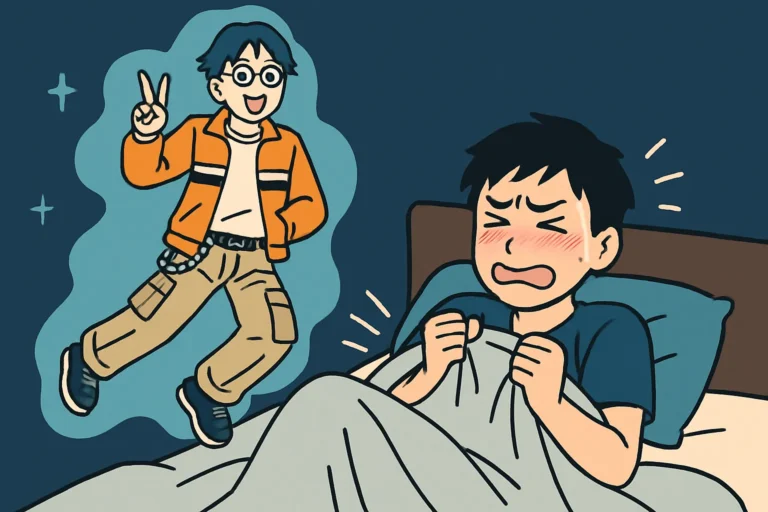
My K-Fashion Fails: How to Talk About Your Cringey Past!
Hello! Welcome to [Maeil Hangul], here to upgrade your Korean skills!
Have you ever looked at an old photo of yourself and thought, “What was I thinking?” We all have those moments! Today, we’re going to learn how to talk about our past fashion mistakes in Korean. This is super useful when you’re sharing old stories with friends.
Lately in Korea, Y2K fashion from the late 90s and early 2000s is making a huge comeback! But while everyone loves the retro vibe, they also love to laugh about the “fashion terrorism” (패션 테러) from that era. Let’s learn some fun expressions to join the conversation!
Core Expressions You Need to Know
Here are some essential words and phrases to talk about your cringey but lovable fashion past.
1. 흑역사 (Heugyeoksa)
- Pronunciation [Romanization]: Heugyeoksa
- English Meaning: Dark history / an embarrassing past you want to erase
- Detailed Explanation: This is a fantastic slang word! It literally means “black history.” It refers to any moment from your past that is so embarrassing you wish it never happened—especially bad hair and fashion choices captured in old photos! It’s a very common and funny word used among friends.
- 💡 Pronunciation Tip:
The final consonant ‘ㄱ(k)’ in ‘흑’ and the first syllable ‘역’ in ‘역사’ blend together. This causes the ‘ㅅ(s)’ sound in ‘사’ to become tense, like ‘싸(ssa)’. So, instead of saying heuk-yeok-sa, a more natural pronunciation sounds like [흐격싸/heugyeokssa].
2. 촌스럽다 (Chonseureopda)
- Pronunciation [Romanization]: Chonseureopda
- English Meaning: To be unfashionable, tacky, countrified
- Detailed Explanation: The word ‘촌’ (chon) means ‘countryside’ or ‘village’. So, ‘촌스럽다’ describes something that is out of style, unsophisticated, or looks like it came from the countryside (in a non-stylish way). You can use it to describe an old outfit, a hairstyle, or even an old-fashioned way of thinking.
- 💡 Pronunciation Tip:
The final consonant ‘ㅂ(b)’ in ‘스럽’ is followed by ‘ㄷ(d)’. This makes the ‘ㄷ’ sound tense, like ‘ㄸ(dd)’. So, you pronounce the ending not as seureop-da, but as [쓰럽따/sseureoptta]. The whole word flows like [촌쓰럽따/chon-sseu-reop-tta].
3. 이불킥 (Ibul-kik)
- Pronunciation [Romanization]: Ibul-kik
- English Meaning: Blanket kick (the act of kicking your blanket in embarrassment)
- Detailed Explanation: This is an action, not just a word! ‘이불’ (ibul) means ‘blanket’ and ‘킥’ (kik) means ‘kick’. ‘이불킥 하다’ (ibul-kik hada) describes the moment you’re lying in bed, suddenly remember something super embarrassing from your past (like that bright neon tracksuit you used to love), and you physically kick your blankets in regret. It perfectly captures that feeling of cringing at your past self!
- 💡 Pronunciation Tip:
This one is quite straightforward! Pronounce ‘이불’ [ibul] and ‘킥’ [kik] clearly. The ‘ㄱ(k)’ at the end of ‘킥’ is an unaspirated, stopped sound. Don’t add an extra “uh” sound at the end.
4. -곤 했다 (-gon haetda)
- Pronunciation [Romanization]: -gon haetda
- English Meaning: Used to (do something)
- Detailed Explanation: This is a grammar pattern you attach to a verb stem to talk about something you habitually did in the past but don’t do anymore. It’s perfect for talking about your old style! For example, “입다” (to wear) becomes “입곤 했다” (ipgon haetda), meaning “I used to wear…”
- 💡 Pronunciation Tip:
When you attach ‘-곤 했다’ to a verb stem, the sounds link smoothly. For example, in ‘입곤 했다’ [ip-gon-haet-da], the sounds flow together naturally without a strong pause.
Example Conversation
Let’s see how these expressions work in a real conversation. Two friends, A and B, are looking at an old photo album.
A: 와, 이 사진 좀 봐! 나 이때 정말 큰 힙합 바지를 입곤 했어.
(Wa, i sajin jom bwa! Na ittae jeongmal keun hipap bajireul ipgon haesseo.)
Wow, look at this picture! I used to wear really big hip-hop pants back then.
B: 하하, 완전 흑역사네! 지금 보니까 진짜 촌스럽다.
(Haha, wanjeon heugyeoksane! Jigeum bonikka jinjja chonseureopda.)
Haha, that’s total dark history! Looking at it now, it’s so tacky.
A: 맞아. 가끔 자기 전에 이 사진 생각나서 이불킥 해.
(Maja. Gakkeum jagi jeone i sajin saenggangnaseo ibul-kik hae.)
I know. Sometimes I remember this photo before bed and do an “embarrassment blanket kick.”
B: 괜찮아. 그때는 그게 유행이었잖아! 다들 그랬어.
(Gwaenchana. Geuttaeneun geuge yuhaengieotjana! Dadeul geuraesseo.)
It’s okay. That was the trend back then! Everyone was like that.
Culture Tip & Trend Deep Dive
In Korea, sharing your 흑역사 (heugyeoksa) is a way of bonding and having a good laugh with friends. It shows you don’t take yourself too seriously!
You’ll often see K-pop idols’ pre-debut photos being shared by fans as their cute ‘흑역사’. It’s a term of endearment, showing how much they’ve grown and changed.
The recent Y2K trend, which Koreans sometimes call ‘세기말 패션’ (segimal paesyeon – “end-of-the-century fashion”), is a perfect example of this. Young Koreans on Instagram and TikTok are now taking styles that were once considered 촌스럽다 (chonseureopda)—like low-rise jeans, cargo pants, and colorful hair clips—and making them cool again. So, if you use these expressions, you’ll sound not only fluent but also totally up-to-date with Korean trends!
Let’s Review & Practice!
Great job today! We learned how to talk about our past fashion blunders using four key expressions:
* 흑역사: Your embarrassing past
* 촌스럽다: To be tacky or unfashionable
* 이불킥: Kicking your blanket in embarrassment
* -곤 했다: Used to…
Now, let’s test your knowledge!
Quick Quiz: Fill in the blank!
My high school graduation photo is so embarrassing. I had such strange hair! It’s my real _______.
1. 이불킥 (ibul-kik)
2. 흑역사 (heugyeoksa)
3. 유행 (yuhaeng – trend)
What was a fashion item you used to wear (-곤 했다)? Share your own fashion 흑역사 in the comments below! We’d love to laugh with you
Frequently Asked Questions (FAQ)
Q: What does "흑역사" mean in Korean and how do you pronounce it?
A: In Korean, "흑역사" is pronounced [heugyeoksa] and means: is a way of bonding and having a good laugh with friends. It shows you don't take yourself too seriously!
Q: What does "'세기말 패션'" mean in Korean and how do you pronounce it?
A: In Korean, "'세기말 패션'" is pronounced [segimal paesyeon - "end-of-the-century fashion"] and means: , is a perfect example of this. Young Koreans on Instagram and TikTok are now taking styles that were once considered
Q: What does "촌스럽다" mean in Korean and how do you pronounce it?
A: In Korean, "촌스럽다" is pronounced [chonseureopda] and means: —like low-rise jeans, cargo pants, and colorful hair clips—and making them cool again. So, if you use these expressions, you'll sound not only fluent but also totally up-to-date with Korean trends!







