

Hello! It’s your favorite Korean upgrade kit, Maeil Hangeul, here to level up your skills!
Have you ever met a friend’s family member and thought, “Wow, you look exactly alike!”? Or maybe you’ve been watching a K-drama and noticed how much the child actor resembles the main star? Today, we’re going to learn how to express this in natural, fluent Korean.
Lately in Korea, the new hit drama “My Second Seoul” is all the rage! The story is about long-lost siblings who find each other, and everyone online is talking about how the actors are perfectly cast because they look so similar. Let’s learn the exact phrases Koreans are using so you can join the conversation!
Core Expressions You Need to Know
Here are three essential ways to talk about resemblance, from the basic to the super native-sounding!
1. 닮다 (damda) – To Resemble / Look Like
This is the standard and most important verb you need to know. You can use it for family, friends, or even celebrities! It’s used with the particle -를/을.
- Korean Expression: 엄마를 닮았어요.
- Pronunciation [Romanized]: Eommareul dalmasseoyo.
- English Meaning: I look like my mom.
- Detailed Explanation: This is a versatile and polite expression you can use in almost any situation. You simply attach the particle
-를/을to the person you resemble and then use the verb닮다. - 💡 Pronunciation Tip:
The final two letters of닮았어요areㅆand어. In Korean, when a consonant at the end of a block is followed by a vowel, the consonant sound often moves over to the next syllable. So,닮았어요is not pronounceddalm-at-eo-yo, but smoothly as [dal-ma-sseo-yo]. This rule is called 연음 (yeon-eum), or liaison, and it makes your Korean sound much more natural!
2. 붕어빵이다 (bungeoppang-ida) – To Be Two Peas in a Pod
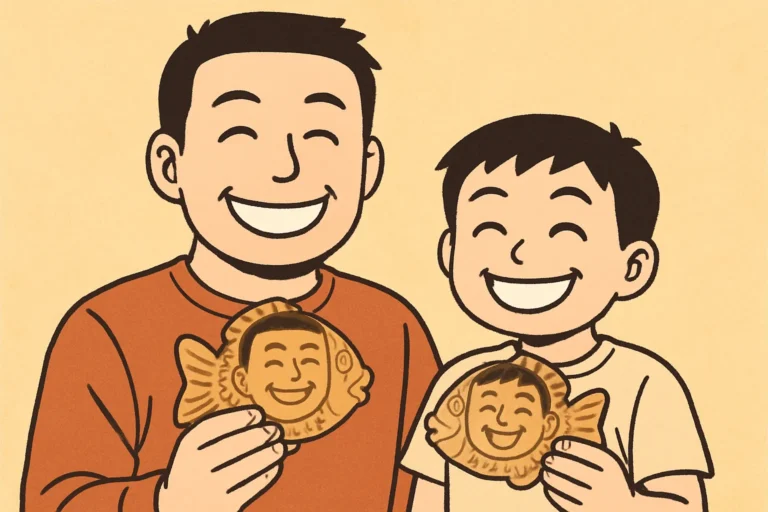
This is a fun, informal, and very common idiom! 붕어빵 is a famous Korean fish-shaped pastry. Since they are all made from the same mold, they look identical!
- Korean Expression: 아빠랑 아들은 완전 붕어빵이네!
- Pronunciation [Romanized]: Apparang adeureun wanjeon bungeoppang-ine!
- English Meaning: The dad and son are total doppelgangers! (Literally: are a complete fish-shaped pastry!)
- Detailed Explanation: Use this idiom with close friends and family to say two people look exactly the same. It has a very cute and positive nuance. It’s the perfect compliment for a parent and their child.
- 💡 Pronunciation Tip:
Notice the빵(ppang) at the end. Theㅃ(ssangbieup) is a “tensed” consonant. It’s not a soft ‘b’ or an airy ‘p’. To make this sound, make a ‘b’ sound but tighten your lips and push the sound out without any puff of air. It’s a short, strong sound: [ppang], not “bang.”
3. 판박이다 (panbag-ida) – To Be a Carbon Copy
This is another fantastic idiom that means someone is a “spitting image” of someone else. 판박이 originally means something made from a mold or a print, like a photograph.
- Korean Expression: 너는 아빠 판박이야.
- Pronunciation [Romanized]: Neoneun appa panbag-iya.
- English Meaning: You’re a carbon copy of your dad.
- Detailed Explanation: This is very similar to
붕어빵이다and is used informally among people you know well. It strongly emphasizes that the resemblance is uncanny and exact. - 💡 Pronunciation Tip:
Let’s look at판박이. The middle syllable is박(bak). When the consonantㄱ(g/k) is sandwiched between two vowels (like the ‘a’ in판and the ‘i’ in이), its sound softens from a ‘k’ to a ‘g’. So, instead of a harsh “pan-bak-i,” it flows more smoothly as [pan-ba-gi].
Example Dialogue
Let’s see how these expressions are used in a real conversation. Two friends, A and B, are looking at a family photo.
A: 이 사진 누구야? 혹시 네 남동생?
(I sajin nugu-ya? Hoksi ne namdongsaeng?)
Who’s this in the photo? Is it your younger brother?
B: 응, 맞아. 작년에 찍은 사진이야.
(Eung, maja. Jangnyeone jjigeun sajin-iya.)
Yeah, that’s him. It’s a picture from last year.
A: 와, 너랑 완전 붕어빵이다! 웃는 모습이 똑같아!
(Wa, neorang wanjeon bungeoppang-ida! Unneun moseubi ttokgata!)
Wow, you guys are two peas in a pod! Your smiles are identical!
B: 그런가? 사람들은 아빠를 더 닮았다고 하던데.
(Geureonga? Saramdeureun appareul deo dalmattago hadeonde.)
You think so? People usually say I look more like my dad.
Culture Tip & Trend Deep Dive
In Korea, talking about family resemblance is a very common and friendly topic of conversation. It’s considered a way of building connection and showing interest.
You’ll hear these expressions everywhere, especially now with the drama “My Second Seoul.” Fans on social media are constantly posting side-by-side pictures of the actors with captions like “둘이 완전 판박이네!” (You two are total carbon copies!).
Here’s a pro-tip: If you meet a Korean friend’s baby or see a family photo, a great way to give a compliment is to say, “아기를 보니까 아빠/엄마를 쏙 닮았어요!” (Seeing the baby, he/she completely resembles his/her dad/mom!). They will be delighted! Using an idiom like 붕어빵 will earn you bonus points for sounding like a local!
Let’s Review and Practice!
Great job today! We learned three awesome ways to say someone looks like another person: the standard verb 닮다, and the fun idioms 붕어빵이다 and 판박이다.
Now, let’s test your knowledge!
- Fill in the blank:
My friend and her older sister look exactly the same. They are total doppelgangers!
친구랑 언니는 완전 ___________이에요. -
Make a sentence:
Using the verb닮다, how would you say, “I want to look like my father”? (Hint: “want to” is-고 싶어요).
Don’t be shy! Who do you look like in your family? Try to answer in the comments below using one of today’s expressions. We’d love to see you practice
Frequently Asked Questions (FAQ)
Q: What does "연음" mean in Korean and how do you pronounce it?
A: In Korean, "연음" is pronounced [yeon-eum] and means: , or liaison, and it makes your Korean sound much more natural!







