

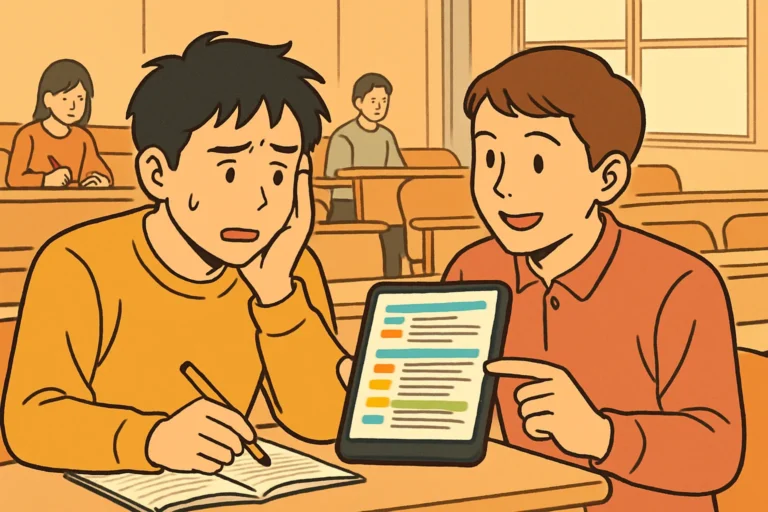
Ask for Help: Borrowing Notes 101
Introduction
Hello! This is [Maeil Hangeul], here to upgrade your Korean skills! 👋
Today, we are going to learn a very essential survival skill for anyone studying or working in Korea: Asking for help with class notes!
Have you ever missed a class because you were sick or had an urgent matter? Or maybe you attended, but the professor spoke too fast? In Korea, exam season (시험 기간) is a very intense time, and having good notes is crucial.
Recently, the trend of “Gong-sta-gram” (Study + Instagram) has taken over, where students share beautiful photos of their notes. Because of this, sharing and borrowing notes has become a part of the culture! But how do you ask politely without sounding rude?
Let’s learn how to ask a friend for their notes naturally and politely! 📚✨
Key Expressions
Here are 3 essential expressions to help you secure those notes!
1. 필기 좀 보여 줄 수 있어?
- Pronunciation: [Pilgi jom boyeo jul su isseo?]
- English Meaning: Can you show me your notes?
- Detailed Explanation:
- ‘필기 (Pilgi)’ means “notes” or “writing.”
- ‘좀 (Jom)’ is short for “a little,” but here it acts as a softener to make the request more polite (like “please” or “could you”).
- This is a casual expression used with friends or classmates of the same age.
- 💡 Pronunciation Tip:
- Linking Sound (Liaison): When you say ‘있어’, don’t say it as [it-eo]. The bottom consonant ‘ㅆ (ss)’ moves over to the empty circle ‘ㅇ’. So, it sounds like [i-sseo].
- Try it smoothly: Boyeo jul su i-sseo?
2. 지난 수업에 못 갔어.
- Pronunciation: [Jinan sueobe mot gasseo.]
- English Meaning: I couldn’t go to the last class.
- Detailed Explanation:
- Before asking for a favor, it is polite to explain why you need help.
- ‘못 (Mot)’ means “cannot.” It expresses that you wanted to go, but couldn’t due to external reasons.
- 💡 Pronunciation Tip:
- Nasalization: When ‘못 (mot)’ is followed by ‘갔어 (gasseo)’, the ‘t’ sound changes to fit the ‘g’ sound for easier flow. It often sounds like [mok-kasseo].
- Also, ‘수업에’ connects smoothly as [su-eo-be].
3. 내가 밥 살게!
- Pronunciation: [Naega bap salge!]
- English Meaning: I’ll buy you a meal! (I’ll treat you!)
- Detailed Explanation:
- In Korea, if someone does you a favor, it is very common to offer food or coffee in return. It shows your gratitude and strengthens the friendship.
- If a full meal is too much, you can say “커피 살게” (I’ll buy you coffee).
- 💡 Pronunciation Tip:
- Tensification: Even though it is written as ‘살게 (sal-ge)’, it is pronounced as [sal-kke]. The ‘ㄹ’ sound makes the following ‘ㄱ’ sound harder and tenser.
- Say it with energy: Bap sal-kke!
Example Dialogue
Let’s see how these expressions work in a real conversation between two university friends, Minji and Jason.
Jason: 민지야, 혹시 필기 좀 보여 줄 수 있어?
(Minji, can you show me your notes by any chance?)Minji: 응? 무슨 일 있어?
(Huh? Is something wrong?)Jason: 몸이 안 좋아서 지난 수업에 못 갔어.
(I wasn’t feeling well, so I couldn’t go to the last class.)Minji: 아, 그랬구나. 알겠어! 태블릿으로 파일 보내 줄게.
(Ah, I see. Okay! I’ll send you the file via tablet.)Jason: 정말 고마워! 내가 나중에 밥 살게!
(Thank you so much! I’ll buy you a meal later!)
Culture Tip & Trend Analysis 📱
“Do you have AirDrop?”
As mentioned in the intro, digital note-taking is a huge trend in Korea right now!
Most Korean university students use tablets (iPads or Galaxy Tabs) instead of paper notebooks.
- The Old Way: Photocopying a friend’s notebook at the library.
- The Trendy Way: Asking, “에어드롭으로 보내 줄 수 있어?” (Can you send it via AirDrop?) or using Quick Share.
If you see a friend using a tablet, asking for a digital file is actually much easier for them than lending a physical notebook. It’s a “win-win” situation! Also, using the phrase “밥 살게” (I’ll treat you) is the magic word that makes Korean friends happy to help you anytime. 🍚❤️
Wrap-up & Quiz
Today, we learned how to ask for class notes and show gratitude in Korean. Remember, explaining why you need help and offering a small treat makes the request perfect!
📝 Mini Quiz
Fill in the blank to complete the sentence below!
“Thank you for the notes! I’ll buy you coffee!”
“고마워! 내가 커피 ____!”
- 갈게 (galge)
- 살게 (salge)
Leave your answer in the comments below! 👇
Don’t be afraid to ask for help. See you in the next post!
Frequently Asked Questions (FAQ)
Q: What does ""밥 살게"" mean in Korean and how do you pronounce it?
A: In Korean, ""밥 살게"" is pronounced [I'll treat you] and means: is the magic word that makes Korean friends happy to help you anytime. 🍚❤️







