

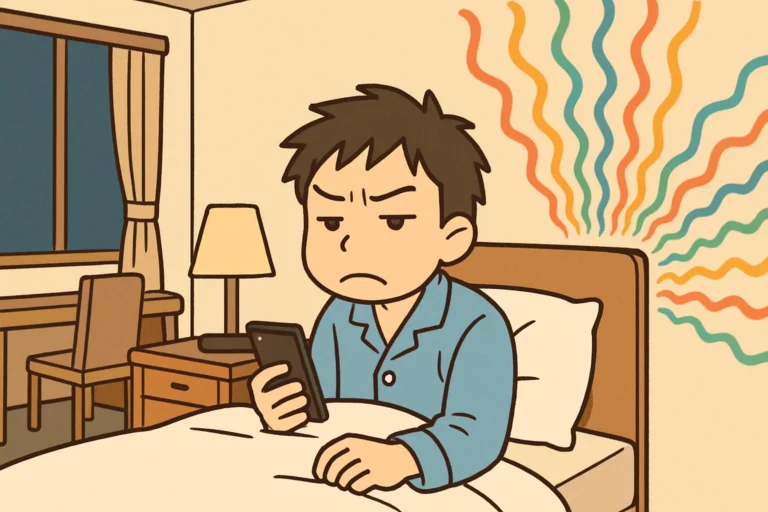
Hocance Ruined by Noise? Say This!
Hello! This is [Daily Korean], here to upgrade your Korean skills! 👋
Are you planning a trip to Korea soon? Lately, “Hocance” (Hotel + Vacance) is a huge trend in Korea. Many people book nice hotels just to relax, watch Netflix, and enjoy good food in their rooms.
But imagine this: You are trying to enjoy your perfect Hocance, but the people in the next room are having a loud party! 😱 In this situation, you need to call the front desk. Today, we will learn how to politely but firmly complain about noise so you can get your peaceful rest back.
Let’s learn the essential expressions to save your sleep!
🔑 Key Expressions
Here are 3 key phrases you can use when calling the front desk.
1. 옆방 (Yeopbang)
- Pronunciation: [Yeop-ppang]
- English Meaning: The room next door
- Detailed Explanation: “Yeop” means “side/next” and “Bang” means “room.” You use this to identify where the noise is coming from.
- 💡 Pronunciation Tip:
- Even though it is written as ‘bang’, it is pronounced as [ppang] (stronger sound).
- This is called Tensification (Doen-sori). When the final consonant ‘ㅂ(p)’ of the first block meets the ‘ㅂ(b)’ of the next block, the second sound becomes a tense, double consonant sound like ‘pp’. So, say it firmly: Yeop-ppang!
2. 너무 시끄러워요 (Neomu sikkeureowoyo)
- Pronunciation: [Neomu sikkeureowoyo]
- English Meaning: It is too noisy.
- Detailed Explanation:
- Neomu: Too / Very
- Sikkeureowoyo: It is noisy.
- This is the most direct way to describe the problem. Adding “yo” at the end makes it polite.
- 💡 Pronunciation Tip:
- Pay attention to the ‘ㄲ (kk)’ in ‘si-kkeu-reo-wo-yo’. This is a tense sound. You shouldn’t let air out like a ‘k’ in ‘kite’. Instead, tense your throat and make a sharp, short sound like the ‘c’ in ‘sky’.
3. 확인해 주세요 (Hwagin-hae juseyo)
- Pronunciation: [Hwaginae juseyo]
- English Meaning: Please check it. / Please look into it.
- Detailed Explanation: Instead of angrily saying “Kick them out!”, Koreans often use this softer, sophisticated phrase. It asks the staff to verify the situation and take action.
- 💡 Pronunciation Tip:
- Notice the pronunciation isn’t [Hwagin-hae], but closer to [Hwagin-ae].
- When the consonant ‘ㅎ(h)’ appears between voiced sounds, it often becomes weak or silent in fast speech. Also, the final ‘ㄴ(n)’ from ‘gin’ moves over to the next spot. This makes the flow much smoother!
🗣️ Let’s Talk! (Example Dialogue)
Let’s see how to use these in a real phone call to the front desk.
(Context: You are trying to sleep, but the guests next door are singing K-pop songs very loudly.)
A (You): 여보세요? 여기 501호인데요.
(Yeoboseyo? Yeogi 501-hoindeyo.)
Hello? This is room 501.B (Front Desk): 네, 고객님. 무엇을 도와드릴까요?
(Ne, gogaengnim. Mueoseul dowadeurilkkayo?)
Yes, guest. How may I help you?A (You): 옆방이 너무 시끄러워요. 잠을 잘 수가 없어요.
(Yeopbang-i neomu sikkeureowoyo. Jameul jal suga eopseoyo.)
The room next door is too noisy. I can’t sleep.B (Front Desk): 죄송합니다. 바로 연락해 보겠습니다.
(Joesonghamnida. Baro yeollakae bogetseumnida.)
I apologize. I will contact them immediately.A (You): 네, 확인해 주세요. 감사합니다.
(Ne, hwagin-hae juseyo. Gamsahamnida.)
Yes, please check it. Thank you.
🇰🇷 Culture Tip & Trend: “Cheung-gan-so-eum”
Have you heard the word 층간소음 (Cheung-gan-so-eum)? It means “noise between floors.”
In Korea, most people live in apartments, so noise issues are a very sensitive topic. This etiquette applies to hotels too! Especially with the “Hocance” trend, people view hotels as a private sanctuary for healing.
Because Koreans value consideration for others (called Baeryeo), complaining directly to the noisy neighbor can sometimes lead to arguments. It is considered much wiser and safer to ask the Front Desk (Manager) to handle it, just like we learned today with “Hwagin-hae juseyo” (Please check it). This solves the problem without direct conflict!
📝 Daily Practice
Let’s review what we learned today! Can you fill in the blanks?
Quiz:
You are calling the front desk because the TV next door is too loud.
“The room next door is too noisy.”
👉 “(________)이 (________________).”
(Hint: Look at Key Expressions 1 & 2!)
Today’s Mission:
Imagine you are on a “Hocance.” Write a comment below using “너무 시끄러워요” to practice!
See you in the next lesson! Let’s make your Korean travel perfect! ✈️🇰🇷
Frequently Asked Questions (FAQ)
Q: What does "층간소음" mean in Korean and how do you pronounce it?
A: In Korean, "층간소음" is pronounced [Cheung-gan-so-eum] and means: ? It means "noise between floors."







