

Saving the Earth: Discussing Our Future in Korean
Hello! This is [Daily Hangeul], here to upgrade your Korean skills!
Welcome back, eager learners! Today, we are going to dive into a somewhat serious but very important topic: Climate Change (기후 변화).
Have you noticed the weather lately? In Korea, terms like ‘extreme heatwaves’ (폭염) and ‘heavy rain’ (폭우) are appearing in the news more frequently than ever. Because of this, conversations about the environment are trending everywhere—from cafes to corporate meeting rooms.
Today, we will learn B2-level expressions to discuss the causes and effects of climate change, and how to share your hopes and fears about the future. Being able to discuss these abstract and social topics is a key milestone for intermediate learners. Let’s get started!
Userful Key Expressions
Here are 4 key expressions to help you sound like an intellectual Korean speaker when discussing global issues.
1. 우려가 되다 (To be concerned/worried)
- Pronunciation: [Uryeoga doeda]
- English Meaning: To be concerned / To be worried
- Detailed Explanation: While ‘걱정하다’ is common for personal worries, ‘우려하다’ or ‘우려가 되다’ is used for more formal, social, or serious issues like the economy or environment. It implies a deeper level of concern regarding a potential negative outcome.
- 💡 Pronunciation Tip:
- When the word ‘우려’ is followed by the particle ‘가’, the sound flows smoothly.
- Rule: This is simple resyllabification. The vowel sounds connect naturally. Just say it as [U-ryeo-ga].
2. 심각성을 깨닫다 (To realize the seriousness/gravity)
- Pronunciation: [Simgakseong-eul kkaedatta]
- English Meaning: To realize the gravity (of a situation)
- Detailed Explanation: ‘심각성’ comes from ‘심각하다’ (serious). This phrase is perfect for expressing that people are finally understanding how dangerous a situation (like global warming) is.
- 💡 Pronunciation Tip:
- Let’s look at ‘깨닫다’. It is pronounced [kkaedatta].
- Rule: This is Tensification (Glottalization). The final consonant
ㄷ(t) of the stem meets the initial consonantㄷ(d) of the ending-다. The secondㄷhardens into a tense soundㄸ(tt). So, it’s not ‘kkae-dat-da’, but [kkae-dat-ta]!
3. 노력해야 할 때이다 (It is time to make an effort)
- Pronunciation: [Noryeokaeya hal ttae-ida]
- English Meaning: It is time to make an effort
- Detailed Explanation: This is a strong phrase used to urge action. It suggests that talking is not enough and immediate action is required. You can replace ‘노력’ (effort) with ‘실천’ (action/practice).
- 💡 Pronunciation Tip:
- Look at ‘노력해야’. It sounds like [noryeokaeya].
- Rule: This is Aspiration. When the batchim
ㄱ(k) meets the consonantㅎ(h), they merge to form the aspirated soundㅋ(k). So ‘ryeok-hae’ becomes [ryeo-kae].
4. 희망을 가지다 (To have hope)
- Pronunciation: [Himang-eul gajida]
- English Meaning: To have hope / To be hopeful
- Detailed Explanation: Even when discussing sad topics, we need optimism. This phrase is used to express that despite the difficulties, we shouldn’t give up.
- 💡 Pronunciation Tip:
- Pronounce ‘희망을’ as [himang-eul]. The
ㅇ(ng) sound carries over to the next vowel softly.
- Pronounce ‘희망을’ as [himang-eul]. The
Real-Life Conversation
Let’s see how Min-ji and Jason discuss the recent news about climate change. Notice how they use the expressions to agree and share their thoughts.
Min-ji: 요즘 뉴스를 보면 기후 변화 때문에 정말 우려가 돼. 이상 기후가 너무 잦아진 것 같아.
(Watching the news these days, I’m really concerned about climate change. Abnormal weather seems to be happening too often.)Jason: 맞아. 빙하가 녹고 있다는 소식을 들었어. 이제는 전 세계가 그 심각성을 깨달아야 해.
(That’s right. I heard news that glaciers are melting. Now, the whole world needs to realize the gravity of it.)Min-ji: 더 늦기 전에 우리 모두가 환경 보호를 위해 노력해야 할 때야.
(Before it’s too late, it is time for all of us to make an effort to protect the environment.)Jason: 응, 우리가 작은 실천을 계속한다면 미래에 대해 희망을 가질 수 있을 거야.
(Yeah, if we continue with small actions, we will be able to have hope for the future.)
🇰🇷 Culture Tip & Trend: “Yong-gi nae!” (용기내!)
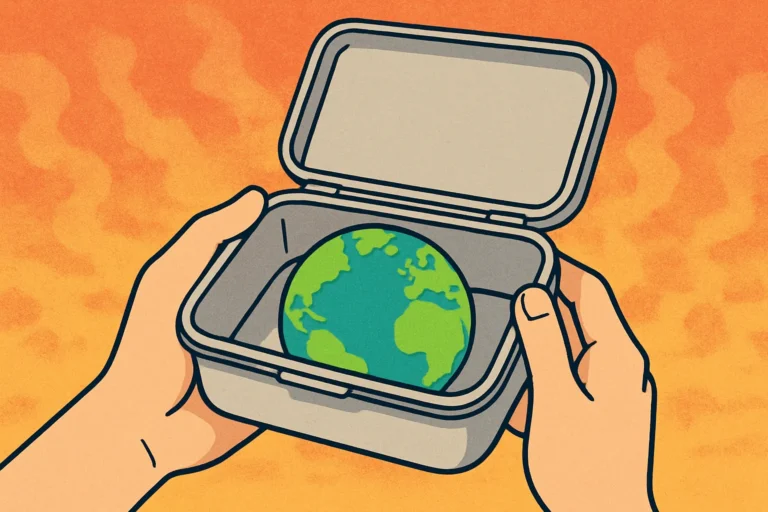
Did you know that Korean Millennials and Gen Z (MZ Generation) are leading a movement called “Yong-gi nae” (용기내)?
This is a clever wordplay!
1. 용기 (Yong-gi) means “Courage.”
2. 용기 (Yong-gi) also means “Container.”
So, “용기내” means both “Have courage!” and “Bring your container!”
It refers to the trend of bringing your own reusable containers to restaurants or cafes to pack food, instead of using disposable plastic. If you use a tumbler or a reusable food box in Korea, you can say, “I am doing the ‘Yong-gi nae’ challenge!” to show you are environmentally conscious. It’s a great way to make friends who care about the Earth!
Wrap-up & Practice
Today, we learned how to express concerns and hopes regarding climate change. These expressions will help you participate in deeper discussions with your Korean friends or colleagues.
📝 Mini Quiz:
Fill in the blank with the correct expression we learned today!
“지금은 말만 할 것이 아니라, 행동으로 ___________.”
(Now is not the time to just talk, but it is time to make an effort through action.)
Answer: (Drag to see) -> [ 노력해야 할 때이다 ]
Do you have any eco-friendly habits?
Leave a comment below using “희망을 가지다” or “노력해야 할 때이다”! I’d love to hear your thoughts in Korean.
See you in the next post! 안녕! 👋
Frequently Asked Questions (FAQ)
Q: What does "용기" mean in Korean and how do you pronounce it?
A: In Korean, "용기" is pronounced [Yong-gi] and means: means "Courage."
Q: What does "용기" mean in Korean and how do you pronounce it?
A: In Korean, "용기" is pronounced [Yong-gi] and means: also means "Container."







