

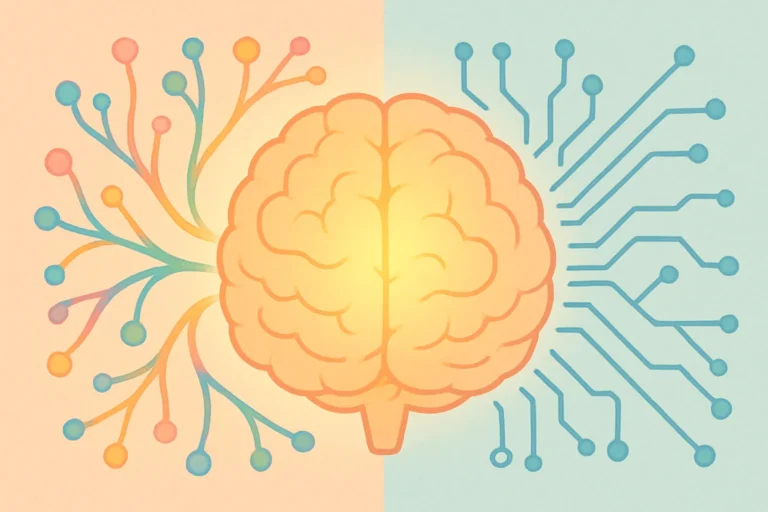
Introduction
Hello! This is [Maeil Hangeul], here to elevate your Korean proficiency to a professional level!
Today, we are diving into a highly sophisticated topic: Neuroscience and Human Behavior. Specifically, we will look at how to present the principles of neurons and synapses in an academic or professional setting.
Why is this trending?
Recently in Korea, with the explosion of AI technologies like ChatGPT, there is a massive surge of interest in comparing artificial neural networks with the human brain. You often see debates on news panels or academic YouTube channels discussing whether AI can truly replicate human “consciousness.” To participate in these high-level intellectual discussions or deliver a presentation at a conference, you need precise and logical vocabulary.
Let’s master the expressions that will make you sound like a true expert!
Key Expressions
Here are 4 advanced expressions essential for explaining complex biological mechanisms.
1. 유기적으로 연결되다 (To be organically connected)
- Pronunciation: [Yu-gi-jeo-geu-ro yeon-gyeol-dwe-da]
- English Meaning: To be organically connected / To be systematically linked
- Detail: In C2-level Korean, you don’t just say things are “connected” (연결되어 있다). When describing complex systems like the brain or a corporate structure where parts influence each other, ‘유기적’ (organic) is the perfect descriptor. It implies a relationship where parts cannot function independently without the whole.
- 💡 Pronunciation Tip:
- When pronouncing ‘유기적’, the ‘ㄱ’ carries over to the next vowel. So it flows like [유기저그로].
- Also, in ‘연결’, pronounce the ‘ㄴ’ clearly.
2. ~에 기인하다 (To stem from / To be caused by)
- Pronunciation: [~e gi-in-ha-da]
- English Meaning: To stem from; to result from; to be attributed to
- Detail: This is a very formal expression used to analyze causes. Instead of the casual ‘때문이다’ (because of), use ‘~에 기인하다’ in presentations or reports to sound objective and analytical. It is often used when explaining the root cause of a phenomenon or a disease.
- 💡 Pronunciation Tip:
- The ‘ㅎ’ in ‘하다’ often becomes weak or silent in fast speech between vowels, so it might sound like [기이나다]. This is known as ‘H-weakening’ (ㅎ 탈락/약화). However, in a formal presentation, enunciating the ‘h’ sound slightly adds clarity.
3. 가소성 (Plasticity)
- Pronunciation: [Ga-so-sseong]
- English Meaning: Plasticity (specifically Neuroplasticity: 신경 가소성)
- Detail: This is a key technical term. ‘가소성’ refers to the quality of being easily shaped or molded. In neuroscience, ‘신경 가소성’ (Neuroplasticity) refers to the brain’s ability to reorganize itself by forming new neural connections. Using this specific terminology shows you have specialized knowledge.
- 💡 Pronunciation Tip:
- Pay attention to ‘성’. Because of the preceding vowel and the nature of the compound word, it is often pronounced with a tense sound [썽] (Tensification/경음화) rather than a soft ‘seong’. So, say [가소썽].
4. 활성화되다 (To become activated)
- Pronunciation: [Hwal-sseong-hwa-dwe-da]
- English Meaning: To become activated / To fire (neurons)
- Detail: In a medical or scientific context, this means a specific area or function has started working. You would say, “The frontal lobe is activated” (전두엽이 활성화됩니다). It is much more professional than saying “The brain is working” (뇌가 일해요).
- 💡 Pronunciation Tip:
- Similar to the tip above, the ‘성’ here is pronounced strongly as [썽].
- ‘활’ (Hwal) requires a clear ‘L’ sound at the bottom. Make sure your tongue touches the roof of your mouth.
Example Dialogue
Let’s see how these expressions are used in a presentation Q&A session regarding AI and the Brain.
A (Presenter): …결론적으로, 인간의 뇌는 단순한 정보 처리를 넘어 경험에 따라 구조가 변하는 신경 가소성을 가지고 있습니다.
(In conclusion, the human brain possesses neuroplasticity, where its structure changes based on experience, going beyond simple information processing.)
B (Audience): 흥미로운 발표 감사합니다. 그렇다면 AI의 학습 능력도 뇌의 시냅스가 유기적으로 연결되는 방식과 유사하다고 볼 수 있나요?
(Thank you for the interesting presentation. Then, can AI’s learning ability be seen as similar to how brain synapses are organically connected?)
A (Presenter): 비슷해 보이지만 다릅니다. AI는 알고리즘에 의한 계산이지만, 인간의 사고는 생물학적 신호 전달 메커니즘에 기인하기 때문입니다. 특정 자극에 의해 뉴런이 활성화되는 과정은 훨씬 복잡하죠.
(They look similar but are different. AI is calculation based on algorithms, but human thought stems from biological signal transmission mechanisms. The process where neurons become activated by specific stimuli is much more complex.)
Culture Tip & Trend Analysis
🧠 The “Brain Science” Craze in Korea
Did you know that “Brain Science” (뇌과학) is currently a hot genre in the Korean publishing and lecture market?
While the MBTI craze swept through Korea a few years ago to explain personality, Koreans are now looking deeper into Neuroscience to explain behavior and efficiency. Books written by neuroscientists (like Dr. Jaeseung Jeong) are bestsellers.
In professional settings, referencing brain science adds significant credibility. For example, instead of saying “We need to rest to work better,” a Korean professional might say, “To maximize the activation (활성화) of the prefrontal cortex, we need to manage our cognitive load.”
Using the terms you learned today—especially ‘가소성’ (plasticity) to describe the potential for growth or change—will make you sound incredibly intellectual and persuasive to a Korean audience.
Conclusion & Practice
Today, we explored high-level vocabulary to discuss Neuroscience and Human Behavior. These words are not only useful for science but also for logical debates in any professional field.
📝 Practice Quiz:
Fill in the blanks with the correct expression from today’s lesson.
“인간의 행동 변화는 뇌의 ( 1 )에 ( 2 )한다고 볼 수 있습니다.”
(Human behavioral change can be seen as stemming from the brain’s plasticity.)
Answers:
1. 가소성 (Plasticity)
2. 기인 (Stem from)
Don’t be afraid to use these “big words”! They will give weight to your opinions.
Leave a comment below using one of today’s expressions!
See you next time!
Frequently Asked Questions (FAQ)
Q: What does "'유기적'" mean in Korean and how do you pronounce it?
A: In Korean, "'유기적'" is pronounced [organic] and means: is the perfect descriptor. It implies a relationship where parts cannot function independently without the whole.
Q: What does "'신경 가소성'" mean in Korean and how do you pronounce it?
A: In Korean, "'신경 가소성'" is pronounced [Neuroplasticity] and means: refers to the brain's ability to reorganize itself by forming new neural connections. Using this specific terminology shows you have specialized knowledge.
Q: What does "'활'" mean in Korean and how do you pronounce it?
A: In Korean, "'활'" is pronounced [Hwal] and means: requires a clear 'L' sound at the bottom. Make sure your tongue touches the roof of your mouth.
Q: What does "'가소성'" mean in Korean and how do you pronounce it?
A: In Korean, "'가소성'" is pronounced [plasticity] and means: to describe the potential for growth or change—will make you sound incredibly intellectual and persuasive to a Korean audience.







