

Introduction
Hello! This is [Daily Hangeul], here to upgrade your Korean skills! 👋
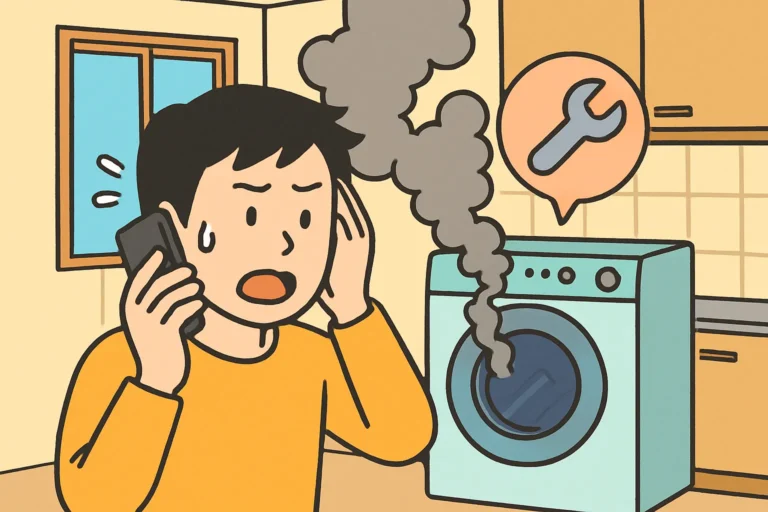
Have you ever experienced a sudden breakdown of your washing machine or air conditioner while living in Korea? It can be really stressful! Today, we are going to learn how to request a repairman visit (Making Appointments).
🔥 Recent Trend in Korea:
Nowadays in Korea, “AS” (After Service) speed is incredibly important. With the rise of single-person households, many Koreans prefer using mobile apps to book repairs quickly without long phone calls. However, knowing how to speak to a repairman is still essential when they call you to confirm the time! Let’s learn the expressions that will make you sound like a pro during these urgent moments. 🛠️
Key Expressions
Here are 4 essential expressions to help you schedule a repair appointment smoothly.
1. 고장 났어요 (It is broken)
- Pronunciation: [Gojang nasseoyo]
- Meaning: It is broken / It’s out of order.
- Description: This is the first thing you say to explain why you are calling. You can put the item name before this phrase. (e.g., “Air conditioner gojang nasseoyo.”)
- 💡 Pronunciation Tip:
- Notice the ‘ss’ sound? The bottom consonant ‘ㅅ’ (s) in ‘났’ moves over to the next vowel ‘어’. So, instead of reading it as ‘nat-eo-yo’, it flows smoothly as [nasseoyo]. This is called Liason (Linking). It makes your Korean sound much more natural!
2. 수리 기사님 부르고 싶어요 (I want to call a repairman)
- Pronunciation: [Suri gisanin bureugo sipeoyo]
- Meaning: I want to call a repair technician.
- Description: ‘수리’ means repair, and ‘기사님’ is a polite title for a technician or driver. Use this when speaking to a service center agent.
- 💡 Pronunciation Tip:
- In ‘싶어요 (sipeoyo)’, the ‘ㅍ (p)’ sound carries over to the next block. So it sounds like [si-peo-yo], not [sip-eo-yo].
3. 언제 방문 가능해요? (When can you visit?)
- Pronunciation: [Eonje bangmun ganeunghaeyo?]
- Meaning: When is a visit possible?
- Description: This is the most common way to ask for an available time slot. ‘방문’ means visit, and ‘가능해요’ means possible.
- 💡 Pronunciation Tip:
- ‘ㅎ (h)’ Weakening: When you say ‘가능해요’, the ‘ㅎ’ sound is often weak or almost silent in fast speech. It sounds closer to [ganeungaeyo]. Don’t stress the ‘H’ too hard!
4. 주소 남겨 주세요 (Please leave the address)
- Pronunciation: [Juso namgyeo juseyo]
- Meaning: Please leave the address (usually via text).
- Description: The repairman might ask you this, or you might ask them to text you confirmation. ‘남기다’ means to leave (a message/record).
Real-life Dialogue
Let’s see how these expressions are used in a real conversation. Imagine your washing machine (se-tak-gi) just stopped working!
A (You): 여보세요? 세탁기가 고장 났어요. (Hello? The washing machine is broken.)
B (Repairman): 아, 네. 언제 방문 가능해요? (Ah, I see. When can I visit?)
A: 내일 오후 2시 괜찮아요? (Is tomorrow 2 PM okay?)
B: 네, 알겠습니다. 주소 남겨 주세요. (Yes, understood. Please leave your address [via text].)
Culture Tip & Trend Dive 🇰🇷
Did you know about “AS Culture”?
In Korea, customer service for repairs is often called “AS” (After Service). Korea is famous for its “Ppalli Ppalli” (Hurry Hurry) culture, and this applies to repairs too!
- Trend Alert: Recently, if you buy appliances from major Korean brands (like Samsung or LG), the repairmen often bring a card reader for payment and wear shoe covers to keep your floor clean.
- Pro Tip: If you use a “Community App” (like Karrot Market/Danggeun), you can find local handymen who are popular among Gen Z for fixing small things quickly at a lower price. Knowing the phrase “고장 났어요” is the key to starting these chats!
Conclusion & Practice
Today, we learned how to schedule a repair appointment in Korean. Don’t panic when something breaks—just remember “Gojang nasseoyo”!
📝 Mini Quiz:
Fill in the blank to complete the sentence!
Q: “My air conditioner is broken.”
A: 에어컨이 _______ ________.
(Hint: It starts with ‘G’!)
- 방문 해요
- 고장 났어요
Leave your answer in the comments below! 👇
See you in the next post, and happy learning!







