

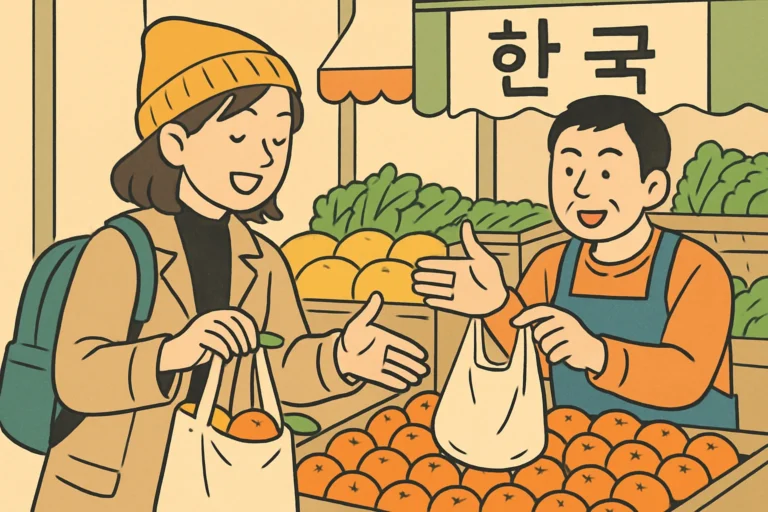
Shop Like a Local: Eco-friendly Korean Souvenirs!
Introduction
Hello! This is [Daily Hangeul], here to upgrade your Korean skills! 🌿
Today, we are going to explore a very special theme: Buying Local Agricultural Products as Souvenirs.
Usually, travelers buy keychains or chocolates, right? But recently in Korea, a new trend called “Value Consumption” (Gachi-sobi) has taken over. Travelers, especially the younger generation, prefer buying fresh, local specialties (like apples from Daegu or tangerines from Jeju) to support local farmers and reduce the carbon footprint of mass-produced goods.
Are you ready to shop like a trendy, eco-friendly local? Let’s dive in!
Key Expressions
Here are 3 essential expressions to help you buy fresh local food and practice environmental protection at the same time.
1. 여기 특산물이 뭐예요?
- Pronunciation: [Yeogi teuksanmuri mwoyeyo?]
- English Meaning: What is the local specialty here?
- Detailed Explanation:
- 특산물 (Teuksanmul): Special products of a region.
- Use this when you visit a new city or a traditional market and want to know what food is famous there. It shows you are interested in their local culture!
- 💡 Pronunciation Tip (Linking):
- When you pronounce 특산물이, the final consonant ‘ㄹ(l)’ moves over to the empty ‘ㅇ’ spot in the next block.
- So, instead of saying ‘Teuk-san-mul-i’ separately, it flows like [Teuk-san-mu-ri]. This makes your Korean sound much smoother!
2. 같이 담아 주세요.
- Pronunciation: [Gachi dama juseyo.]
- English Meaning: Please put them in together (in one bag).
- Detailed Explanation:
- If you are buying multiple items (like 3 apples and 2 pears), say this phrase. It implies, “Don’t use separate plastic bags for each; just put them all in one.” It’s a great phrase for environmental protection!
- 💡 Pronunciation Tip (Palatalization – Gu-gae-eum-hwa):
- Look at the word ‘같이’. You might think it is pronounced ‘gat-i’.
- However, in Korean, when a final consonant ‘ㅌ(t)’ meets the vowel ‘ㅣ(i)’, the sound changes to ‘ㅊ(ch)’.
- So, it is pronounced [gachi], not [gati]. This is the same rule as the word ‘Hello’ in “Good morning” (Haedoji -> [Haedoji])!
3. 봉투는 괜찮아요.
- Pronunciation: [Bongtuneun gwaenchanayo.]
- English Meaning: I don’t need a bag. (Literally: As for the bag, it is okay.)
- Detailed Explanation:
- 괜찮아요 (Gwaenchanayo): Usually means “I’m okay,” but in a shopping context, it is a polite way to refuse something (like a receipt or a plastic bag).
- Use this when you have your own eco-bag!
- 💡 Pronunciation Tip (H-Weakening):
- The word ‘괜찮아요’ has a bottom consonant ‘ㅎ(h)’.
- When ‘ㅎ’ is between voiced sounds or followed by a vowel, it becomes very weak or silent. Also, the ‘ㄴ’ moves over.
- So, you don’t say ‘Gwaen-chanh-a-yo’. You pronounce it softly as [Gwaen-cha-na-yo].
Example Dialogue
Imagine you are at a market in Jeju Island, looking for fruit.
- Tourist (A): 안녕하세요! 여기 특산물이 뭐예요? (Hello! What is the local specialty here?)
- Seller (B): 여기는 감귤이 유명해요. 아주 달아요! (Tangerines are famous here. They are very sweet!)
- Tourist (A): 그럼 감귤 좀 주세요. 아, 같이 담아 주세요. (Then please give me some tangerines. Ah, please put them together.)
- Seller (B): 네, 알겠습니다. 봉투 드릴까요? (Okay. Do you need a bag?)
- Tourist (A): 아니요, 가방 있어요. 봉투는 괜찮아요. (No, I have a bag. I don’t need a bag.)
Culture Tip & Trend Analysis 🌏
“Locavore” (Local + Vor) in Korea
Did you know that buying local specialties is a huge trend on Korean Instagram right now? This is part of the ESG (Environmental, Social, and Governance) movement in daily life.
- Ugly Agricultural Products (못난이 농산물): Recently, buying “ugly” fruits (fruits that look a bit weird but taste perfect) is popular among Gen Z. It prevents food waste and is cheaper!
- Market Vibes: Visiting traditional markets (Sijang) isn’t just for older people anymore. Young Koreans love the retro vibe and the freshness of the products. If you use the phrase “봉투는 괜찮아요” while holding your own eco-bag, the market merchants will give you a “thumbs up” for being a conscious consumer!
Wrap-up & Quiz
Today, we learned how to buy local souvenirs while protecting the environment. By using these expressions, you can enjoy fresh Korean food and reduce plastic waste!
📝 Mini Quiz:
Fill in the blank to complete the sentence meaning “Please put them in together” (using the Palatalization rule we learned!):
“_____ 담아 주세요.”
(Hint: It sounds like [Gachi]!)
Answer: _______
Please leave your answer in the comments below! Try using these expressions on your next trip to Korea. See you next time! 👋
Frequently Asked Questions (FAQ)
Q: What does "특산물" mean in Korean and how do you pronounce it?
A: In Korean, "특산물" is pronounced [Teuksanmul] and means: Special products of a region.
Q: What does "괜찮아요" mean in Korean and how do you pronounce it?
A: In Korean, "괜찮아요" is pronounced [Gwaenchanayo] and means: Usually means "I'm okay," but in a shopping context, it is a polite way to







