

Your Voice Matters! How to Write to a Korean City Council Member
Hello! This is Maeil Hangul (매일한글), here to upgrade your Korean skills!
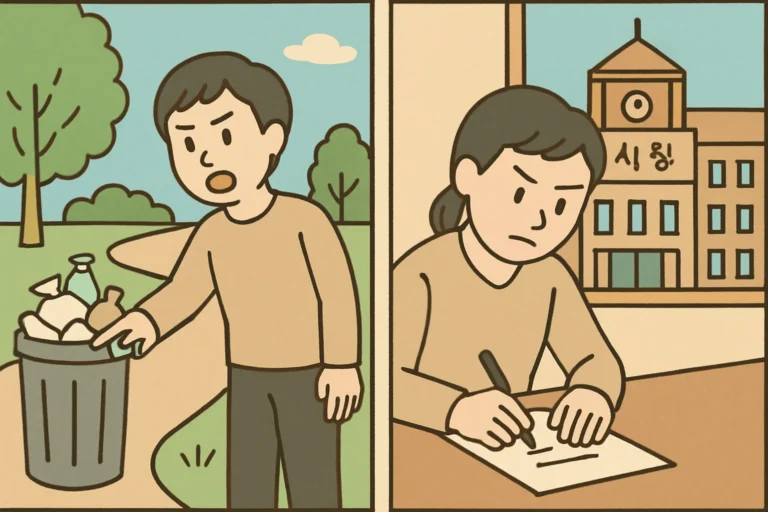
Have you ever walked through your neighborhood in Korea and thought, “I wish they would fix this,” or “This could be so much better”? Whether it’s a broken streetlight, a lack of recycling bins, or a need for a new crosswalk, your opinion as a resident matters! Today, we’re going to learn a powerful and practical skill: how to write a formal letter to a city council member (시의원) to solve a local community problem.
Lately in Korea, there’s a growing passion for civic participation (시민 참여). People are more actively voicing their opinions to improve their local communities. Learning how to do this in Korean is not just great language practice—it’s your chance to make a real difference. Let’s learn how to turn your thoughts into action!
Core Expressions for Your Letter
Here are some essential phrases you’ll need to write a polite and effective letter to a public official.
1. OOO 시의원님께 (OOO siuiwon-nim-kke)
- English Meaning: To the Honorable Council Member OOO
- Detailed Explanation: This is the standard, formal opening for a letter to a person you respect. -께 (kke) is the honorific version of the particle -에게 (ege), which means “to.” You always use -께 when addressing elders, teachers, bosses, or public officials. The suffix -님 (nim) is also added to their title (시의원) to show respect.
- 💡 Pronunciation Tip:
The letter ‘ㄲ’ (kk) in 께 [kke] is a “tense” consonant. It’s pronounced with more tension in your throat than a regular ‘ㄱ’ (g/k), without the puff of air you’d use for ‘ㅋ’ (k). Think of it as a sharp, strong ‘k’ sound.
2. ~에 대해 건의드립니다 (~e daehae geonui-deurimnida)
- English Meaning: I would like to make a suggestion regarding…
- Detailed Explanation: This is the perfect phrase to formally introduce your topic. ~에 대해 (e daehae) means “about” or “regarding.” 건의드립니다 (geonui-deurimnida) is a very polite and formal way to say “I suggest.” It combines the noun ‘건의’ (suggestion/proposal) with ‘드리다’ (deurida), the humble form of the verb ‘주다’ (juda – to give). You are literally “giving a suggestion” in a respectful way.
- 💡 Pronunciation Tip:
When you say ‘건의’, the ‘ㄴ’ (n) sound at the end of ‘건’ links to the next syllable, making it sound like [거니/geoni]. This is a common liaison rule in Korean called ‘연음’ (yeon-eum).
3. 조속한 해결을 부탁드립니다 (Josokhan haegyeoreul butak-deurimnida)
- English Meaning: I ask for a prompt resolution.
- Detailed Explanation: This is a classic and effective closing sentence. 조속한 (josokhan) means “prompt” or “speedy,” and 해결 (haegyeol) means “solution” or “resolution.” 부탁드립니다 (butak-deurimnida) is the formal and humble way to say “I ask” or “please.” It’s much more formal than ‘부탁해요’ (butakaeyo). This phrase clearly and politely states your desire for action.
- 💡 Pronunciation Tip:
The pronunciation of ‘해결을’ is another example of liaison! The final ‘ㄹ’ (l) of ‘해결’ moves to the next syllable, making it sound like [해겨를/haegyeoreul]. This makes your speech sound much more natural and fluid.
4. 검토 후 회신 주시면 감사하겠습니다 (Geomto hu hoesin jusimyeon gamsa-haget-sseumnida)
- English Meaning: I would be grateful if you could review this and reply.
- Detailed Explanation: This is how you politely request a response. Let’s break it down: 검토 (geomto) means “review” or “examination,” 후 (hu) means “after,” and 회신 (hoesin) means “reply.” The grammar -시면 감사하겠습니다 (simyeon gamsa-haget-sseumnida) is a very formal way to say “I would be thankful if you would…” It’s the perfect way to ask for a follow-up without sounding demanding.
- 💡 Pronunciation Tip:
The ending -겠습니다 [-get-sseumnida] often sounds like [-겠습니다/-gesseumnida] in speech. The ‘ㅆ’ (ss) is a tense consonant, similar to the ‘ㄲ’ we saw earlier. Make it a sharp, strong ‘s’ sound.
Example Situation
Let’s see how these expressions work in a real-life context. Imagine two friends, Alex and Min-jun, discussing a problem in their neighborhood.
A (Alex): 민준아, 우리 동네 공원에 쓰레기통이 너무 부족하지 않아? 사람들이 그냥 바닥에 쓰레기를 버려서 너무 지저분해.
Min-jun, don’t you think there aren’t enough trash cans in our neighborhood park? It’s so messy because people just throw trash on the ground.
B (민준): 맞아, 정말 문제야. 우리 구역 시의원님께 편지를 써보는 건 어때?
You’re right, it’s a real problem. How about we try writing a letter to our district’s city council member?
A (Alex): 좋은 생각이야! 어떻게 시작해야 해?
Great idea! How should I start?
B (민준): 먼저, “김민준 시의원님께” 이렇게 시작하고, 본론에서 “공원 내 쓰레기통 추가 설치에 대해 건의드립니다.”라고 쓰는 거야.
First, start with “To the Honorable Council Member Kim Min-jun,” and in the main body, write, “I would like to make a suggestion regarding the installation of additional trash cans in the park.”
A (Alex): 알겠어. 그리고 마지막에는… “이 문제에 대한 조속한 해결을 부탁드립니다.”라고 쓰면 되겠지?
Got it. And for the ending… I can write, “I ask for a prompt resolution to this issue,” right?
B (민준): 완벽해! 그렇게 쓰면 네 의견이 아주 정중하고 효과적으로 전달될 거야.
Perfect! If you write it like that, your opinion will be delivered politely and effectively.
Culture Tip: The Modern “Sinmungo” (신문고)
Did you know that petitioning the government has a long history in Korea? During the Joseon Dynasty, there was a system called Sinmungo (신문고), a giant drum that citizens could beat to directly alert the king to their grievances.
Today, that spirit lives on! The modern version is the e-People (국민신문고) website, a government portal where anyone can submit civil petitions, suggestions, and complaints online. While writing a formal letter is a powerful tool, especially for local issues, remember that Korea has a well-established digital infrastructure for civic engagement. Understanding this cultural background shows that you’re not just learning the language, but also how Korean society functions!
Let’s Wrap It Up & Practice!
Great job today! You’ve learned how to formally and politely express your opinion to a public official in Korean. You now have the tools to be an active and engaged member of your community.
Remember these key phrases:
* OOO 시의원님께: To start your letter respectfully.
* ~에 대해 건의드립니다: To clearly state your suggestion.
* 조속한 해결을 부탁드립니다: To politely ask for action.
Now, it’s your turn to practice!
- Fill in the blank: You want to suggest creating a new crosswalk for safety. Complete the sentence.
“안전을 위한 횡단보도 설치에 대해 ______.”
- Sentence Building: Imagine the park near your house is too dark at night. How would you formally request a swift solution to this problem?
Leave your answers in the comments below! We’d love to see you try out these new expressions. Keep up the great work
Frequently Asked Questions (FAQ)
Q: What does "-께" mean in Korean and how do you pronounce it?
A: In Korean, "-께" is pronounced [kke] and means: is the honorific version of the particle -에게 (ege), which means "to." You
Q: What does "-님" mean in Korean and how do you pronounce it?
A: In Korean, "-님" is pronounced [nim] and means: is also added to their title (시의원) to show respect.
Q: What does "께" mean in Korean and how do you pronounce it?
A: In Korean, "께" is pronounced [kke] and means: is a "tense" consonant. It's pronounced with more tension in your throat than a regular 'ㄱ' (g/k), without the puff of air you'd use for 'ㅋ' (k). Think of it as a sharp, strong 'k' sound.
Q: What does "~에 대해" mean in Korean and how do you pronounce it?
A: In Korean, "~에 대해" is pronounced [e daehae] and means: means "about" or "regarding."







