

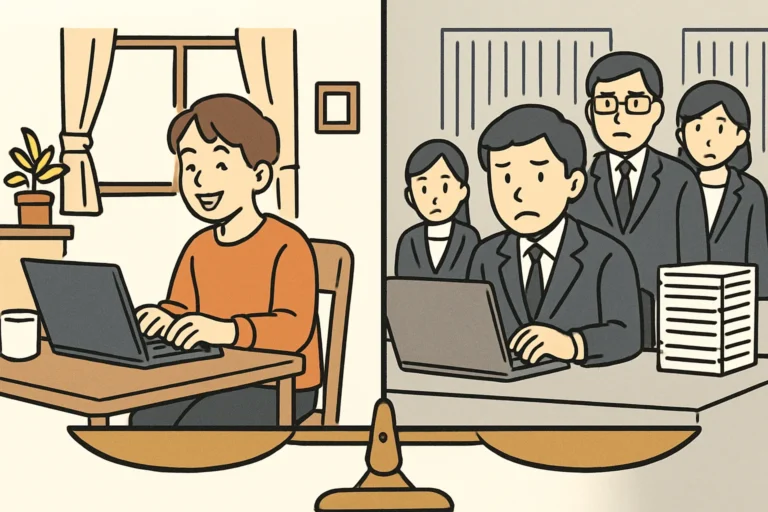
Korea’s “Untact” Revolution: Mastering Remote Work Korean
Hello! Welcome to Maeil Hangeul, your go-to blog for upgrading your Korean skills!
Are you working from home? Or perhaps you’re just fascinated by how work culture is changing around the world. Today, we’re diving into a super relevant topic: the language used to discuss remote work and the societal shifts it’s causing in Korea.
You’ve probably noticed that Korea’s response to the recent pandemic has accelerated its “untact” (언택트) culture. Suddenly, concepts like remote work (재택근무) and flexible schedules went from being a niche perk to a nationwide conversation. Mastering the vocabulary around this topic will not only make you sound more fluent but also give you a deeper insight into the debates shaping modern Korean society. Let’s get started!
Core Expressions for Your Professional Toolkit
Here are the essential terms you need to discuss the new era of work in Korean.
1. 유연근무제 (Yuyeon-geunmuje)
- Pronunciation [Romanization]: [Yuyeon-geunmuje]
- English Meaning: Flexible Work System
- Detailed Explanation: This is a comprehensive term that goes beyond just working from home. It covers various arrangements like staggered work hours (
시차출퇴근제), compressed workweeks, and of course, remote work (원격근무). It’s the central concept in any discussion about modernizing Korea’s traditionally rigid work culture. Using this term shows you understand the broader context of labor reform. - 💡 Pronunciation Tip: The pronunciation here is quite straightforward and follows the spelling. Just break it down syllable by syllable: 유(yu) – 연(yeon) – 근(geun) – 무(mu) – 제(je). It’s a compound word made of
유연(flexible),근무(work), and제(system).
2. 업무 효율성 (Eommu hyoyulseong)
- Pronunciation [Romanization]: [Eommu hyoyulsseong]
- English Meaning: Work Efficiency / Productivity
- Detailed Explanation: This is the key metric at the heart of the remote work debate. Do people get more done at home, or less? You’ll hear this phrase constantly in Korean news articles and office meetings. Is the lack of a commute a boost to
업무 효율성, or do distractions at home lower it? It’s often used with verbs like높이다(to raise) or떨어뜨리다(to drop). - 💡 Pronunciation Tip: Pay close attention to the sound change here! The syllable
성(seong) is pronounced with a tensed consonant, [sseong], because it follows a syllable ending inㄹ(l). This is a common phonetic rule in Korean called ‘tensing’ or gyeong-eumhwa (경음화). So, instead of a soft ‘s’, you make a strong ‘ss’ sound, like in the word ‘ssam’. It’s [hyoyul-sseong], not hyoyul-seong.
3. 일과 삶의 균형 (Il-gwa salm-ui gyunhyeong)
- Pronunciation [Romanization]: [Ilgwa salmui gyunhyeong]
- English Meaning: Work-Life Balance
- Detailed Explanation: You probably know the trendy Konglish abbreviation ‘워라밸’ (Worabel). This is the full, formal term for it. As an advanced learner, knowing both is crucial. You’d use
워라밸in casual conversation with colleagues, but일과 삶의 균형in a formal presentation, report, or a serious discussion about corporate policy. - 💡 Pronunciation Tip: This phrase showcases the linking sound rule, or yeon-eum (연음). In 삶의 (salm-ui), the final consonant
ㅁ(m) from삶“links” to the following vowel의(ui). This makes it sound smooth, like [salme]. Practice saying it as one fluid phrase: [il-gwa-sal-me-gyun-hyeong].
4. 비대면 (Bidaemyeon)
- Pronunciation [Romanization]: [Bidaemyeon]
- English Meaning: Non-face-to-face / Untact / Remote
- Detailed Explanation: This became one of the most important keywords in Korea during the pandemic. It’s formed by adding
비(非), a Hanja character meaning ‘non-‘, to대면(對面), which means ‘face-to-face’. It describes everything from remote meetings (비대면 회의) and online classes (비대면 수업) to contactless delivery. It perfectly captures the essence of the “untact” society. - 💡 Pronunciation Tip: The pronunciation is clear and follows the spelling. Understanding the Hanja components helps immensely with vocabulary expansion.
대(對)means ‘to face’ and면(面)means ‘face’.비(非)is a common prefix for negation, as in비공식(unofficial) or비정상(abnormal).
Example Dialogue: Office Talk
Let’s see how these expressions play out in a real conversation between two colleagues, Minjun and Sora.
A: 민준 (Minjun)
우리 회사도 다음 달부터 전면 유연근무제를 도입한다고 들었어요. 이제 재택근무가 가능해지겠네요.
I heard our company is introducing a full flexible work system starting next month. It looks like working from home will be possible now.
B: 소라 (Sora)
네, 맞아요. 출퇴근 시간이 줄어서 일과 삶의 균형을 찾기에는 좋겠지만, 저는 업무 효율성이 좀 걱정돼요.
Yes, that’s right. It’ll be great for finding work-life balance since commute time will be reduced, but I’m a bit worried about work efficiency.
A: 민준 (Minjun)
저도 그 부분이 조금 우려되긴 해요. 특히 팀원들과의 소통이 전부 비대면으로 이루어지면 프로젝트 진행이 더딜 수도 있겠어요.
I’m a little concerned about that part, too. Especially if all communication with team members becomes non-face-to-face, it could slow down our projects.
B: 소라 (Sora)
맞아요. 그래도 새로운 시도니까 긍정적으로 봐야겠죠. 일단 적응해 봐요!
Exactly. But since it’s a new attempt, we should look at it positively. Let’s try to adapt for now!
Culture Tip: The “Return to Office” Debate in Korea
While the “untact” trend has been powerful, the conversation in Korea is now shifting. Many large corporations, including Kakao and Naver (often seen as trendsetters), are asking employees to return to the office, at least for a few days a week.
Why? The management often cites concerns about a drop in 업무 효율성 and the erosion of corporate culture. They argue that spontaneous, face-to-face collaboration is essential for innovation.
However, this has been met with significant resistance from employees, especially from the MZ Generation (Millennials + Gen Z). They argue that the forced return to a traditional office environment ignores the proven benefits of remote work for 일과 삶의 균형 (워라밸). This ongoing tension is a hot topic in Korean news and a perfect example of how the concepts we learned today are shaping the future of work in Korea. If you use these terms, you’ll sound like you’re right in the middle of this cutting-edge debate!
Let’s Practice!
Ready to put your knowledge to the test?
Practice Question:
Imagine your company is deciding whether to continue its remote work policy. Using at least two of the expressions we learned today (유연근무제, 업무 효율성, 일과 삶의 균형, 비대면), write a short paragraph in Korean (2-3 sentences) expressing your opinion on the matter.
Example Answer Idea:
“저는 유연근무제가 유지되어야 한다고 생각합니다. 비대면으로 일하더라도 업무 효율성은 충분히 높일 수 있고, 무엇보다 일과 삶의 균형에 큰 도움이 되기 때문입니다.”
(I believe the flexible work system should be maintained. Even if we work remotely, work efficiency can be sufficiently increased, and above all, it’s a great help for work-life balance.)
Now it’s your turn! Share your own sentences in the comments below. We’d love to see what you come up with
Frequently Asked Questions (FAQ)
Q: What does "'워라밸'" mean in Korean and how do you pronounce it?
A: In Korean, "'워라밸'" is pronounced [Worabel] and means: . This is the full, formal term for it. As an advanced learner, knowing both is crucial. You'd use
Q: What does "삶의" mean in Korean and how do you pronounce it?
A: In Korean, "삶의" is pronounced [salm-ui] and means: , the final consonant
Q: What does "일과 삶의 균형" mean in Korean and how do you pronounce it?
A: In Korean, "일과 삶의 균형" is pronounced [워라밸] and means: . This ongoing tension is a hot topic in Korean news and a perfect example of how the concepts we learned today are shaping the future of work in Korea. If you use these terms, you'll sound like you're right in the middle of this cutting-edge debate!







