

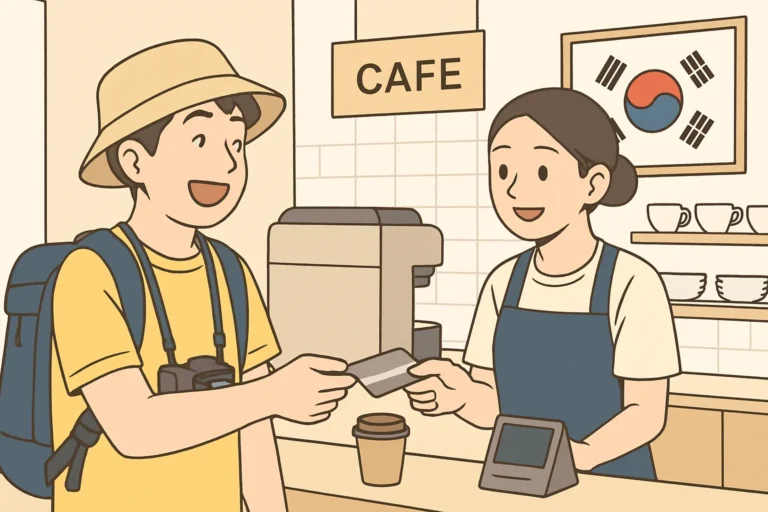
Swipe, Tap, & Go! Pay by Card in Korean Cafes
Hello! Welcome to [Daily Hangul], here to upgrade your Korean skills!
Have you ever walked into a trendy cafe in Seoul, ordered a delicious iced americano, and then frozen at the counter, unsure how to say “I’ll pay by card”? You’re not alone! Today, we’re going to master the simple but essential phrases you need to pay for your coffee like a local.
These days in Korea, it’s a nearly cashless society. From bustling cafes to small corner stores, everyone taps their card or phone to pay. Learning these phrases will not only make your life easier but also help you blend right in. Let’s get started!
Core Expressions You Need to Know
Here are three key phrases to make your cafe experience smooth and stress-free.
1. 카드로 계산할게요. (I’ll pay by card.)
- Pronunciation [Romanization]: Kadeuro gyesanhalgeyo.
- English Meaning: I’ll pay by card.
- Detailed Explanation: This is the most standard and polite way to tell the cashier you want to use your card. Let’s break it down:
카드(kadeu) means “card.”-로(-ro) is a particle meaning “by” or “with.”계산할게요(gyesanhalgeyo) means “I will pay/calculate.” It’s a polite expression of your intention.
- 💡 Pronunciation Tip:
The계(gye) sound can be tricky. It’s not “ge-ye,” but a single, smooth syllable: [gye]. Also, notice the finalㄹin할(hal) smoothly connects to the게요(geyo), making the whole phrase flow nicely: [gyesanalgeyo].
2. 일시불로 해주세요. (One-time payment, please.)
- Pronunciation [Romanization]: Ilsibullo haejuseyo.
- English Meaning: One-time payment, please.
- Detailed Explanation: For larger purchases in Korea, cashiers might ask if you want to pay in installments (
할부, halbu). For a coffee, they usually won’t, but knowing this phrase is super useful!일시불(ilsibul) means “lump-sum” or “one-time payment.” By saying this, you’re confirming you’ll pay the full amount now. - 💡 Pronunciation Tip:
When the syllable불(bul), which ends in aㄹ(l) consonant, is followed by로(ro), which starts withㄹ(l), the two sounds merge into one long, clear “L” sound. So, instead of “ilsi-bul-ro,” you pronounce it smoothly as [ilsibullo].
3. 영수증은 버려주세요. (Please throw away the receipt.)
- Pronunciation [Romanization]: Yeongsujeungeun beoryeojuseyo.
- English Meaning: Please throw away the receipt.
- Detailed Explanation: Being eco-friendly is cool! Many Koreans don’t take receipts for small purchases to save paper. This is a very natural and common phrase.
영수증(yeongsujeung) means “receipt.”버려주세요(beoryeojuseyo) is a polite way to ask someone to “please throw it away for me.”
- 💡 Pronunciation Tip:
This is a perfect example of a Korean pronunciation rule called “linking” or yeon-eum (연음). The final consonantㅇ(ng) in증(jeung) links to the vowel으(eu) in the next syllable은(eun). So, you don’t pronounce it as “yeongsujeung-eun,” but as one smooth sound: [yeongsujeungeun].
Example Dialogue at a Cafe
Let’s see how these phrases work in a real conversation!
- A (Cashier): 주문하시겠어요? (Jumunhasigesseoyo? / May I take your order?)
- B (You): 아이스 아메리카노 한 잔 주세요. (Aiseu Amerikano han jan juseyo. / One iced Americano, please.)
- A (Cashier): 네. 5,000원입니다. (Ne. Ocheonwonimnida. / Yes. That’s 5,000 won.)
- B (You): 카드로 계산할게요. (Kadeuro gyesanhalgeyo.)
- A (Cashier): 여기에 카드 꽂아주세요. (Yeogie kadeu kkojajuseyo. / Please insert your card here.)
- B (You): 네. 일시불로 해주세요. 그리고 영수증은 버려주세요. (Ne. Ilsibullo haejuseyo. Geurigo yeongsujeungeun beoryeojuseyo.)
- A (Cashier): 네, 알겠습니다. 감사합니다! (Ne, algesseumnida. Gamsahamnida! / Yes, I understand. Thank you!)
Culture Tip & Trend Deep Dive
Welcome to Korea, the Cashless Society!
You’ve learned the phrases, but here’s a deeper look. Korea is one of the most card-friendly countries in the world. In fact, some of the trendiest new cafes and shops in Seoul are “No-Cash Zones” (현금 없는 매장), where they only accept cards or mobile payments.
Speaking of mobile payments, systems like Samsung Pay (삼성페이) and Kakao Pay (카카오페이) are incredibly popular. If you use one, you can impress the cashier by swapping out 카드 (card) for the payment system’s name!
- Example: “삼성페이로 계산할게요.” (Samsungpei-ro gyesanhalgeyo. / I’ll pay with Samsung Pay.)
Using this phrase will instantly make you sound like you’ve been living in Korea for years!
Let’s Review & Practice!
Great job today! You’ve learned how to pay with a card, confirm a one-time payment, and handle the receipt—all in natural, polite Korean.
Now, it’s your turn to practice!
Quiz: You’re at a cafe and want to pay for your 6,000 won latte with your card. You don’t need the receipt. What would you say to the cashier? (Fill in the blanks)
Cashier: 6,000원입니다. (That’s 6,000 won.)
You: 네, _________ 계산할게요. 그리고 ___________ 버려주세요.
Think you know the answer? Leave your response in the comments below using the phrases we learned today! We’d love to see you try. Good luck







