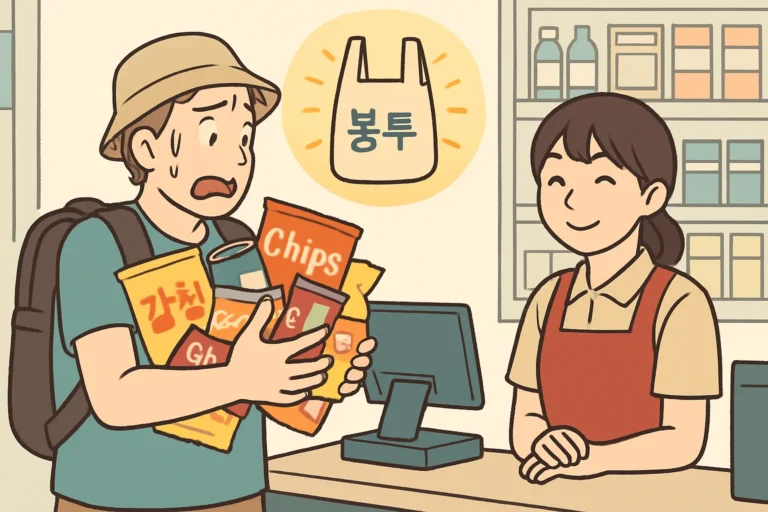
Korean Shopping Hack: The Magic Phrase for a Bag!
Hello! Welcome to [Maeil Hangeul], here to upgrade your Korean skills!
Ever been shopping in Korea, bought a bunch of amazing snacks or K-pop merch, and then realized at the counter… you have no way to carry it all? Don’t worry, we’ve all been there! Today, we’re going to learn the super simple, absolutely essential phrases for asking for a bag.
You might have noticed that these days in Korea, you almost always have to ask for a shopping bag, and they usually cost a small fee (like 100 won). This is part of a nationwide effort to be more eco-friendly! So, knowing how to ask isn’t just convenient—it’s necessary. Let’s get you ready for your next shopping spree!
Core Expressions You Need to Know
Here are three simple but powerful phrases to master.
1. 봉투 주세요. (A bag, please.)
- Pronunciation [Romanization]: Bongtu juseyo.
- English Meaning: A bag, please.
- Detailed Explanation: This is the most direct and common way to ask for a bag. ‘봉투’ (bongtu) means “bag” or “envelope,” and ‘주세요’ (juseyo) is the magic polite phrase for “please give me.” You can attach ‘주세요’ to almost any noun to request something. For example, “물 주세요” (Mul juseyo) means “Water, please.” It’s polite and perfect for any store.
- 💡 Pronunciation Tip: In ‘주세요’ (juseyo), the vowel ‘ㅔ’ (e) is pronounced like the ‘e’ in “set.” Make sure to pronounce it clearly. The ‘요’ (yo) at the end is what makes the phrase polite, so don’t forget it!
2. 봉투 하나 필요해요. (I need one bag.)
- Pronunciation [Romanization]: Bongtu hana piryohaeyo.
- English Meaning: I need one bag.
- Detailed Explanation: This is another great way to express your need. ‘하나’ (hana) is the native Korean number for “one,” and ‘필요해요’ (piryohaeyo) means “to need.” This phrase sounds very natural and is also perfectly polite for shopping situations.
- 💡 Pronunciation Tip: Let’s look at ‘필요해요’ [piryohaeyo]. Notice how the 받침 (bottom consonant) ‘ㄹ’ (l) in ‘필’ links with the next syllable ‘요’. Instead of saying “pil-yo-hae-yo,” the ‘ㄹ’ sound flows over, making it sound like [pi-ryo-hae-yo]. This linking sound rule, called 연음 (yeoneum), is super common in Korean and will make you sound much more natural!
3. 봉투 얼마예요? (How much is the bag?)
- Pronunciation [Romanization]: Bongtu eolmayeyo?
- English Meaning: How much is the bag?
- Detailed Explanation: Since bags usually cost money in Korea, this is a very important question! ‘얼마예요?’ (eolmayeyo?) is the essential phrase for asking the price of anything. Just point at an item and say “이거 얼마예요?” (Igeo eolmayeyo?) to ask, “How much is this?”
- 💡 Pronunciation Tip: In ‘얼마예요’ [eolmayeyo], the word ‘얼마’ ends in a vowel. When a noun ending in a vowel is followed by ‘예요’ (yeyo), they blend together smoothly. It’s one fluid sound: eol-ma-ye-yo.
Example Conversation
Let’s see these phrases in action! Imagine you’re at a popular cosmetics store like Olive Young, buying the latest trending sunscreen.
- A (You): 이거 계산해 주세요. (Please ring this up.)
- [Igeo gyesanhae juseyo.]
- B (Cashier): 네. 5만 원입니다. 봉투 필요하세요? (Okay. It’s 50,000 won. Do you need a bag?)
- [Ne. Oman wonimnida. Bongtu piryohaseyo?]
- A (You): 네, 봉투 하나 필요해요. 봉투 얼마예요? (Yes, I need one bag. How much is the bag?)
- [Ne, bongtu hana piryohaeyo. Bongtu eolmayeyo?]
- B (Cashier): 100원 추가됩니다. (It’s an additional 100 won.)
- [Baegwon chugadoemnida.]
- A (You): 네. 같이 계산해 주세요. (Okay. Please charge it together.)
- [Ne. Gachi gyesanhae juseyo.]
See how simple that was? You successfully got your bag!
🌿 Culture Tip & Trend Deep Dive
As we mentioned, the reason you have to ask for and pay for bags in Korea is due to environmental laws aimed at reducing single-use plastic. This is a big deal, and most Koreans carry their own reusable bags (에코백 – ekobaek).
But here’s a pro-tip to sound even more like a local! There are different kinds of bags you can ask for:
- 비닐봉투 (binil-bongtu): A plastic bag.
- 종이봉투 (jongi-bongtu): A paper bag.
And the ultimate life-hack for travelers:
* 종량제 봉투 (jongnyangje-bongtu): This is the official city-mandated trash bag. At most supermarkets and convenience stores, you can ask for this bag to carry your groceries. The best part? You can then use it to throw away your trash at your Airbnb or hotel. It’s a two-in-one deal! You can ask: “종량제 봉투로 주세요.” (Jongnyangje bongturo juseyo.)
Using these specific terms will definitely impress the cashier!
Let’s Review & Practice!
Great job today! You’ve learned how to ask for a bag, ask for its price, and even learned some cultural background and pro-tips.
Now, let’s test your knowledge!
- Fill in the blank: You just bought some souvenirs and your hands are full. You want to politely ask the cashier for a bag.
“저기요, _________ 주세요.” (Excuse me, _________, please.)
- Challenge: You want to buy your groceries and use the bag for your trash later. What special kind of bag would you ask for?
Leave your answers in the comments below! We’d love to see you try using the phrases you learned today. Happy shopping
Frequently Asked Questions (FAQ)
Q: What does "'봉투'" mean in Korean and how do you pronounce it?
A: In Korean, "'봉투'" is pronounced [bongtu] and means: means "bag" or "envelope," and
Q: What does "'주세요'" mean in Korean and how do you pronounce it?
A: In Korean, "'주세요'" is pronounced [juseyo] and means: is the magic polite phrase for "please give me." You can attach '주세요' to almost any noun to request something. For example, "물 주세요" (Mul juseyo) means "Water, please." It's polite and perfect for any store.
Q: What does "'주세요'" mean in Korean and how do you pronounce it?
A: In Korean, "'주세요'" is pronounced [juseyo] and means: , the vowel 'ㅔ' (e) is pronounced like the 'e' in "set." Make sure to pronounce it clearly. The '요' (yo) at the end is what makes the phrase polite, so don't forget it!
Q: What does "'하나'" mean in Korean and how do you pronounce it?
A: In Korean, "'하나'" is pronounced [hana] and means: is the native Korean number for "one," and