

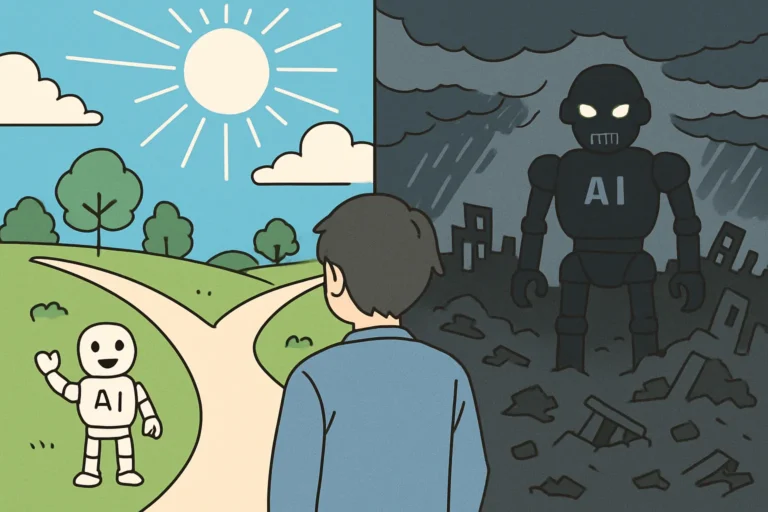
Beyond the Singularity: Critically Debating Korea’s Future
Hello! This is Maeil Hangeul (매일한글), here to upgrade your Korean proficiency to the highest level!
Today, we’re moving beyond everyday conversation and diving into a topic that requires nuanced and sophisticated language: critically analyzing the concept of the Technological Singularity and envisioning alternative futures. Sounds complex, right? But it’s a conversation happening right now in Korea. Lately, with webtoons and dramas depicting dystopian futures driven by AI, the question of “What’s next for humanity?” has become a major topic of public interest. This lesson will equip you with the advanced vocabulary needed to participate in these profound discussions, just like a native speaker.
Core Expressions for Future Discourse
Here are some essential phrases you’ll need to articulate your thoughts on complex future scenarios.
1. 가설에 불과하다 (gaseore bulgwahada)
- Romanization: [Gaseore bulgwahada]
- English Meaning: To be nothing more than a hypothesis; to be merely a theory.
- Detailed Explanation: This is a powerful phrase used to express skepticism or to frame a popular idea as unproven.
가설(gaseol) means ‘hypothesis,’ and~에 불과하다(e bulgwahada) is a grammatical structure meaning ‘to be nothing more than…’. It’s commonly used in academic, journalistic, or debate settings to challenge an assumption. When someone presents the Singularity as an inevitable event, you can use this phrase to counter that it remains a theoretical concept, not a confirmed fact. - 💡 Pronunciation Tip:
The key here is the liaison (or linking) in가설에. Instead of pronouncing it asgaseol-e, the final consonantㄹ(l) of설moves to the next syllable, making it sound like [가서레] (gaseore). This smooths out the pronunciation and is a fundamental rule for sounding natural in Korean.
2. 명과 암 (myeonggwa am)
- Romanization: [Myeonggwa am]
- English Meaning: The light and the shadow; the pros and cons; the bright and dark sides.
- Detailed Explanation: This is a literary, Hanja-based idiom (
明for light,暗for dark) that beautifully captures the duality of an issue. Instead of simply saying장단점(jangdanjeom – pros and cons), using명과 암elevates the conversation, implying a deeper, more philosophical understanding of the positive and negative aspects. It’s perfect for discussing the double-edged sword of technological progress. - 💡 Pronunciation Tip:
There are no complex sound changes here, but pay attention to the unaspiratedㅁ(m) andㅇ(ng). Ensure the sounds are soft and not overly enunciated. The과(gwa) is a single, fluid syllable. Practice saying [myeong-gwa-am] smoothly.
3. 화두로 떠오르다 (hwaduro tteoolleuda)
- Romanization: [Hwaduro tteoolleuda]
- English Meaning: To emerge as a major topic of conversation; to become a hot-button issue.
- Detailed Explanation:
화두(hwadu) is a term originally from Zen Buddhism referring to a topic for meditation, but in modern Korean, it means a key topic or a subject of intense public interest.떠오르다(tteoolleuda) means ‘to rise’ or ‘to surface.’ Together, this phrase describes a situation where a particular subject suddenly captures the public’s attention and dominates discussions. - 💡 Pronunciation Tip:
The verb떠오르다can be tricky. It’s a combination of뜨다(to float) and오르다(to rise). The double consonantㄸ(tt) requires a tense, sharp pronunciation with no puff of air, like the ‘t’ in the English word “stop.” Pronounce it as [hwadu-ro tteo-o-reu-da].
4. 담론을 형성하다 (damnoneul hyeongseonghada)
- Romanization: [Damnoneul hyeongseonghada]
- English Meaning: To form/shape a discourse.
- Detailed Explanation: This is a highly advanced, academic phrase.
담론(damnon) means ‘discourse’ (a formal discussion of a topic in speech or writing), and형성하다(hyeongseonghada) means ‘to form’ or ‘to shape.’ This phrase goes beyond simple conversation; it refers to the collective process by which a society builds a framework of ideas, language, and understanding around a significant issue. For example, discussing alternative futures helps shape the discourse away from a purely techno-deterministic viewpoint. - 💡 Pronunciation Tip:
This phrase contains a crucial nasalization rule. When a syllable ending in a nasal consonant likeㅁ(m) is followed by a syllable starting withㄹ(r/l), theㄹis pronounced asㄴ(n). Therefore,담론is not pronounceddam-ronbut rather [담논] (damnon). This same rule applies to words like대통령[대통녕] (daetongnyeong) and심리학[심니학] (simnihak). Mastering this will make your Korean sound incredibly polished.
Example Dialogue
Let’s see how these expressions are used in a conversation about a popular sci-fi K-drama.
A: 요즘 새로 시작한 드라마 ‘코드 제네시스’ 봤어? 인공지능 특이점이 사회의 화두로 떠오르고 있는 시점을 다루더라.
(A: Have you seen the new drama ‘Code Genesis’? It deals with a time when the AI Singularity is emerging as a major topic of conversation in society.)
B: 응, 봤어. 근데 난 특이점이라는 개념 자체가 아직은 가설에 불과하다고 생각해. 너무 비관적이거나 낙관적으로만 보는 경향이 있는 것 같아.
(B: Yes, I have. But I think the concept of the Singularity itself is nothing more than a hypothesis for now. People tend to view it either too pessimistically or too optimistically.)
A: 맞아. 기술 발전의 명과 암을 균형 있게 봐야지. 드라마가 그런 고민을 잘 담아낸 것 같아.
(A: Right. We need to look at the light and shadow of technological progress in a balanced way. I think the drama captures that concern well.)
B: 그래서 이런 작품들이 중요한 거야. 대중들이 미래에 대해 비판적으로 생각하게 만들고, 더 건강한 사회적 담론을 형성하는 데 기여하니까.
(B: That’s why these kinds of works are important. They make the public think critically about the future and contribute to shaping a healthier social discourse.)
Culture Tip & Trend Analysis: Korea’s Techno-Realism
While Silicon Valley often champions a utopian vision of the future, the discourse in South Korea is frequently more grounded in what could be called “techno-realism.”
- From Webtoons to Public Policy: In Korea, speculative fiction isn’t just for entertainment. Popular webtoons and dramas often become catalysts for real-world public debate. When a series vividly portrays the societal fallout of advanced AI, it prompts viewers and even policymakers to seriously consider the 명과 암 (myeonggwa am) of the technologies being developed by giants like Naver and Kakao.
- Beyond Inevitability: The expression 가설에 불과하다 (gaseore bulgwahada) is particularly resonant in Korea. As a nation that has experienced incredibly rapid technological and social change, there’s a deep-seated awareness that the future isn’t a fixed path. Rather, it’s something that must be actively shaped. Using this phrase isn’t just about being contrarian; it’s about opening the door to alternative scenarios and asserting human agency.
- Shaping the Narrative: When you hear news anchors or pundits say a certain issue has become a 화두 (hwadu), it signals a national moment of reflection. The subsequent discussions in online forums, academic seminars, and op-eds all contribute to 담론을 형성하는 (shaping the discourse) process. For an advanced learner, being able to identify and use these terms means you can understand and participate in the very conversations that are shaping Korea’s future.
Wrap-up & Practice
Today, we learned four sophisticated expressions to critically discuss complex topics like the future and technology. By moving beyond simple pros and cons, you can now articulate nuanced perspectives on hypothetical scenarios, the duality of progress, and the formation of societal ideas.
Now, it’s your turn to practice!
- Fill in the blank:
인터넷의 발달은 정보의 민주화라는 긍정적 측면과 가짜뉴스의 확산이라는 부정적 측면을 모두 가지고 있다. 이것이 바로 기술의 ________이다.
(The development of the internet has both the positive aspect of democratizing information and the negative aspect of spreading fake news. This is the very ________ of technology.) -
Your Opinion:
“인공지능이 인간의 지능을 뛰어넘는 특이점은 곧 올 것이다”라는 주장에 대해, 오늘 배운 표현 중 하나를 사용하여 여러분의 생각을 짧게 써보세요.
(Regarding the claim, “The Singularity, where AI surpasses human intelligence, will soon arrive,” please write your short opinion using one of the expressions you learned today.)
Leave your answers in the comments below! We’d love to see you engage in this fascinating discussion.
Frequently Asked Questions (FAQ)
Q: What does "[가서레]" mean in Korean and how do you pronounce it?
A: In Korean, "[가서레]" is pronounced [gaseore] and means: . This smooths out the pronunciation and is a fundamental rule for sounding natural in Korean.
Q: What does "[담논]" mean in Korean and how do you pronounce it?
A: In Korean, "[담논]" is pronounced [damnon] and means: . This same rule applies to words like
Q: What does "명과 암" mean in Korean and how do you pronounce it?
A: In Korean, "명과 암" is pronounced [myeonggwa am] and means: of the technologies being developed by giants like Naver and Kakao.
Q: What does "가설에 불과하다" mean in Korean and how do you pronounce it?
A: In Korean, "가설에 불과하다" is pronounced [gaseore bulgwahada] and means: is particularly resonant in Korea. As a nation that has experienced incredibly rapid technological and social change, there's a deep-seated awareness that the future isn't a fixed path. Rather, it's something that must be actively shaped. Using this phrase isn't just about being contrarian; it's about opening the door to alternative scenarios and asserting human agency.







