

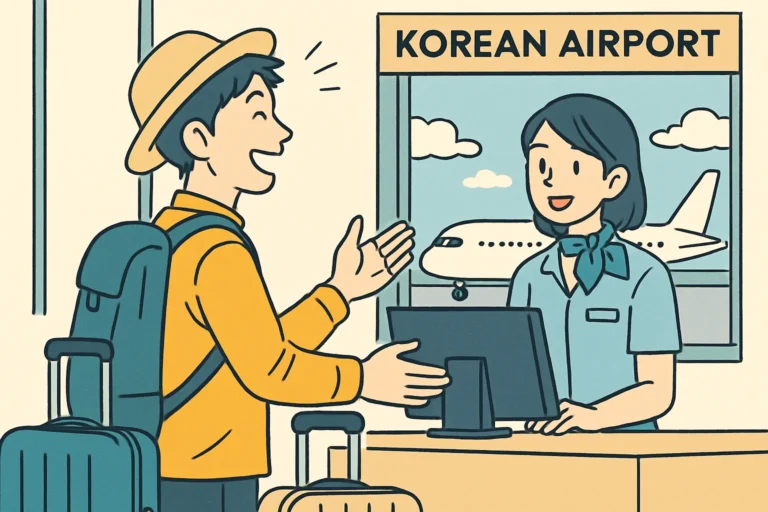
Flying to Korea? How to Check Your Bags Like a Pro! ✈️
Hello! This is Maeil Hangeul (매일한글), here to upgrade your Korean skills! 😊
Are you planning a trip to Korea soon? The excitement starts at the airport! But wait… how do you check in your luggage in Korean? Don’t worry! Today, we’re going to learn some super useful phrases for checking in your bags, so you can start your Korean adventure smoothly and confidently.
These days in Korea, the airports are buzzing with energy, especially with K-pop concerts and festivals happening all year round. Imagine breezing through the check-in counter like a local! Let’s get you ready for that moment.
Core Expressions You Need to Know
Here are the essential phrases for a stress-free baggage check-in experience.
1. I’d like to check in my baggage.
- Korean: 수하물을 부치고 싶어요.
- Pronunciation [Romanization]: Suhamureul buchigo sipeoyo.
- English Meaning: I’d like to check in my baggage.
- Detailed Explanation: This is the magic sentence to start the process! 수하물 (suhamul) means ‘baggage’ or ‘luggage’. 부치다 (buchida) means ‘to send’ or ‘to check in (mail, luggage)’. And -고 싶어요 (-go sipeoyo) is the polite way to say ‘I want to…’. It’s the perfect, polite phrase to use at the counter.
- 💡 Pronunciation Tip: The syllable 치 (chi) in 부치고 (buchigo) is key. In Korean, the letter ‘ㅌ’ (t) at the end of a syllable block, when followed by a vowel ‘ㅣ’ (i), often changes its sound to ‘ㅊ’ (ch). This is called palatalization. While ‘부치다’ doesn’t follow this specific rule, remembering that ‘ㅊ’ is a ‘ch’ sound (like in “church“) will help you sound much more natural!
2. How many bags do you have?
- Korean: 가방이 몇 개예요?
- Pronunciation [Romanization]: Gabangi myeot gaeyeyo?
- English Meaning: How many bags do you have?
- Detailed Explanation: This is a question you will almost certainly hear from the airline staff. 가방 (gabang) means ‘bag’, 몇 (myeot) means ‘how many’, and 개 (gae) is a counter for items or things.
- 💡 Pronunciation Tip: The pronunciation of 몇 개예요 (myeot gaeyeyo) can be a bit tricky. The final consonant ‘ㅊ’ in 몇 (myeot) is pronounced like a ‘ㄷ’ [t] sound when it’s at the end of a syllable. So, you don’t say “myeoch”; you say [멷 / meot]. Then, you connect it to the next word: [meot gae-ye-yo]. Practice saying it slowly first!
3. This one is a carry-on.
- Korean: 이건 기내용이에요.
- Pronunciation [Romanization]: Igeon ginaeyong-ieyo.
- English Meaning: This one is a carry-on.
- Detailed Explanation: What about the bag you’re taking with you on the plane? This is the phrase for that! 이건 (igeon) is a casual contraction of ‘이것은’ (igeoseun), meaning ‘this thing’ or ‘this one’. 기내용 (ginaeyong) is a useful word made from 기내 (ginae), meaning ‘in-flight’, and 용 (yong), meaning ‘for use’. So, ‘for in-flight use’!
- 💡 Pronunciation Tip: Notice how smoothly 기내용이에요 (ginaeyong-ieyo) flows. The final consonant ‘ㅇ’ (ng) in 용 (yong) links directly to the vowel ‘ㅣ’ (i) that follows it. It’s not “yong. i-e-yo,” but rather a connected [yo-ngi-e-yo]. This linking of sounds (called 연음 / yeoneum) is fundamental to sounding natural in Korean.
4. A window seat, please.
- Korean: 창가 쪽으로 주세요.
- Pronunciation [Romanization]: Changga jjogeuro juseyo.
- English Meaning: A window seat, please.
- Detailed Explanation: While you’re at the counter, you might as well ask for your preferred seat! 창가 (chang-ga) means ‘window side’, 쪽 (jjok) means ‘side’ or ‘direction’, -으로 (-euro) is a particle meaning ‘to’ or ‘toward’, and 주세요 (juseyo) means ‘please give’. It’s a very polite and common way to make a request. (For an aisle seat, you can say 복도 쪽으로 주세요 / Bokdo jjogeuro juseyo).
- 💡 Pronunciation Tip: The sound ㅉ (jj) in 쪽 (jjok) is a ‘tense’ or ‘double’ consonant. It’s stronger and sharper than the regular ‘ㅈ’ (j) sound. To make this sound, put the tip of your tongue behind your teeth (like for ‘j’) but tighten your throat muscles and release the sound without a puff of air. It’s the sound you hear in pizza!
Example Dialogue at Incheon Airport
Let’s see how these phrases work in a real conversation!
- A: Traveler
- B: Airline Staff
A: 안녕하세요. 수하물을 부치고 싶어요.
(Annyeonghaseyo. Suhamureul buchigo sipeoyo.)
(Hello. I’d like to check in my baggage.)
B: 네, 여권이랑 비행기 표 보여주세요. 가방이 몇 개예요?
(Ne, yeogwon-irang bihaenggi pyo boyeojuseyo. Gabangi myeot gaeyeyo?)
(Yes, please show me your passport and ticket. How many bags do you have?)
A: 한 개요. 그리고 이건 기내용이에요.
(Han gaeyo. Geurigo igeon ginaeyong-ieyo.)
(One. And this one is a carry-on.)
B: 알겠습니다. 선호하는 좌석 있으세요?
(Algesseumnida. Seonhohaneun jwaseok isseuseyo?)
(I understand. Do you have a preferred seat?)
A: 네, 창가 쪽으로 주세요.
(Ne, chang-ga jjogeuro juseyo.)
(Yes, a window seat, please.)
Culture Tip & Trend Deep Dive
Master the Kiosks: Self Check-in is King in Korea!
When you arrive at Incheon Airport (ICN), you’ll notice many Koreans don’t even go to the main counter first. They head straight for the kiosks!
- 셀프 체크인 (selpeu chekeu-in): This is Konglish for “Self Check-in.” These machines are everywhere and are a super-fast way to get your boarding pass.
- 자동 수하물 위탁 (jadong suhamul witak): This means “Automatic Baggage Drop.” After getting your ticket from the kiosk, you can take your luggage to a self-service machine, scan your ticket, and send your bag on its way.
Using these automated services is very common for the tech-savvy “ppalli-ppalli” (빨리빨리, hurry-hurry) culture in Korea. While it’s efficient, don’t be afraid to use the phrases we learned today at the regular counter. The staff are always happy to help! Knowing these terms will make you look like a seasoned traveler in Korea.
Let’s Review and Practice!
Great job today! You’ve learned how to handle one of the most important steps of traveling to Korea. You can now state your purpose, answer questions about your bags, and even request your favorite seat.
Time for a quick quiz!
- You walk up to the counter. How do you say, “I’d like to check in my baggage”?
수하물을 ______________.
- The staff asks how many bags you have. You want to point to your small backpack and say, “This one is a carry-on.” What do you say?
_________________.
Leave your answers in the comments below! And tell us, what’s the first thing you want to do when you land in Korea?
Happy learning! 다음에 또 만나요! (See you next time!)
Frequently Asked Questions (FAQ)
Q: What does "수하물" mean in Korean and how do you pronounce it?
A: In Korean, "수하물" is pronounced [suhamul] and means: means 'baggage' or 'luggage'.
Q: What does "부치다" mean in Korean and how do you pronounce it?
A: In Korean, "부치다" is pronounced [buchida] and means: means 'to send' or 'to check in (mail, luggage)'. And
Q: What does "-고 싶어요" mean in Korean and how do you pronounce it?
A: In Korean, "-고 싶어요" is pronounced [-go sipeoyo] and means: is the polite way to say 'I want to...'. It's the perfect, polite phrase to use at the counter.
Q: What does "부치고" mean in Korean and how do you pronounce it?
A: In Korean, "부치고" is pronounced [buchigo] and means: is key. In Korean, the letter 'ㅌ' (t) at the end of a syllable block, when followed by a vowel 'ㅣ' (i), often changes its sound to 'ㅊ' (ch). This is called







