

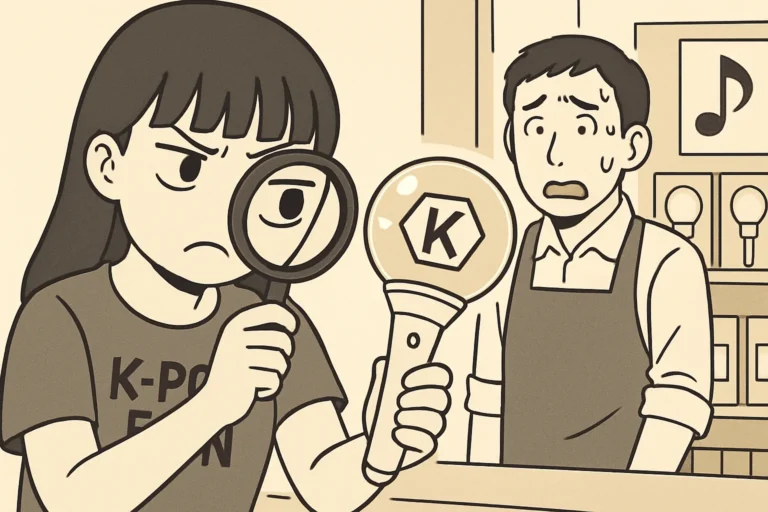
K-Pop Merch a Fake? How to Deal with “Jjaktung” in Korean!
Hello! Welcome to Daily Hangul, here to upgrade your Korean skills!
Have you ever been excited to buy something, only to realize it wasn’t the real deal? It’s a frustrating experience, and it can happen to anyone. Especially these days, with K-Pop’s global popularity, the market for merchandise is huge, but so is the market for fakes.
So, what do you do if you accidentally buy a counterfeit photocard or a knock-off light stick in Korea? Today, we’re going to learn the essential Korean phrases to handle this situation confidently. Let’s learn how to spot a “짝퉁” and get your money back!
Core Expressions You Need to Know
Here are the key phrases to protect your consumer rights in Korea.
1. 짝퉁 (Jjaktung)
- Pronunciation [Romanization]: [Jjak-tung]
- English Meaning: Fake, counterfeit, knock-off
- Detailed Explanation: This is the most common, everyday word for a counterfeit product. It’s a slang term, so you’ll hear it used frequently among friends and in casual settings. It can describe anything from a designer bag to a K-Pop album with a fake signature. The opposite of
짝퉁is정품(jeongpum), which means “genuine article.” - 💡 Pronunciation Tip: The first syllable ‘짝’ starts with ‘ㅉ’ (jj). This is a “tense” consonant. To make this sound, press your tongue firmly against the roof of your mouth as if you’re about to say ‘j’, but release the sound without any puff of air. It’s stronger and tighter than the regular ‘ㅈ’ (j) sound. Think of the difference between ‘자다’ (jada – to sleep) and ‘짜다’ (jjada – to be salty).
2. 환불해 주세요 (Hwanbulhae juseyo)
- Pronunciation [Romanization]: [Hwan-bul-hae ju-se-yo]
- English Meaning: Please give me a refund.
- Detailed Explanation: This is the essential phrase you need to know. It’s a polite but direct way to ask for your money back. It combines the verb
환불하다(hwanbulhada – to refund) with the polite request form-(아/어) 주세요(-(a/eo) juseyo), which means “please do something for me.” - 💡 Pronunciation Tip: This phrase is pronounced pretty much as it’s written. The key is to say it smoothly. Notice the polite ending
세요(seyo). Instead of a choppy “se-yo,” try to blend it into one smooth sound, almost like “seyo.”
3. 이거 가짜인 것 같아요 (Igeo gajjain geot gatayo)
- Pronunciation [Romanization]: [I-geo ga-jja-in geot ga-ta-yo]
- English Meaning: I think this is a fake.
- Detailed Explanation: This is a slightly softer, less confrontational way to bring up the issue. The grammar pattern “-(으)ㄴ/는 것 같다” means “I think…” or “It seems like…”. By using this phrase, you’re expressing your suspicion without making a direct accusation, which can make the conversation go more smoothly.
가짜(gajja) is another word for “fake” and is often used interchangeably with짝퉁. - 💡 Pronunciation Tip: The pronunciation of
같아요is a classic Korean sound-change rule! The final consonant ‘ㅌ’ (t) in ‘같’ moves over to the next syllable when it’s followed by a vowel. So, instead ofgat-a-yo, it’s pronounced smoothly as [가타요 (gatayo)]. This linking rule is called 연음 (yeon-eum) and makes Korean sound much more fluid.
4. 정품 맞아요? (Jeongpum majayo?)
- Pronunciation [Romanization]: [Jeong-pum ma-ja-yo?]
- English Meaning: Is this genuine/authentic?
- Detailed Explanation: This is the perfect question to ask before you buy something you’re unsure about. As we learned,
정품(jeongpum) means “genuine article.”맞아요?(majayo?) is a useful question pattern that means “Is that right?” or “Is it correct?”. Asking this directly can save you a lot of trouble later! - 💡 Pronunciation Tip: Here’s another example of 연음 (yeon-eum)! The final consonant ‘ㅈ’ (j) in ‘맞’ links to the vowel ‘아’ (a) that follows it. So, you don’t pronounce it as
mat-a-yo. Instead, the ‘ㅈ’ sound moves over, making it [마자요 (majayo)].
Example Dialogue
Let’s see how these phrases work in a real conversation. Imagine you bought a Stray Kids light stick from an online seller, but it feels a bit off.
- A (You): 저기요, 제가 주문한 응원봉을 받았는데요… 이거 정품 맞아요?
- (Jeogiyo, jega jumunhan eungwonbongeul badanneundeyo… igeo jeongpum majayo?)
- Excuse me, I received the light stick I ordered… Is this authentic?
- B (Seller): 네, 고객님. 그럼요. 정품입니다.
- (Ne, gogaengnim. Geureomyo. Jeongpum-imnida.)
- Yes, customer. Of course. It’s genuine.
- A (You): 음… 그런데 로고 색깔이 좀 이상하고, 블루투스 연결이 안 돼요. 이거 짝퉁인 것 같아요.
- (Eum… geureonde logo saekkkari jom isanghago, beullutuseu yeongyeori an dwaeyo. Igeo jjaktung-in geot gatayo.)
- Hmm… but the logo color is a bit strange, and the Bluetooth won’t connect. I think this is a fake.
- B (Seller): 아, 그러세요? 죄송합니다. 바로 확인해 보겠습니다.
- (A, geureoseyo? Joesonghamnida. Baro hwaginhae bogetseumnida.)
- Oh, is that so? I apologize. I will check on it immediately.
- A (You): 아니요, 괜찮습니다. 그냥 환불해 주세요.
- (Aniyo, gwaenchanseumnida. Geunyang hwanbulhae juseyo.)
- No, that’s okay. Just please give me a refund.
Culture Tip & Trend Deep Dive
In Korea, consumer protection is taken very seriously. However, with the massive international demand for K-Pop goods, the market for “짝퉁 굿즈” (jjaktung gutjeu – fake merchandise) has exploded.
Korean fans are experts at spotting fakes! They check for tiny details: the quality of the print on a photocard, the exact color of a group’s logo on an album, or the specific features of an official light stick (응원봉 – eungwonbong). Official merchandise is almost always sold through verified channels like the Weverse Shop, official company websites, or certified pop-up stores.
When you use phrases like “정품 맞아요?” or “이거 짝퉁인 것 같아요,” you’re not just speaking Korean; you’re showing that you are a savvy and informed consumer. It signals that you know your rights and understand the market.
Let’s Review & Practice!
Great job today! You’ve learned how to stand up for yourself as a consumer in Korean. Remember these four key phrases:
* 짝퉁: Fake / Knock-off
* 환불해 주세요: Please give me a refund.
* 이거 가짜인 것 같아요: I think this is a fake.
* 정품 맞아요?: Is this authentic?
Now, let’s test your knowledge!
1. You bought a hoodie online, but the logo is spelled wrong. Which is the most polite way to tell the seller you think it’s a fake?
A) 이거 짝퉁! (This is a fake!)
B) 이거 짝퉁인 것 같아요. (I think this is a fake.)
2. Fill in the blank to ask if a product is genuine.
“이 화장품 ________ 맞아요?” (Is this cosmetic product authentic?)
(Answers: 1. B, 2. 정품)
Have you ever accidentally bought a 짝퉁? Share your story or try making a sentence with today’s expressions in the comments below! We’d love to hear from you
Frequently Asked Questions (FAQ)
Q: What does "연음" mean in Korean and how do you pronounce it?
A: In Korean, "연음" is pronounced [yeon-eum] and means: and makes Korean sound much more fluid.
Q: What does "연음" mean in Korean and how do you pronounce it?
A: In Korean, "연음" is pronounced [yeon-eum] and means: ! The final consonant 'ㅈ' (j) in '맞' links to the vowel '아' (a) that follows it. So, you don't pronounce it as







