

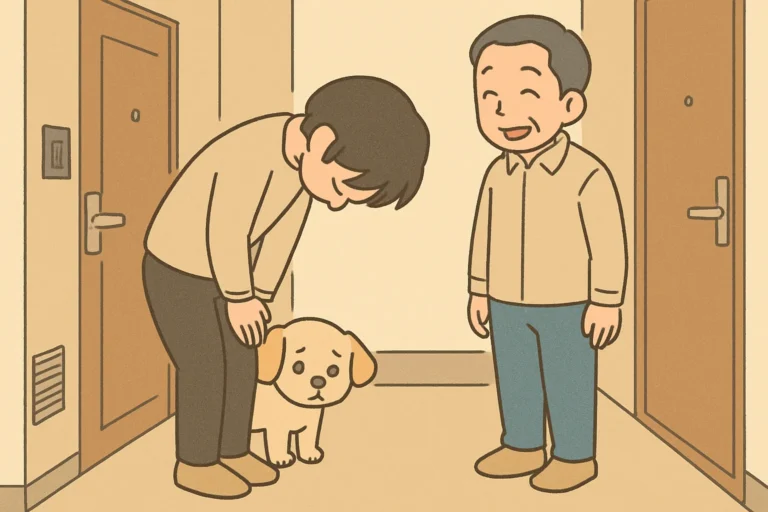
Woof! Sorry! Master Pet Noise Apologies in Korean
Hello! Welcome to Maeil Hangeul, where we upgrade your Korean skills!
Do you live with a furry friend? 🐶🐱 Having a pet is wonderful, but sometimes they can be a little noisy, especially if you live in an apartment. What do you do if your neighbor is bothered by the noise? Don’t worry! Today, we’re going to learn how to apologize politely and kindly in Korean, turning an awkward situation into a chance to be a great neighbor.
These days in Korea, with more and more people adopting pets (you see them all over K-dramas and with K-pop idols!), knowing good “petiquette” (펫티켓) is more important than ever. Let’s learn some key phrases to handle this situation like a pro!
Core Expressions for a Considerate Pet Owner
Here are three essential expressions to help you apologize smoothly.
1. 혹시 저희 집 강아지 때문에 시끄러우셨어요? (By any chance, was it noisy because of my dog?)
- Pronunciation [Romanization]: Hoksi jeohui jip gangaji ttaemune sikkeureousyeosseoyo?
- English Meaning: By any chance, was it noisy because of my dog?
- Detailed Explanation: This is a perfect way to start the conversation. ‘혹시 (hoksi)’ means ‘by any chance’ or ‘perhaps’, making the question sound much softer and less confrontational. You’re showing consideration by asking first, rather than waiting for them to complain. You can replace ‘강아지 (gangaji – puppy/dog)’ with ‘고양이 (goyangi – cat)’ or ‘반려동물 (ballyeodongmul – pet)’.
- 💡 Pronunciation Tip:
The word ‘같이 (gachi)’ is a classic example of a sound change rule called palatalization. The final consonant ‘ㅌ (t)’ in ‘같’ meets the vowel ‘ㅣ (i)’, and its sound changes to ‘ㅊ (ch)’. So, instead of saying ‘gat-i’, Koreans say [gachi], which is smoother. You can see the same rule in ‘굳이 (gudi)’, which is pronounced as [구지, guji].
2. 정말 죄송합니다. 앞으로 더 조심할게요. (I’m really sorry. I’ll be more careful from now on.)
- Pronunciation [Romanization]: Jeongmal joesonghamnida. Apeuro deo josimhalgeyo.
- English Meaning: I’m really sorry. I’ll be more careful from now on.
- Detailed Explanation: This is a standard and very polite apology. ‘정말 죄송합니다 (jeongmal joesonghamnida)’ is a formal and sincere way to say “I’m very sorry.” The second part, ‘앞으로 더 조심할게요 (apeuro deo josimhalgeyo)’, shows that you are taking responsibility and will try to prevent it from happening again. The ‘-ㄹ게요 (-lgeyo)’ ending implies a promise or intention that you are communicating to the listener.
- 💡 Pronunciation Tip:
In ‘죄송합니다 (joesonghamnida)’, the ‘ㅂ (b)’ sound in ‘합’ changes to an ‘ㅁ (m)’ sound because it is followed by ‘ㄴ (n)’. This is a very common rule called nasalization. So, instead of ‘joesong-hap-nida’, the natural pronunciation is [죄송함니다, joesong-hamnida]. This makes the flow much smoother!
3. 아이가 혼자 있는 걸 무서워해서요. (It’s because he/she is scared of being alone.)
- Pronunciation [Romanization]: Aiga honja itneun geol museowohaeseoyo.
- English Meaning: It’s because he/she is scared of being alone.
- Detailed Explanation: After apologizing, giving a brief, gentle reason can help your neighbor understand the situation. Koreans often refer to their pets as ‘아이 (ai)’, which means ‘child’, showing how much they are part of the family. ‘-는 걸 (-neun geol)’ is a casual contraction of ‘-는 것을 (-neun geoseul)’. The ‘-아서/어서요 (-aseo/eoseoyo)’ ending is a soft way to provide a reason or explanation.
- 💡 Pronunciation Tip:
The pronunciation of ‘있는 걸 (itneun geol)’ is a great example of connected speech. The ‘ㄴ’ sound from ‘있는’ carries over, so it sounds like [인는걸, inneun-geol]. This linking of sounds is key to making your spoken Korean sound fluid and natural.
Example Dialogue
Let’s see how these expressions work in a real conversation! Imagine A (the pet owner) meets their neighbor B in the elevator.
A: 안녕하세요! 저 702호에 사는 사람인데요.
(Annyeonghaseyo! Jeo chil-baek-i-ho-e saneun saramindeyo.)
Hello! I live in apartment 702.
B: 아, 네! 안녕하세요.
(A, ne! Annyeonghaseyo.)
Oh, yes! Hello.
A: 저, 혹시 저희 집 강아지 때문에 시끄러우셨어요? 제가 없을 때 가끔 짖어서요.
(Jeo, hoksi jeohui jip gangaji ttaemune sikkeureousyeosseoyo? Jega eopseul ttae gakkeum jijeoseoyo.)
Um, by any chance, was it noisy because of my dog? He sometimes barks when I’m not home.
B: 아, 괜찮아요. 어제 오후에 조금 짖는 소리가 들리긴 했어요. 요즘 인기 드라마 ‘선재 업고 튀어’ 보는데 집중이 잘 안돼서요. (웃음)
(A, gwaenchanayo. Eoje ohue jogeum jinneun soriga deulligin haesseoyo. Yojeum ingi deurama ‘Seonjae eopgo twieo’ boneunde jipjungi jal andwaeseoyo. (useum))
Ah, it’s okay. I did hear a little barking yesterday afternoon. I was trying to focus on the popular drama ‘Lovely Runner’. (laughs)
A: 정말 죄송합니다. 아이가 혼자 있는 걸 무서워해서요. 앞으로 더 조심할게요!
(Jeongmal joesonghamnida. Aiga honja itneun geol museowohaeseoyo. Apeuro deo josimhalgeyo!)
I’m really sorry. It’s because he’s scared of being alone. I’ll be more careful from now on!
B: 아니에요. 이해해요. 알려주셔서 감사해요.
(Anieyo. Ihaehaeyo. Allyeojusyeoseo gamsahaeyo.)
No, it’s fine. I understand. Thanks for letting me know.
Culture Tip: Understanding Korean “Petiquette” (펫티켓)
In Korea, especially in high-rise apartment buildings where most people live, neighborly relations are very important. The concept of 층간소음 (cheung-gan so-eum), or noise between floors, is a sensitive social issue.
This is why 펫티켓 (petiket), a combination of “pet” and “etiquette,” is a widely used term. Being a responsible pet owner means being mindful of noise. By apologizing proactively and politely like in our dialogue, you’re not just saying sorry; you are showing respect for your neighbors and participating in a considerate community culture. It shows you care, which can make your neighbors much more understanding in the future! Plus, seeing K-pop stars like BTS’s V with his dog Yeontan or BLACKPINK’s Jennie with her dogs Kuma and Kai has made responsible pet ownership a cool and trendy topic among the younger generation.
Let’s Practice!
Time to check what you’ve learned. You can do it!
- Fill in the blank: You realize your dog was barking while you were out. How do you apologize to your neighbor?
“어제 저희 집 강아지 소리 때문에 힘드셨죠? ______ _________. 앞으로는 이런 일 없도록 하겠습니다.”
(Answer: 정말 죄송합니다) - Make a sentence: Your cat made a loud noise because it was surprised by thunder. Using “때문에 (ttaemune)”, how would you explain this?
(Example: “천둥 소리 때문에 고양이가 놀랐어요.” – Cheondung sori ttaemune goyang-iga nollasseoyo.)
Great job today! Being a good neighbor is just as important as being a good language learner.
Why not try using one of today’s phrases in the comments below? Tell us about your pet in Korean! We’d love to hear from you.
Frequently Asked Questions (FAQ)
Q: What does "층간소음" mean in Korean and how do you pronounce it?
A: In Korean, "층간소음" is pronounced [cheung-gan so-eum] and means: , or noise between floors, is a sensitive social issue.
Q: What does "펫티켓" mean in Korean and how do you pronounce it?
A: In Korean, "펫티켓" is pronounced [petiket] and means: , a combination of "pet" and "etiquette," is a widely used term. Being a responsible pet owner means being mindful of noise. By apologizing proactively and politely like in our dialogue, you're not just saying sorry; you are showing respect for your neighbors and participating in a considerate community culture. It shows you care, which can make your neighbors much more understanding in the future! Plus, seeing K-pop stars like BTS's V with his dog Yeontan or BLACKPINK's Jennie with her dogs Kuma and Kai has made responsible pet ownership a cool and trendy topic among the younger generation.







