

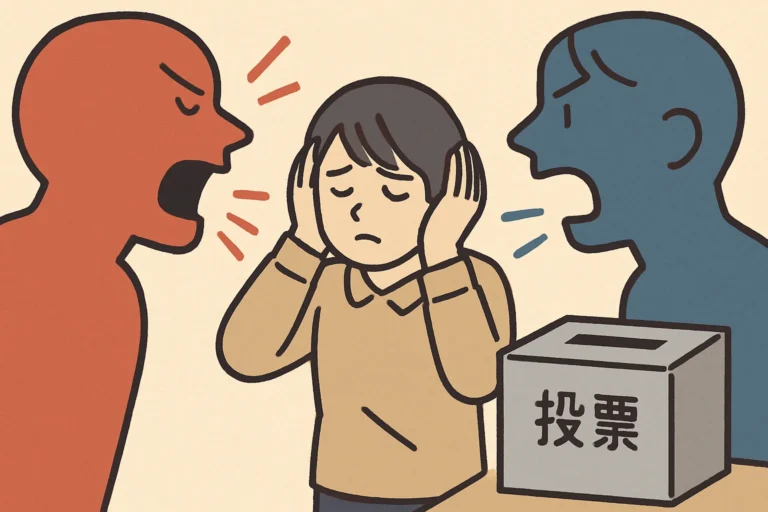
Is Democracy in Crisis? Debating Political Apathy in Korean
Hello! Welcome back to [Everyday Hangul], your go-to source for upgrading your Korean skills!
Today, we’re diving deep into a sophisticated topic perfect for advanced learners: political philosophy and modern democracy. Specifically, we’ll learn how to discuss a phenomenon seen across the globe—political indifference. This isn’t just for academic essays! 요즘 한국에서는 (yojeum hangugeseoneun)… there’s a constant, heated debate about low voter turnout, especially among younger generations, and the growing cynicism towards politics. Understanding how to articulate these complex ideas will not only allow you to comprehend Korean news and opinion pieces but also to engage in meaningful discussions about the future of society. Let’s get started!
Core Expressions for Your Debate Toolkit
Here are four essential phrases you’ll need to discuss political indifference like a pro.
1. 정치적 무관심 (Jeongchijeok Mugwansim)
- Romanization: [Jeong-chi-jeok mu-gwan-sim]
- English Meaning: Political indifference; political apathy.
- Detailed Explanation: This is the core term for our topic. It’s a formal, Sino-Korean based phrase used in news, academic papers, and serious discussions. It’s constructed from 정치 (jeongchi), meaning ‘politics’, the adjectival suffix -적 (-jeok), and 무관심 (mugwansim), which means ‘indifference’ or ‘lack of interest’ (무 means ‘none’ and 관심 means ‘interest’). It perfectly describes a citizen’s lack of concern or engagement in political affairs.
- 💡 Pronunciation Tip:
In 정치적 (jeongchijeok), the final consonant ‘ㄱ’ (k) in ‘적’ is an unreleased stop. This means you form the ‘k’ sound at the back of your throat but don’t release the puff of air. It creates a clean stop at the end of the word, making your pronunciation sound sharp and precise, rather than letting it trail off.
2. 양극화가 심화되다 (Yanggeukwaga Simhwadoeda)
- Romanization: [Yang-geu-kwa-ga sim-hwa-doe-da]
- English Meaning: For polarization to intensify/deepen.
- Detailed Explanation: This is a crucial phrase for explaining why apathy might occur. 양극화 (yanggeukwa) means ‘polarization’ (from 양극, ‘both poles’). 심화되다 (simhwadoeda) is a passive verb meaning ‘to be deepened’ or ‘to become more severe’. You use this phrase to describe situations where political divisions become more extreme, often leading people to disengage from the seemingly futile conflict.
- 💡 Pronunciation Tip:
The vowel ‘ㅚ’ in 되다 (doeda) is technically pronounced [ø], similar to the ‘ö’ in German. However, in modern standard Seoul Korean, it is almost always pronounced the same as ‘ㅞ’ [we]. So, while the spelling is ‘doeda’, a more natural pronunciation sounds like [simhwadweda]. Nailing this will make you sound incredibly fluent.
3. 투표율이 저조하다 (Tupyoyuri Jeojohada)
- Romanization: [Tu-pyo-yu-ri jeo-jo-ha-da]
- English Meaning: Voter turnout is low/poor.
- Detailed Explanation: This is the most common way to state the factual outcome of political indifference. 투표율 (tupyoyul) is ‘voter turnout rate’, and 저조하다 (jeojohada) is a descriptive verb meaning ‘to be low,’ ‘sluggish,’ or ‘poor’ in performance. It’s the standard vocabulary you will hear from every news anchor after an election.
- 💡 Pronunciation Tip:
This is a perfect example of liaison, or linking (연음, yeoneum). The word is투표율 (tupyoyul)+이 (i). The final consonant ‘ㄹ’ (l) of ‘율’ moves over to the next syllable, which starts with a vowel. Therefore, it’s not pronounced “tupyoyul / i” but flows smoothly as [tupyoyuri]. This rule is fundamental to making your Korean sound natural and connected.
4. 효능감을 느끼지 못하다 (Hyoneunggameul Neukkiji Motada)
- Romanization: [Hyo-neung-ga-meul neu-kki-ji mo-ta-da]
- English Meaning: To be unable to feel a sense of efficacy.
- Detailed Explanation: This is a very sophisticated, psychological term that gets to the heart of apathy. 효능감 (hyoneunggam) means ‘a sense of efficacy’—the belief that one’s actions can produce a desired effect. When you say someone 효능감을 느끼지 못하다, you’re saying they feel their vote or political participation doesn’t make a difference, which is a primary cause of indifference.
- 💡 Pronunciation Tip:
Let’s look at 못하다 [모타다, motada]. Two rules are at play here. First, the final ‘ㅅ’ in ‘못’ is pronounced as a ‘ㄷ’ [t] sound when at the end of a syllable (음절의 끝소리 규칙). Second, when this ‘ㄷ’ [t] sound meets the ‘ㅎ’ [h] in ‘하다’, they combine and become an aspirated ‘ㅌ’ [tʰ] sound. So,mot-hadais pronounced [motada]. Mastering this consonant assimilation rule is a hallmark of an advanced speaker.
Sample Dialogue: Post-Election Chat
Let’s see how these expressions work in a real conversation.
A: 이번 총선 청년 투표율이 또 저조하더라. 걱정스러울 정도야.
(I saw the youth voter turnout for this general election was low again. It’s genuinely worrisome.)
B: 맞아. 정치적 양극화가 심화되면서 다들 지친 것 같아. 자기가 뭘 해도 바뀌는 게 없다고 생각하니까 효능감을 느끼지 못하는 거지.
(I agree. As political polarization has intensified, I think everyone is just exhausted. They can’t feel a sense of efficacy because they think nothing will change no matter what they do.)
A: 일리가 있네. 이런 정치적 무관심이 계속되면 민주주의의 기반이 흔들릴 텐데.
(That makes sense. If this political indifference continues, the very foundation of democracy could be shaken.)
B: 그러니까 말이야. 시민 교육을 강화하든, 새로운 정치 플랫폼을 만들든 뭔가 대책이 시급해.
(Exactly. We urgently need a solution, whether it’s strengthening civic education or creating new political platforms.)
Culture Tip & Trend Deep Dive
In Korea, discussions about 정치적 무관심 are often centered on the “2030 Generation” (people in their 20s and 30s). While some are highly engaged, a significant portion expresses deep cynicism online.
On popular online communities, you’ll see this apathy manifest in specific slang or phrases. For example, the term ‘정치 혐오’ (jeongchi hyeomo), or ‘hatred of politics’, is often used. People might say things like “어차피 그 나물에 그 밥이다” (eochapi geu namure geu babida), a proverb meaning “it’s all the same,” to express that no political party offers a real alternative.
This feeling is directly tied to the concept of 효능감 (hyoneunggam). When the media focuses solely on partisan fighting (정쟁, jeongjaeng) instead of policy debates (정책 토론, jeongchaek toron), many young voters feel their concerns about issues like housing, employment, and social justice are being ignored. Therefore, understanding the term 효능감 is key to grasping the nuanced emotional and psychological state behind the statistic of low voter turnout in Korea. Using it in a discussion shows you’re not just observing the phenomenon, but you understand its root causes.
Let’s Wrap It Up & Practice!
Today, we’ve learned four powerful expressions—정치적 무관심, 양극화가 심화되다, 투표율이 저조하다, and 효능감을 느끼지 못하다—to elevate your discussions on politics and society in Korean. These aren’t just vocabulary words; they are analytical tools to help you frame your arguments.
Now, it’s your turn to practice!
- Fill in the blank:
극심한 정치적 대립은 유권자들이 _______을/를 느끼지 못하게 만들어 결국 _______으로 이어질 수 있다.
(Extreme political confrontation can make voters unable to feel _______, ultimately leading to _______.) -
Sentence Building:
Using 투표율이 저조하다, write a short sentence explaining one possible reason for low voter turnout in your country.
What are your thoughts on this complex issue? Try using one of today’s expressions to share your opinion in the comments below! We’d love to hear your perspective.
Frequently Asked Questions (FAQ)
Q: What does "정치" mean in Korean and how do you pronounce it?
A: In Korean, "정치" is pronounced [jeongchi] and means: , meaning 'politics', the adjectival suffix
Q: What does "-적" mean in Korean and how do you pronounce it?
A: In Korean, "-적" is pronounced [-jeok] and means: , and
Q: What does "무관심" mean in Korean and how do you pronounce it?
A: In Korean, "무관심" is pronounced [mugwansim] and means: , which means 'indifference' or 'lack of interest' (무 means 'none' and 관심 means 'interest'). It perfectly describes a citizen's lack of concern or engagement in political affairs.
Q: What does "정치적" mean in Korean and how do you pronounce it?
A: In Korean, "정치적" is pronounced [jeongchijeok] and means: , the final consonant 'ㄱ' (k) in '적' is an unreleased stop. This means you form the 'k' sound at the back of your throat but don't release the puff of air. It creates a clean stop at the end of the word, making your pronunciation sound sharp and precise, rather than letting it trail off.







