

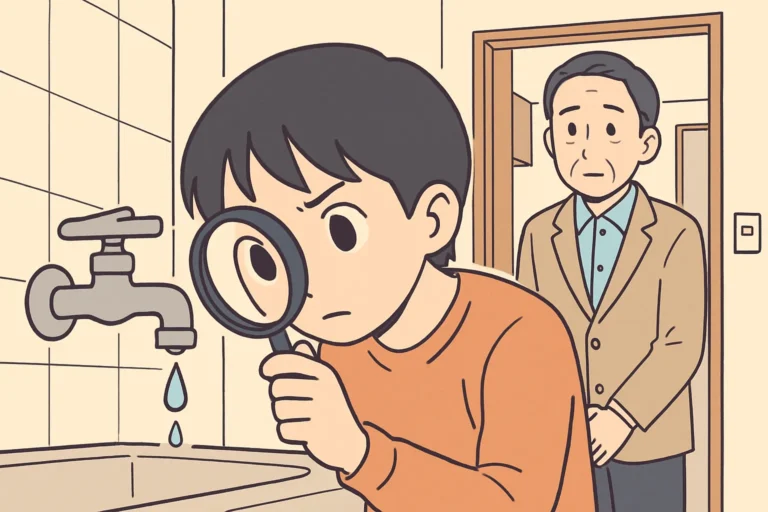
Leaky Faucet? Master Korean Repair Negotiations!
Hello! This is Maeil Hangul, here to upgrade your Korean skills!
Moving to a new place in Korea? Congratulations! But before you sign the contract, there’s a crucial step: the inspection. What do you do if you find a problem, like a leaky faucet or a cracked window? Today, we’re tackling this super practical situation: how to talk about home repairs and negotiate fixes in Korean.
These days in Korea, with housing prices on the rise, it’s a huge trend for young people to buy older apartments and renovate them beautifully. This means the pre-move-in inspection is more important than ever! Knowing how to clearly and politely ask for repairs can save you a lot of money and stress. Let’s get you ready to negotiate like a pro!
Core Expressions You Need to Know
Here are three essential phrases for your home inspection toolkit.
1. Pointing Out a Problem Politely
- Korean: 여기에 문제가 좀 있는 것 같아요.
- Pronunciation [Romanization]: Yeogie munjega jom inneun geot gatayo.
- English Meaning: I think there’s a bit of a problem here.
- Detailed Explanation: This is the perfect opening line. It’s polite, indirect, and much smoother than saying “This is broken!” The grammar point -(으)ㄴ/는 것 같다 means “it seems like…” or “I think that…”. Adding 좀 (a little) softens the statement even more, making you sound considerate.
- 💡 Pronunciation Tip:
The word 같아요 is written asgat-a-yo, but it’s pronounced [가타요 | gatayo]. Why? It’s because of a rule called liaison (연음 | yeoneum). The final consonant sound of a syllable (in this case, the ‘ㅌ’ [t] sound from ‘같’) moves over to the next syllable if it starts with a vowel (like ‘아’). So,gat + ayobecomesga-ta-yo. You’ll hear this everywhere! For example,밭에(in the field) is pronounced[바테 | bate].
2. Requesting a Repair
- Korean: 수리해 주실 수 있을까요?
- Pronunciation [Romanization]: Surihae jusil su isseulkkayo?
- English Meaning: Could you please repair it?
- Detailed Explanation: This is your go-to phrase for politely asking for action. It’s a powerhouse of polite grammar!
- 수리하다 (to repair) + -아/어 주다 (to do something for someone) + -(으)ㄹ 수 있다 (can / to be able to) + -(으)ㄹ까요? (a gentle question form).
It literally means, “Is it possible for you to do the favor of repairing it for me?” and is the gold standard for polite requests.
- 수리하다 (to repair) + -아/어 주다 (to do something for someone) + -(으)ㄹ 수 있다 (can / to be able to) + -(으)ㄹ까요? (a gentle question form).
- 💡 Pronunciation Tip:
Pay attention to 있을까요, which is pronounced [이쓸까요 | isseulkkayo]. This is an example of tensing (경음화 | gyeong-eumhwa). When a syllable ending in certain consonants (like the ‘ㅆ’ [ss] sound in ‘있’) is followed by a syllable starting with ㄱ, ㄷ, ㅂ, ㅅ, or ㅈ, that second consonant becomes its “tense” or “twin” version (ㄲ, ㄸ, ㅃ, ㅆ, ㅉ). So,있-을makes the을sound like쓸. Another common example is학생(student), pronounced[학쌩 | hakssaeng].
3. Negotiating the Cost
- Korean: 수리 비용을 좀 깎아 주시면 안 될까요?
- Pronunciation [Romanization]: Suri biyongeul jom kkakka jusimyeon an doelkkayo?
- English Meaning: Would it be possible to get a discount on the repair cost?
- Detailed Explanation: What if the owner can’t fix it, but you’re willing to do it for a discount on the rent or price? This phrase is perfect. 깎다 means “to cut” or “to discount.” The structure -아/어 주시면 안 될까요? literally means “If you do X for me, would it not be okay?” It’s an extremely common and indirect way to make a request you’re a little hesitant about, like asking for a discount.
- 💡 Pronunciation Tip:
The word 깎아 is pronounced [까까 | kkakka]. When a final consonant (받침) is the same as the consonant that begins the next syllable (which often happens when adding -아/어), the final consonant sound just merges smoothly into the next syllable. So instead of a pause likekkak-a, it flows intokka-kka. It’s the same principle for믿어(believe me), which is pronounced[미더 | mideo].
Sample Dialogue
Let’s see these phrases in action! Here, B (a prospective tenant) is inspecting an apartment with A (the landlord).
A: 집은 어떠세요? 마음에 드세요?
(Jibeun eotteoseyo? Maeume deuseyo?)
How’s the apartment? Do you like it?B: 네, 전반적으로 좋은데… 화장실을 보니까 여기에 문제가 좀 있는 것 같아요. 수도꼭지에서 물이 계속 새네요.
(Ne, jeonbanjeogeuro joeunde… hwajangsireul bonikka yeogie munjega jom inneun geot gatayo. Sudokkokjieseo muri gyesok saeneyo.)
Yes, it’s good overall, but… looking at the bathroom, I think there’s a bit of a problem here. The faucet keeps leaking.A: 아, 정말이요? 제가 꼼꼼히 확인을 못 했네요. 죄송합니다.
(A, jeongmallyo? Jega kkomkkomhi hwagineul mot haenneyo. Joesonghamnida.)
Oh, really? I failed to check it thoroughly. I’m sorry.B: 괜찮습니다. 혹시 제가 입주하기 전에 수리해 주실 수 있을까요?
(Gwaenchanseumnida. Hoksi jega ipjuhagi jeone surihae jusil su isseulkkayo?)
It’s okay. By any chance, could you please repair it before I move in?A: 그럼요! 그건 당연히 해 드려야죠. 바로 사람 불러서 고칠게요.
(Geureomnyo! Geugeon dangyeonhi hae deuryeoyajyo. Baro saram bulleoseo gochilgeyo.)
Of course! I should definitely get that done for you. I’ll call someone to fix it right away.
Culture Tip & Trend Deep Dive
In Korea, the concept of fixing defects is called 하자 보수 (haja bosu). Especially with the trend of buying older homes, which you can see on popular TV shows like “구해줘! 홈즈” (Where is My Home?), negotiating haja bosu is a key skill.
Here’s a tip to sound like a native: Always start politely and indirectly. While it might feel faster to say “이거 고쳐주세요!” (Fix this!), it can come across as demanding and might make the negotiation more difficult. Starting with “~문제가 좀 있는 것 같아요” shows respect and opens the door for a smoother, more successful conversation. Also, always take photos of the issues you find! Having visual proof is a universal language that helps your case immensely.
Let’s Wrap It Up & Practice!
Great work today! You’ve learned how to politely point out a problem, request a repair, and even ask for a discount. These phrases are your best friends during any housing negotiation in Korea.
Now, let’s test your knowledge!
- Fill in the Blank: You notice the wallpaper is peeling in the corner. You want to politely ask the landlord to fix it.
- “벽지가 좀 떴는데, 혹시 ___________?” (The wallpaper is peeling a bit, by any chance ___________?)
- Make a Sentence: You found a small crack on the living room window. How would you politely bring this to the owner’s attention using the
...는 것 같아요pattern?
You’re doing an amazing job. Keep practicing, and you’ll be a confident negotiator in no time!
Why not try making your own sentence in the comments using one of today’s expressions? We’d love to see it
Frequently Asked Questions (FAQ)
Q: What does "하자 보수" mean in Korean and how do you pronounce it?
A: In Korean, "하자 보수" is pronounced [haja bosu] and means: . Especially with the trend of buying older homes, which you can see on popular TV shows like
Q: What does ""구해줘! 홈즈"" mean in Korean and how do you pronounce it?
A: In Korean, ""구해줘! 홈즈"" is pronounced [Where is My Home?] and means: , negotiating







