

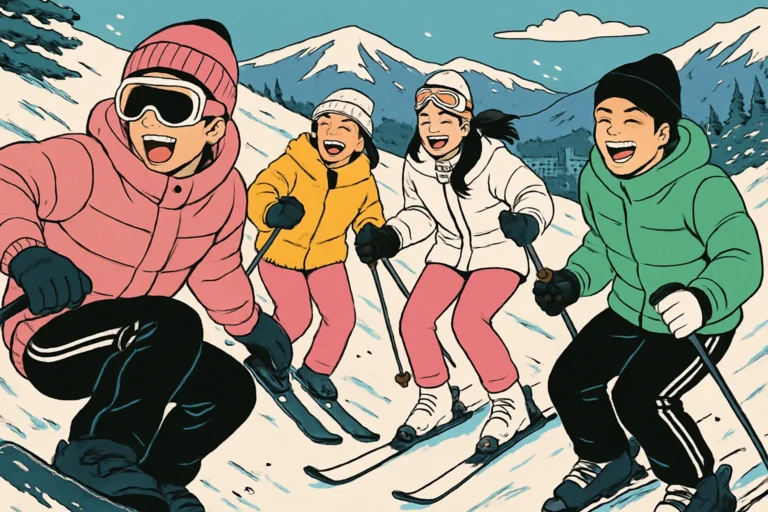
Skiing Like a K-Pop Idol: Your Guide to Korean Winter Sports Lingo
Hello! This is Maeil Hangeul, here to upgrade your Korean skills! ❄️
Are you dreaming of a winter trip to Korea? Or maybe you just want to talk about your favorite winter hobbies with your Korean friends. Well, you’re in luck! Today, we’re going to learn some essential Korean phrases for talking about skiing and snowboarding.
Lately in Korea, hitting the slopes has become a super popular weekend activity, especially for the younger generation. You’ll see social media flooded with amazing pictures from ski resorts. So, let’s learn the key phrases you need to join the conversation and maybe even plan your own trip!
Core Expressions You Need to Know
Here are three simple but powerful expressions to get you started.
1. To go skiing / To go snowboarding
- Korean Expression: 스키 타러 가다 / 스노보드 타러 가다
- Pronunciation [Romanized]: Seuki tareo gada / Seunobodeu tareo gada
- English Meaning: To go skiing / To go snowboarding
- Detailed Explanation: This is the most fundamental phrase! It combines the noun (스키/스노보드) with ‘타러 가다’ (tareo gada), which means “to go in order to ride.” You can use this pattern for many activities, like “놀러 가다 (nolleo gada)” – to go hang out. It’s a casual and very common expression.
- 💡 Pronunciation Tip: The particle ‘-으러’ (euro) or ‘-러’ (reo) is used to show purpose. If the verb stem ends in a consonant, you use ‘-으러’ (e.g., 먹으러 가다, meogeureo gada – to go to eat). If it ends in a vowel, like ‘타다(tada)’, you just add ‘-러’ (reo). Easy, right?
2. I’m not good at it.
- Korean Expression: 잘 못 타요.
- Pronunciation [Romanized]: Jal mot tayo.
- English Meaning: I can’t ride well / I’m not good at it.
- Detailed Explanation: This is a humble and useful way to say you’re a beginner. ‘잘 (jal)’ means “well,” and ‘못 타요 (mot tayo)’ means “cannot ride.” It’s much more natural than saying “I am a bad skier.” If you are good, you can simply say “잘 타요 (jal tayo).”
- 💡 Pronunciation Tip: Pay close attention to the sound of ‘못 타요’. Even though it’s written as
mot-tayo, Koreans pronounce it as [몯따요 / mot-ttayo]. When the final consonant ‘ㅅ(s)’ in ‘못(mot)’ meets the ‘ㅌ(t)’ sound, it creates a tense, double-consonant sound ‘ㄸ(tt)’. This change makes your pronunciation sound much more natural!
3. It’s so much fun!
- Korean Expression: 너무 재미있어요!
- Pronunciation [Romanized]: Neomu jaemiisseoyo!
- English Meaning: It’s so much fun!
- Detailed Explanation: The perfect reaction phrase! ‘너무 (neomu)’ means “so” or “very,” and ‘재미있어요 (jaemiisseoyo)’ means “it’s fun” or “it’s interesting.” You can use this for almost any enjoyable activity, from watching a K-drama to snowboarding down a mountain.
- 💡 Pronunciation Tip: This phrase is a great example of a Korean pronunciation rule called linking sound (연음/yeoneum). The word 재미있다 is made of ‘재미(jaemi)’ + ‘있다(itda)’. When you say it, the final consonant ‘ㅆ(ss)’ from ‘있’ links to the next syllable ‘어(eo)’. So, instead of saying
jaemi-it-eo-yo, the sounds flow together smoothly to become [재미써요 / jaemi-isseo-yo].
Example Conversation
Let’s see how these phrases work in a real conversation!
A: 주말에 뭐 해요? (Jumare mwo haeyo?)
What are you doing this weekend?
B: 친구들이랑 스노보드 타러 가요! 같이 갈래요? (Chingudeurirang seunobodeu tareo gayo! Gachi gallaeyo?)
I’m going snowboarding with friends! Do you want to go with us?
A: 와! 좋네요! 근데 저는 잘 못 타요. 괜찮아요? (Wa! Jonneyo! Geunde jeoneun jal mot tayo. Gwaenchanayo?)
Wow! Sounds great! But I’m not very good at it. Is that okay?
B: 그럼요! 제가 가르쳐 줄게요. 너무 재미있어요! (Geureomyo! Jega gareuchyeo julgeyo. Neomu jaemiisseoyo!)
Of course! I can teach you. It’s so much fun!
Culture Tip & Trend Deep Dive 🏂
In Korea, going to a 스키장 (seukijang – ski resort) is more than just a sport; it’s a whole cultural experience.
The Korean MZ Generation loves posting “인증샷” (ingeung-syat), which means “proof shot” or “certification shot,” on Instagram. After a day on the slopes, they’ll post cool photos of themselves in stylish ski wear with hashtags like #스키스타그램 (seukiseutageuraem – skistagram) or #겨울여행 (gyeoul-yeohaeng – winter trip).
Popular resorts like Yongpyong (where scenes from the famous K-drama Goblin were filmed) or Vivaldi Park are always buzzing with energy. So, if you use the phrases you learned today at a Korean ski resort, you’ll not only be able to communicate but also perfectly blend in with the trendy local vibe!
Let’s Practice!
Time to check what you’ve learned.
- Fill in the blank: Your friend asks you to go skiing. How do you say, “Let’s go skiing!”
스키 ______! (Seuki ______!)
- Your turn! Are you good at snowboarding? Answer in a full Korean sentence.
(If yes): 네, __________. (Ne, __________.)
(If no): 아니요, __________. (Aniyo, __________.)
Great job today! You’re now ready to talk about your winter adventures in Korean.
Why not try leaving a comment below using one of the phrases you learned? See you next time at Maeil Hangeul! ✨
Frequently Asked Questions (FAQ)
Q: What does "'타러 가다'" mean in Korean and how do you pronounce it?
A: In Korean, "'타러 가다'" is pronounced [tareo gada] and means: , which means "to go in order to ride." You can use this pattern for many activities, like "놀러 가다 (nolleo gada)" - to go hang out. It's a casual and very common expression.
Q: What does "'-러'" mean in Korean and how do you pronounce it?
A: In Korean, "'-러'" is pronounced [reo] and means: is used to show purpose. If the verb stem ends in a consonant, you use '-으러' (e.g., 먹으러 가다, meogeureo gada - to go to eat). If it ends in a vowel, like '타다(tada)', you just add '-러' (reo). Easy, right?
Q: What does "스키장" mean in Korean and how do you pronounce it?
A: In Korean, "스키장" is pronounced [seukijang - ski resort] and means: is more than just a sport; it's a whole cultural experience.
Q: What does ""인증샷"" mean in Korean and how do you pronounce it?
A: In Korean, ""인증샷"" is pronounced [ingeung-syat] and means: , which means "proof shot" or "certification shot," on Instagram. After a day on the slopes, they'll post cool photos of themselves in stylish ski wear with hashtags like







