

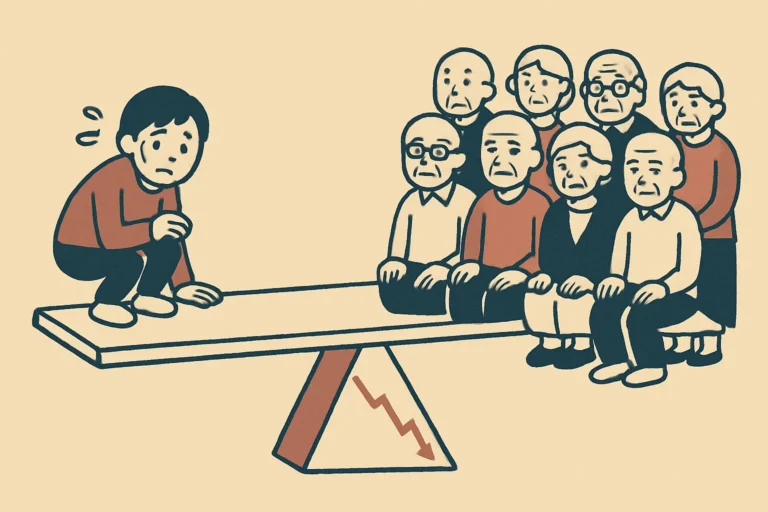
Graying Korea: Master These Key Phrases!
Hello! This is [Maeil Hangeul], here to upgrade your Korean skills!
Have you ever watched Korean news or dramas and heard people talking seriously about the population? Today, we’re going to learn how to talk about a very important topic in modern Korea: the economic impact of an aging population. This might sound complex, but with a few key phrases, you’ll be able to understand and even participate in these conversations! In Korea these days, the “low birthrate” and “aging society” are huge social issues, so knowing these expressions will make you sound incredibly informed and fluent.
Let’s dive in!
Core Expressions You Need to Know
Here are the essential phrases to discuss this topic like a pro.
1. 고령화 사회 (Goryeonghwa sahoe)
- Pronunciation [Romanization]: Go-ryeong-hwa sa-hoe
- English Meaning: Aging society
- Detailed Explanation: This is the key term. Let’s break it down: 고령 (goryeong) means ‘old age’, -화 (-hwa) is a suffix that means ‘-ization’ or ‘becoming’, and 사회 (sahoe) means ‘society’. So, it literally means “a society that is becoming old.” This is a slightly formal term you’ll hear constantly in news reports, articles, and serious discussions.
- 💡 Pronunciation Tip: The ‘ㄹ’ (r/l) in 고령 (goryeong) is a soft ‘r’ sound, almost like an ‘l’. It’s made by lightly tapping the tip of your tongue behind your front teeth. Practice saying “goryeong” smoothly, not like a hard English ‘r’.
2. 저출산 (Jeochulsan)
- Pronunciation [Romanization]: Jeo-chul-ssan
- English Meaning: Low birthrate
- Detailed Explanation: This is the root cause of the aging society issue. 저 (jeo) means ‘low’ and 출산 (chulsan) means ‘childbirth’. Together, they mean ‘low birthrate’. This word is always paired with 고령화 사회.
- 💡 Pronunciation Tip: Notice the first syllable is ‘저 (jeo)’, not ‘jo’. Keep your mouth relaxed. The second syllable, ‘출 (chul)’, has an aspirated ‘ch’ sound. You should feel a puff of air if you put your hand in front of your mouth. For ‘산 (san)’, it’s pronounced with a tensed [ssan] sound because of the consonant that comes before it. It sounds stronger than a regular ‘s’.
3. 감소하다 (Gamsohada)
- Pronunciation [Romanization]: Gam-so-ha-da
- English Meaning: To decrease; to decline
- Detailed Explanation: This is a crucial verb for this topic. You can use it to talk about many things: “the population is decreasing” (인구가 감소해요) or “the workforce is decreasing” (노동력이 감소해요). It’s a versatile verb for any context involving numbers going down.
- 💡 Pronunciation Tip: The pronunciation here is quite straightforward and follows the letters. Just remember to pronounce each syllable clearly: 감 (gam) – 소 (so) – 하 (ha) – 다 (da).
4. ~에 영향을 미치다 (~e yeonghyang-eul michida)
- Pronunciation [Romanization]: ~e yeong-hyang-eul mi-chi-da
- English Meaning: To have an impact on ~; to affect ~
- Detailed Explanation: This is a key grammar pattern to explain cause and effect. You attach it to the noun that is being affected. For example, “It affects the economy” would be “경제에 영향을 미치다 (gyeongje-e yeonghyang-eul michida).”
- 💡 Pronunciation Tip: When you say 영향을 (yeonghyang-eul), the final consonant ‘ㅇ (ng)’ of ‘향 (hyang)’ links to the next syllable ‘을 (eul)’. So, it sounds like one smooth word: [yeonghyangeul]. This linking rule, called ‘연음 (yeoneum)’, is super important for sounding natural in Korean!
Example Dialogue
Let’s see how these expressions are used in a real conversation.
A: I saw on the news that the Korean economy is facing some challenges.
(뉴스에서 한국 경제가 어렵다는 이야기를 봤어.)
B: 맞아. 요즘 한국은 저출산 때문에 고령화 사회가 되고 있잖아.
(Maja. Yojeum han-gug-eun jeochulsan ttaemun-e goryeonghwa sahoe-ga doego itjana.)
Right. Because of the low birthrate, Korea is becoming an aging society.
A: 아, 그래서 일할 수 있는 사람이 줄어드는구나.
(A, geuraeseo ilhal su inneun saram-i jureodeuneun-guna.)
Ah, so the number of people who can work is decreasing.
B: 응. 일하는 인구가 감소해서 경제에 영향을 미치고 있어.
(Eung. Ilhaneun in-guga gamsohaeseo gyeongje-e yeonghyang-eul michigo isseo.)
Yes. The working population is decreasing, so it’s having an impact on the economy.
Culture Tip & Trend Deep Dive
In Korea, the speed of population aging is one of the fastest in the world. This isn’t just a topic for economists; it’s a real-life concern for everyone.
- Why it matters to young Koreans: For the Korean Z generation, this is a very personal topic. They worry about immense competition for jobs, the pressure to support a larger elderly population in the future, and whether they can even afford to have families themselves, which contributes to the 저출산 (low birthrate) problem.
- How to sound like a native: When you use these phrases, you show that you understand a core social issue in modern Korea. If you want to sound even more advanced, you can mention the 생산가능인구 (saengsan-ganeung-in-gu), which means the “working-age population.” For example: “고령화 사회가 되면 생산가능인구가 감소해요.” (In an aging society, the working-age population decreases.) Using this specific term will surely impress your Korean friends!
Let’s Recap & Practice!
Great job! Today we learned four key expressions to talk about Korea’s aging population and its economic impact: 고령화 사회, 저출산, 감소하다, and ~에 영향을 미치다.
Now, let’s test your knowledge!
1. Fill in the blank:
한국은 (___________) 문제 때문에 일하는 인구가 (___________) 있어요. 이것이 경제에 나쁜 (___________) 미쳐요.
Choices: 영향을, 감소하고, 저출산
2. Make a sentence:
Try to make your own short sentence using 고령화 사회 (aging society).
Leave your answers in the comments below! We’d love to see what you come up with. Keep up the great work
Frequently Asked Questions (FAQ)
Q: What does "고령" mean in Korean and how do you pronounce it?
A: In Korean, "고령" is pronounced [goryeong] and means: means 'old age',
Q: What does "-화" mean in Korean and how do you pronounce it?
A: In Korean, "-화" is pronounced [-hwa] and means: is a suffix that means '-ization' or 'becoming', and
Q: What does "사회" mean in Korean and how do you pronounce it?
A: In Korean, "사회" is pronounced [sahoe] and means: means 'society'. So, it literally means "a society that is becoming old." This is a slightly formal term you'll hear constantly in news reports, articles, and serious discussions.
Q: What does "고령" mean in Korean and how do you pronounce it?
A: In Korean, "고령" is pronounced [goryeong] and means: is a soft 'r' sound, almost like an 'l'. It's made by lightly tapping the tip of your tongue behind your front teeth. Practice saying "goryeong" smoothly, not like a hard English 'r'.







