

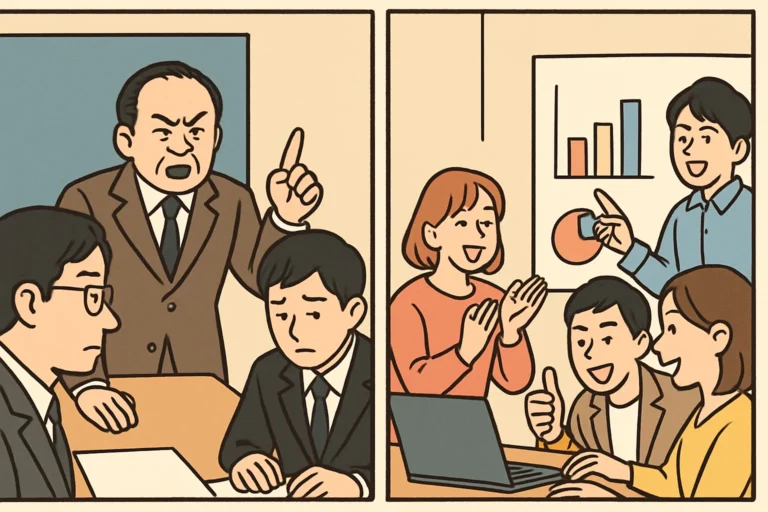
From ‘Kkondae’ Meetings to MZ Efficiency!
Hello! Welcome to [Daily Korean], where we upgrade your Korean skills!
Ever felt stuck in a meeting that goes on forever without a clear purpose? You’re not alone! Today, we’re going to learn how to suggest a more efficient meeting culture, just like the new generation in Korean workplaces.
These days in Korea, the MZ generation (a term for Millennials and Gen Z) is changing the game at work. They value speed, efficiency, and clear communication over the old, hierarchical ways. So, if you want to sound like a savvy, modern professional in a Korean office, these phrases are your secret weapon! Let’s dive in.
Core Expressions for Efficient Meetings
Here are three key phrases you can use to politely suggest a better way to hold meetings.
1. 핵심만 간단히 (Haeksimman Gandanhi)
- Pronunciation [Romanization]: [Haeksimman Gandanhi]
- English Meaning: Just the key points, briefly.
- Detailed Explanation: This phrase is a perfect way to express the need for conciseness. It’s polite but direct. You can use it to suggest that reports or discussions should focus only on the most important information to save time. It shows you value everyone’s time. You can use it in a sentence like, “핵심만 간단히 말씀해 주세요” (Please state just the key points briefly).
- 💡 Pronunciation Tip:
The word 핵심만 is pronounced [핵심만/haeksimman], not [haeksipman]. Why? Because of a rule called nasalization (비음화). When a final consonant like ‘ㅂ(p)’ is followed by a nasal consonant like ‘ㅁ(m)’ or ‘ㄴ(n)’, the ‘ㅂ(p)’ sound changes to a ‘ㅁ(m)’ sound to make it easier to pronounce. It’s a small change that makes you sound much more natural!
2. 안건을 미리 공유하다 (An-geoneul Miri Gong-yuhada)
- Pronunciation [Romanization]: [An-geo-neul Miri Gong-yuhada]
- English Meaning: To share the agenda in advance.
- Detailed Explanation: This is a fundamental principle of any productive meeting. By suggesting this, you show that you are proactive and want everyone to come prepared. The most polite way to suggest this is by using the -면 좋겠다 (it would be nice if…) grammar pattern: “안건을 미리 공유해 주시면 좋겠습니다” (It would be great if you could share the agenda in advance).
- 💡 Pronunciation Tip:
Listen closely to 안건을. It’s not pronounced [an-geon-eul] with a pause. Instead, it’s pronounced [안거늘/an-geo-neul]. This is a basic and very important Korean pronunciation rule called linking sound (연음). When a syllable ending in a consonant is followed by a syllable starting with the silent ‘ㅇ’ vowel, the consonant sound “links” or moves over to the next syllable. So, 안건 + 을 becomes [안거늘]!
3. 자유롭게 아이디어를 내다 (Jayuropge Aidieoreul Naeda)
- Pronunciation [Romanization]: [Jayuropge Aidieoreul Naeda]
- English Meaning: To share ideas freely.
- Detailed Explanation: This phrase is perfect for shifting the meeting’s atmosphere from a top-down report to a collaborative brainstorming session. It encourages a more horizontal culture where everyone, regardless of their position, feels comfortable contributing. You can use it as a suggestion: “자유롭게 아이디어를 내봅시다!” (Let’s share ideas freely!).
- 💡 Pronunciation Tip:
In the word 자유롭게 [jayuropge], the ‘ㅂ’ sound in ‘롭’ is clearly pronounced as a [p] sound before the ‘게’ starts. Pay attention to the clear separation of consonants. Also, in the word 내봅시다 [naebopsida], the ending ‘-ㅂ시다’ (let’s…) is a classic suggestion form. Practice saying it clearly to make your suggestions sound confident and friendly.
Example Dialogue
Let’s see how these phrases work in a real conversation between a new employee (Min-jun) and his team leader (Daeri Ji-hye).
A: 민준 (Min-jun)
대리님, 다음 주 주간 회의는 좀 더 효율적으로 진행하는 게 어떨까요?
(Daeri-nim, how about we run next week’s weekly meeting a bit more efficiently?)
B: 지혜 대리 (Daeri Ji-hye)
좋은 생각이에요, 민준 씨. 구체적인 아이디어 있어요?
(That’s a good idea, Min-jun. Do you have any specific ideas?)
A: 민준 (Min-jun)
네. 회의 전에 안건을 미리 공유해 주시면 다들 준비를 더 잘해올 것 같아요. 그리고 회의 때는 핵심만 간단히 이야기하고, 자유롭게 아이디어를 내보는 시간을 가지면 좋겠습니다.
(Yes. If you could share the agenda before the meeting, I think everyone could come better prepared. And during the meeting, it would be great if we could talk about just the key points briefly and have time to share ideas freely.)
B: 지혜 대리 (Daeri Ji-hye)
아주 좋은 제안이네요! 다음 주부터 바로 그렇게 해봅시다.
(That’s an excellent suggestion! Let’s start doing that right away next week.)
Culture Tip: Avoiding “Kkondae” Culture
So, what’s the big deal with meeting efficiency in Korea? It’s all connected to a key cultural concept: 꼰대 (Kkondae).
A 꼰대 (Kkondae) is a term, often used humorously, to describe an older person (usually a boss) who is stuck in their old ways and often lectures younger people. Classic “kkondae” behavior includes hosting long, pointless meetings where only they do the talking.
The MZ generation strongly dislikes this culture. By using phrases like the ones we learned today, you are not just suggesting a better workflow; you are actively participating in the modern, horizontal communication style that is becoming the new standard in Korean companies. Using these expressions shows that you are a flexible, collaborative, and trendy professional—the opposite of a kkondae! You’ll often see this cultural shift portrayed in recent K-dramas about office life, like Start-Up or Run On.
Let’s Practice!
Ready to test your knowledge?
- Fill in the blank: To make a meeting shorter and more focused, you can suggest, “____________ 말씀해 주세요.”
(Answer: 핵심만 간단히) -
Your Turn! You want to suggest a brainstorming session for a new project. What would you say to your team members in Korean?
You did an amazing job today! Making suggestions at work can be intimidating, but with these phrases, you’re ready to shine.
Try leaving a comment below using one of today’s expressions! How would you make your meetings better? See you next time
Frequently Asked Questions (FAQ)
Q: What does "자유롭게" mean in Korean and how do you pronounce it?
A: In Korean, "자유롭게" is pronounced [jayuropge] and means: , the 'ㅂ' sound in '롭' is clearly pronounced as a [p] sound before the '게' starts. Pay attention to the clear separation of consonants. Also, in the word
Q: What does "내봅시다" mean in Korean and how do you pronounce it?
A: In Korean, "내봅시다" is pronounced [naebopsida] and means: , the ending '-ㅂ시다' (let's...) is a classic suggestion form. Practice saying it clearly to make your suggestions sound confident and friendly.
Q: What does "A: 민준" mean in Korean and how do you pronounce it?
A: In Korean, "A: 민준" is pronounced [Min-jun] and means: 대리님, 다음 주 주간 회의는 좀 더 효율적으로 진행하는 게 어떨까요?
Q: What does "B: 지혜 대리" mean in Korean and how do you pronounce it?
A: In Korean, "B: 지혜 대리" is pronounced [Daeri Ji-hye] and means: 좋은 생각이에요, 민준 씨. 구체적인 아이디어 있어요?







