

Korean Humor 101: From Slapstick Gags to Witty Puns
Hello everyone! Welcome back to [Maeil Hangeul], the blog that will upgrade your Korean skills!
Today, we’re diving into a topic that will not only make you sound more like a native speaker but also help you truly understand Korean culture: humor! Specifically, we’ll explore the difference between simple physical comedy and the clever, witty humor that’s taking over Korean media.
Lately, in Korea, there’s been a huge shift. While slapstick comedy still has its place, web variety shows like ‘Psick Univ’ and ‘The Genius’ are incredibly popular for their sharp, dialogue-based wit. Understanding this type of humor is key to enjoying the latest content and connecting with people on a deeper level. Ready to level up your comedy game? Let’s go!
Core Expressions: The Building Blocks of Korean Wit
Here are three essential expressions you’ll hear constantly in witty conversations and modern Korean comedy shows.
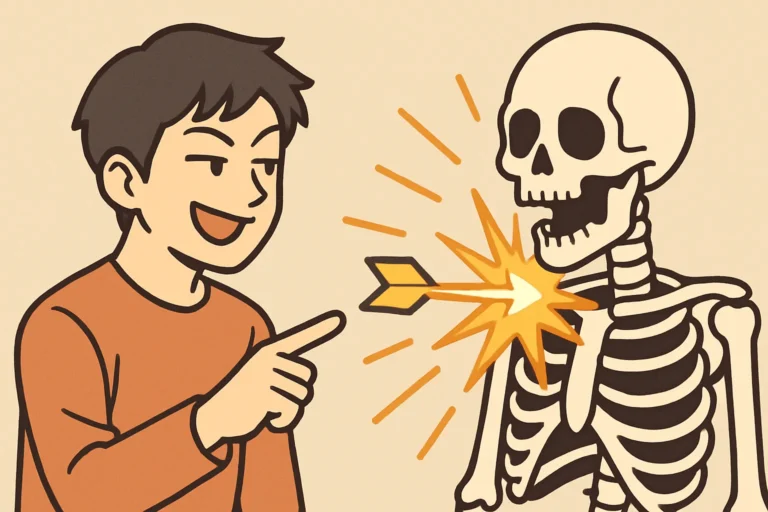
1. 뼈 때리다 (ppyeo ttaerida)
- Pronunciation [ppyeo ttaerida]
- English Meaning: Literally “to hit the bone.” It means to say something that is a harsh, undeniable truth; a “truth bomb.”
- Detailed Explanation: This phrase is used when someone makes a comment that is so accurate and insightful that it’s almost painful, like a direct hit to the bone. It’s not necessarily mean-spirited; it’s often used to describe a sharp, clever observation that gets right to the heart of a matter, often in a funny way. It’s a key component of modern satirical and observational humor.
- 💡 Pronunciation Tip:
The challenge here is the tense consonants ‘ㅃ’ (pp) and ‘ㄸ’ (tt). Unlike their softer cousins ‘ㅂ’ (b/p) and ‘ㄷ’ (d/t), these sounds are produced with no puff of air. Tense your throat slightly as you say them, making the sound sharp and clipped. Think of the “p” in “spy” or the “t” in “stop.” This tension is what distinguishes 뼈 [ppyeo] from 벼 [byeo] and 펴 [pyeo].
2. 아재 개그 (ajae gaegeu)
- Pronunciation [ajae gaegeu]
- English Meaning: “Dad joke.”
- Detailed Explanation: ‘아재’ (ajae) is an informal term for a middle-aged man, and ‘개그’ (gaegeu) comes from the English word “gag” (joke). So, an ‘아재 개그’ is a classic “dad joke”—usually a pun that’s so cheesy it makes you groan and laugh at the same time. While it might seem like simple humor, understanding the wordplay in these jokes is a fantastic test of your Korean vocabulary and cultural knowledge.
- 💡 Pronunciation Tip:
The vowel ‘ㅐ’ (ae) in 아재 and 개그 is technically different from ‘ㅔ’ (e), but in modern Seoul Korean, their pronunciations have almost completely merged. You can pronounce them both like the “e” in the word “bed.” So don’t stress too much about distinguishing them—most Koreans don’t!
3. 드립 (deurip)
- Pronunciation [deurip]
- English Meaning: An ad-lib, a witty remark, or a clever joke.
- Detailed Explanation: This is a crucial piece of modern Korean slang, derived from the English “ad-lib.” A ‘드립’ is a spontaneous, witty comment thrown into a conversation. Someone who is good at this is said to have ‘드립력’ (deurimnyeok), or “ad-libbing skill.” This concept is central to the fast-paced, back-and-forth humor you see on popular variety shows. It’s not a pre-written joke, but a sign of quick thinking.
- 💡 Pronunciation Tip:
The final consonant ‘ㅂ’ (b) in ‘드립’ is an “unreleased stop.” This means you close your lips to make the ‘p’ sound, but you don’t release the puff of air that normally follows. It should sound like a very soft, abrupt stop. Try saying “stop” but don’t pronounce the “op” part. That’s the sound you’re aiming for: [deurip], not [deuribeu].
Example Dialogue
Let’s see how these expressions work in a real conversation. Two friends, A and B, are watching a popular comedy talk show.
A: 방금 저 코미디언 말 들었어? 게스트의 문제점을 정확히 짚어냈네.
(Bangeum jeo komidieon mal deureosseo? Geseuteuui munjejjeomeul jeonghwaki jipeonaenne.)
Did you hear what that comedian just said? He pointed out the guest’s problem so accurately.
B: 응, 완전 뼈 때리는 드립이었어. 저런 지적인 유머가 요즘 대세인 것 같아.
(Eung, wanjeon ppyeo ttaerineun deuripieosseo. Jeoreon jijeogin yumeoga yojeum daesein geot gata.)
Yeah, that was a total truth-bomb ad-lib. It seems like that kind of intellectual humor is the trend these days.
A: 맞아. 우리 아빠가 맨날 하시는 아재 개그랑은 차원이 다르지.
(Maja. Uri appaga maennal hasineun ajae gaegeurangeun chawoni dareuji.)
I agree. It’s on a whole different level from the dad jokes my father tells all the time.
B: 하하, 그래도 가끔은 그런 유머도 재밌지 않아?
(Haha, geuraedo gakkeumeun geureon yumeodo jaemitji ana?)
Haha, but aren’t those kinds of jokes fun sometimes too?
Culture Tip & Trend Deep Dive
In Korea, the ability to engage in witty banter is becoming an increasingly valued social skill, especially among younger generations. The term ‘드립력’ (deurimnyeok), or “ad-lib skill,” is often used to praise someone’s quick wit.
This is a departure from the more slapstick-focused comedy that dominated older shows. While physical comedy is universal, the humor in shows like ‘Psick Univ’ relies heavily on cultural context, subtle wordplay, and sharp observations.
The concept of ‘뼈 때리다’ is also tied to a cultural trend known as ‘팩트 폭행’ (paekteu pokaeng), which literally means “fact assault.” It refers to overwhelming someone with cold, hard facts. In a humorous context, a “bone-hitting” comment is a form of ‘팩트 폭행’ that is so clever and true that you can’t help but laugh. Mastering this kind of humor shows a sophisticated understanding of not just the language, but the social dynamics at play.
Wrap-up & Practice Time!
Today, we learned how to distinguish between different types of Korean humor by looking at three key expressions: 뼈 때리다 (a truth bomb), 아재 개그 (a dad joke), and 드립 (a witty ad-lib). Using these will help you better understand modern Korean content and participate in more nuanced conversations.
Now, let’s put your knowledge to the test!
- Fill in the blank: Your friend made a spontaneous and hilarious comment during your conversation. You can praise them by saying, “와, 너 ___________ 장난 아니다!” (Wow, your ___________ is no joke!).
- Your turn: Think of a time a friend told you a funny but harsh truth. How would you describe that moment in Korean using ‘뼈 때리다’?
Leave your answers in the comments below! We’d love to see you practice these new expressions. See you next time at [Maeil Hangeul]
Frequently Asked Questions (FAQ)
Q: What does "뼈" mean in Korean and how do you pronounce it?
A: In Korean, "뼈" is pronounced [ppyeo] and means: from 벼 [byeo] and 펴 [pyeo].
Q: What does "'드립력'" mean in Korean and how do you pronounce it?
A: In Korean, "'드립력'" is pronounced [deurimnyeok] and means: , or "ad-libbing skill." This concept is central to the fast-paced, back-and-forth humor you see on popular variety shows. It's not a pre-written joke, but a sign of quick thinking.
Q: What does "'드립력'" mean in Korean and how do you pronounce it?
A: In Korean, "'드립력'" is pronounced [deurimnyeok] and means: , or "ad-lib skill," is often used to praise someone's quick wit.
Q: What does "'팩트 폭행'" mean in Korean and how do you pronounce it?
A: In Korean, "'팩트 폭행'" is pronounced [paekteu pokaeng] and means: , which literally means "fact assault." It refers to overwhelming someone with cold, hard facts. In a humorous context, a "bone-hitting" comment is a form of '팩트 폭행' that is so clever and true that you can't help but laugh. Mastering this kind of humor shows a sophisticated understanding of not just the language, but the social dynamics at play.







