

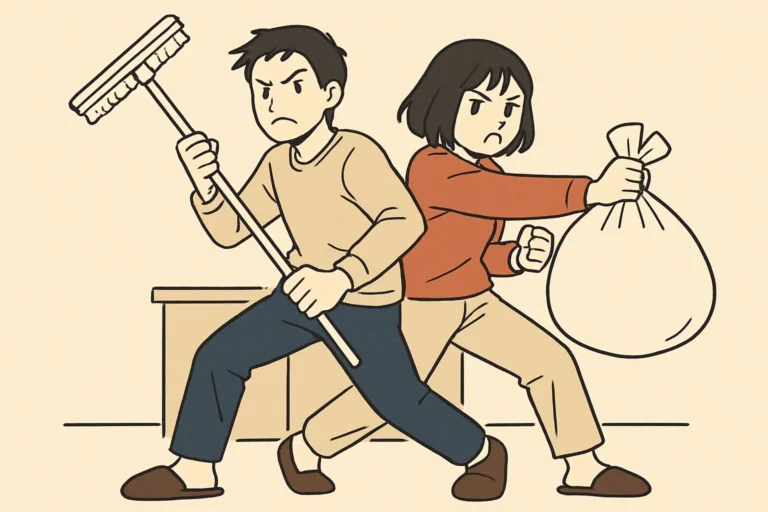
Peaceful Cohabitation 101: How to Divide Chores in Korean!
Hello! This is Maeil Hangul (Daily Korean), here to upgrade your Korean skills!
Ever had that awkward moment with a roommate where the trash is overflowing, but no one wants to bring it up? Today, we’re going to learn how to solve that problem like a pro! We’ll cover essential Korean phrases for making suggestions, agreeing, and disagreeing, specifically for dividing house chores.
Lately in Korea, living in share houses (셰어하우스) has become super popular, especially among young people in big cities like Seoul. You see it all the time in popular reality shows like “Heart Signal” (하트시그널)! So, knowing how to communicate clearly and politely with your housemates is a more useful skill than ever. Let’s learn how to create a peaceful home together!
Key Expressions for House Rules
Here are some must-know phrases to help you negotiate chores with your Korean roommate.
1. ~는 게 어때? (neun ge eottae?) – How about doing…?
- Korean Expression: 우리 집안일 분담하는 게 어때? (Uri jibanil bundamhaneun ge eottae?)
- Pronunciation [Romanization]: [Uri jibanil bundamhaneun ge eottae?]
- English Meaning: How about we divide the house chores?
- Detailed Explanation: This is the perfect, gentle way to make a suggestion. It’s not a command, but an invitation to discuss something. You can use it for anything, from suggesting a movie (
영화 보는 게 어때?– How about watching a movie?) to chores. It’s formed by adding -는 게 어때(요)? to a verb stem. Use어때?with close friends and어때요?to be more polite. - 💡 Pronunciation Tip: The double consonant
ㄸin어때(eottae) has a tensed sound. It’s stronger and sharper than a singleㄷ(d/t). Imagine holding your breath for a split second before saying “ttae.” This tensed sound is a key feature of Korean, so practice it!
2. 나는 찬성이야. (Naneun chanseong-iya.) – I agree / I’m for it.
- Korean Expression: 좋은 생각이야. 나는 찬성이야! (Joeun saenggak-iya. Naneun chanseong-iya!)
- Pronunciation [Romanization]: [Joeun saenggak-iya. Naneun chanseong-iya!]
- English Meaning: That’s a good idea. I agree!
- Detailed Explanation: This is a clear and direct way to show your agreement.
찬성(chanseong) means “approval” or “agreement.” The opposite is반대(bandae), meaning “opposition.” So if you disagree, you can say나는 반대야(Naneun bandae-ya). The ending-이야(iya) is a casual way to say “it is,” used after a noun ending in a consonant. - 💡 Pronunciation Tip: The word
찬성is pronounced [chanseong]. Notice how theㄴ(n) sound at the end of찬(chan) is a clear nasal sound. Make sure you don’t drop it. Also, theㅊ(ch) sound is aspirated, meaning you should release a small puff of air when you say it, like the ‘ch’ in “chart.”
3. 그럼 이렇게 하자. (Geureom ireoke haja.) – Then, let’s do it like this.
- Korean Expression: 그럼 이렇게 하자. 내가 요리할게, 네가 설거지해. (Geureom ireoke haja. Naega yorihalkke, nega seolgeojihae.)
- Pronunciation [Romanization]: [Geureom ireoke haja. Naega yorihalkke, nega seolgeojihae.]
- English Meaning: Then, let’s do it like this. I’ll cook, you do the dishes.
- Detailed Explanation: This phrase is perfect for when you’ve agreed on an idea and are now making a concrete plan.
그럼(geureom) means “then,”이렇게(ireoke) means “like this,” and the -자 (ja) ending is the casual “Let’s…” form. It shows you’re ready to take action. - 💡 Pronunciation Tip: When Koreans speak quickly, the ‘ㅎ’ (h) sound in
이렇게(ireoke) often gets weakened or disappears. So, it can sound more like [이러케 (ireoke)]. This is a very common pronunciation rule called ‘h’ reduction. Sounding more natural is all about these little details!
Example Dialogue
Let’s see how these phrases work in a real conversation between roommates, Sujin and Mark.
- 수진 (Sujin): 마크, 요즘 집이 좀 지저분한 것 같아. 우리 집안일 분담하는 게 어때?
(Mark, I think the house is a bit messy these days. How about we divide the chores?) - 마크 (Mark): 좋아! 나는 찬성이야. 어떻게 나눌까?
(Sounds good! I agree. How should we divide them?) - 수진 (Sujin): 음… 그럼 이렇게 하자. 내가 화장실이랑 분리수거를 할게. 너는 거실 청소랑 음식물 쓰레기 버리기를 맡아줘.
(Hmm… Then, let’s do it like this. I’ll take care of the bathroom and recycling. You be in charge of cleaning the living room and throwing out the food waste.) - 마크 (Mark): 완벽해! 공평한 것 같아. 그렇게 하자!
(Perfect! Seems fair. Let’s do that!)
Culture Tip & Trend Deep Dive
In Korea, setting clear house rules (집 규칙 – jip gyuchik) is considered a very mature and considerate way to live together. It’s not about being strict; it’s about respecting each other’s space and effort to prevent future arguments.
One chore mentioned in the dialogue, 분리수거 (bullisugeo), is a HUGE deal in Korea. It means “separate collection” or recycling. Korean households have to separate paper, plastic, cans, glass, and food waste into different bags or bins. If you live in Korea, mastering 분리수거 will definitely make you look like a local and earn you respect from your roommates! Using a phrase like “공평하게 하자 (gongpyeonghage haja – Let’s be fair)” shows that you value harmony, which is a very important concept in Korean culture.
Let’s Review & Practice!
Great job today! We learned how to make suggestions (~는 게 어때?), agree (나는 찬성이야), and make a plan (이렇게 하자). Now you’re ready to have a productive chat with your roommate!
Time for a quick quiz to check your understanding.
- Fill in the blank: You want to suggest ordering chicken for dinner.
“오늘 저녁에 치킨 시켜 ______?” - Make a sentence: Your friend suggests cleaning on Saturday, and you agree. How would you say, “Okay! I agree!” in Korean?
Leave your answers in the comments below using the phrases we learned today! Keep practicing, and you’ll be a master of Korean negotiations in no time
Frequently Asked Questions (FAQ)
Q: What does "수진" mean in Korean and how do you pronounce it?
A: In Korean, "수진" is pronounced [Sujin] and means: 마크, 요즘 집이 좀 지저분한 것 같아. 우리 집안일 분담하는 게 어때?
Q: What does "마크" mean in Korean and how do you pronounce it?
A: In Korean, "마크" is pronounced [Mark] and means: 좋아! 나는 찬성이야. 어떻게 나눌까?
Q: What does "수진" mean in Korean and how do you pronounce it?
A: In Korean, "수진" is pronounced [Sujin] and means: 음... 그럼 이렇게 하자. 내가 화장실이랑 분리수거를 할게. 너는 거실 청소랑 음식물 쓰레기 버리기를 맡아줘.
Q: What does "마크" mean in Korean and how do you pronounce it?
A: In Korean, "마크" is pronounced [Mark] and means: 완벽해! 공평한 것 같아. 그렇게 하자!







