

Beyond the Screen: How Korean Brands Win Over Your Senses
Hello! Welcome to [Maeil Hangeul], the place to upgrade your Korean skills!
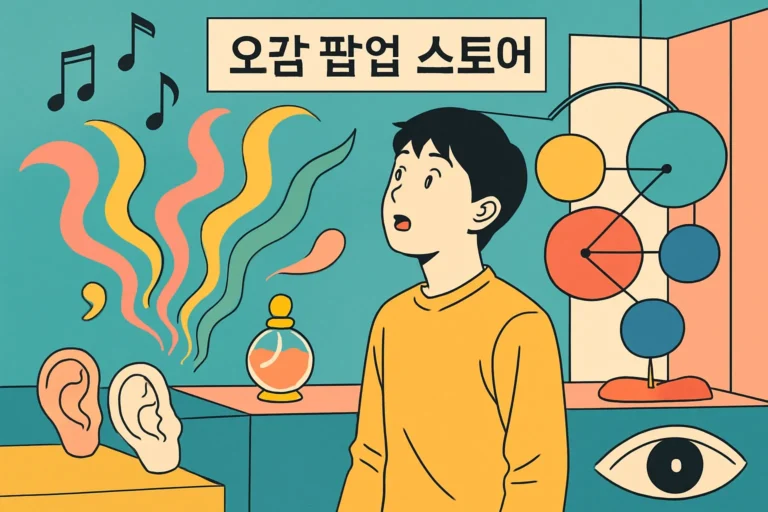
Have you ever walked into a store and felt an immediate connection, not just to the products, but to the entire atmosphere? The subtle scent, the curated playlist, the stunning visuals… that’s not an accident. It’s a powerful strategy, and today, we’re diving deep into the world of Sensory Marketing (오감 마케팅).
Especially these days in Korea, the competition among brands is fierce. To stand out, they’re no longer just selling products; they’re selling experiences. From viral pop-up stores in Seongsu-dong to immersive flagship stores in Gangnam, brands are creating unforgettable worlds for their customers. Today, we’ll learn the advanced Korean vocabulary you need to analyze and discuss this fascinating trend like a native speaker.
Core Expressions You Need to Know
Here are three key expressions that will help you dissect the magic of Korean marketing.
1. 오감을 자극하다 (Ogam-eul jageukada)
- Romanization: [Ogam-eul jageukada]
- English Meaning: To stimulate the five senses.
- Detailed Explanation: This is the foundational phrase for our topic. ‘오감’ (ogam) literally means ‘five senses’ (sight, hearing, smell, taste, touch), and ‘자극하다’ (jageukada) means ‘to stimulate’ or ‘to provoke’. This phrase is used in business and marketing contexts to describe a strategy that intentionally engages all senses to create a powerful brand impression. It implies a conscious and strategic effort by the brand.
- 💡 Pronunciation Tip:
When you say ‘오감을’, the final consonant ‘ㅁ’ (m) from ‘감’ links directly to the following vowel ‘을’, making the sound [오가믈] (o-ga-meul). This is a liaison rule called ‘연음’ (yeoneum), and mastering it will make your Korean sound much more fluid and natural.
2. 공감각적 경험 (Gong-gamgak-jeok gyeongheom)
- Romanization: [Gong-gamgak-jjeok gyeongheom]
- English Meaning: A synesthetic experience.
- Detailed Explanation: This is a sophisticated, C1-level term. ‘공감각’ (gong-gamgak) means ‘synesthesia’—the phenomenon where the stimulation of one sense leads to an automatic experience in a second sense (e.g., ‘hearing’ a color). In marketing, a ‘공감각적 경험’ refers to a masterfully designed experience where different sensory inputs blend together to create a single, powerful, and unique brand feeling. Think of a perfume brand that uses specific visual art and music to ‘express’ a scent.
- 💡 Pronunciation Tip:
The character ‘적’ is often tensed after a noun. So, instead of [jeok], it’s pronounced with a strong ‘ㅉ’ (jj) sound, like [쩍] (jjeok). This is a common phonetic change called ‘경음화’ (gyeong-eumhwa), or tensification. Practice saying ‘공감각쩍’ to sound more like a native speaker.
3. 입소문을 타다 (Ipsomun-eul tada)
- Romanization: [Ip-sso-mun-eul tada]
- English Meaning: To go viral by word-of-mouth; to be the talk of the town.
- Detailed Explanation: ‘입소문’ (ipsomun) combines ‘입’ (ip, mouth) and ‘소문’ (somun, rumor). ‘타다’ (tada) means ‘to ride’. So, you are literally ‘riding the rumor of the mouth’. This is the most common and natural way to say something is spreading through word-of-mouth, both online and offline. It’s the ultimate goal of any great sensory marketing campaign.
- 💡 Pronunciation Tip:
When the final consonant ‘ㅂ’ (p) in ‘입’ meets the ‘ㅅ’ (s) in ‘소문’, it causes the ‘ㅅ’ to become a tensed ‘ㅆ’ (ss). So, you don’t pronounce it as ‘ip-so-mun’, but as [입쏘문] (ip-sso-mun). This is another example of tensification (‘경음화’) and is a key detail that distinguishes advanced learners.
Example Dialogue
Let’s see how these phrases work in a real conversation about a trendy pop-up store.
A: 성수동에 새로 생긴 탬버린즈 팝업 스토어 가 봤어? 완전 핫플레이스래.
(Seongsu-dong-e saero saenggin Tamburins pap-eop seuto-eo ga bwasseo? Wanjeon hat-peulle-isu-rae.)
(Have you been to the new Tamburins pop-up store in Seongsu-dong? I heard it’s a super hot spot.)
B: 아, 인스타에서 엄청 입소문 탄 거기? 후기 보니까 단순히 화장품만 파는 게 아니라던데.
(A, Inseuta-eseo eomcheong ipsomun tan geogi? Hugi bonikka dansunhi hwajangpum-man paneun ge aniradeonde.)
(Oh, the one that’s gone viral on Instagram? I saw some reviews; they said it’s not just selling cosmetics.)
A: 맞아. 공간 디자인부터 향기, 음악까지 모든 게 완벽하게 계산되어 있어. 말 그대로 소비자의 오감을 자극하더라.
(Maja. Gonggan dijain-buteo hyanggi, eumak-kkaji modeun ge wanbyeokage gyesan-doe-eo isseo. Mal geudaero sobija-ui ogam-eul jageukadeora.)
(Exactly. Everything from the spatial design to the scent and music is perfectly calculated. It literally stimulates the consumer’s five senses.)
B: 와, 그 정도야? 완전 공감각적 경험을 제공하는 거네. 그러니까 사람들이 그렇게 열광하는구나.
(Wa, geu jeongdo-ya? Wanjeon gong-gamgak-jeok gyeongheom-eul jegonghaneun geone. Geureonikka saramdeuri geureoke yeolgwanghaneunguna.)
(Wow, is it that good? So they’re providing a complete synesthetic experience. No wonder people are so enthusiastic about it.)
Culture Tip & Trend Analysis: The “Instagrammable” Experience Economy
Why is sensory marketing so huge in Korea right now? It’s all about the “Experience Economy.”
Especially for the Korean Z-generation (Z세대), the value of a product isn’t just in its function but in the experience and story surrounding it. This is why brands like Tamburins and Gentle Monster are winning. They don’t just create stores; they create art galleries and fantasy worlds.
These spaces are meticulously designed to be ‘인스타그래머블’ (inseuta-geuraemeobeul – Instagrammable). Every corner is a photo opportunity. When a visitor shares a photo of a giant kinetic sculpture or a unique art installation from the store, they aren’t just posting a picture; they are amplifying the brand’s message. This turns every customer into a marketer, creating the perfect condition for a product to 입소문을 타다 (go viral). This focus on creating shareable, multi-sensory moments is the key to understanding modern Korean consumerism.
Wrap-up & Practice!
Today, we explored the fascinating world of sensory marketing in Korea with three advanced expressions: 오감을 자극하다, 공감각적 경험, and 입소문을 타다. By understanding these terms, you can now analyze marketing strategies and consumer trends on a much deeper level.
Now it’s your turn to practice!
- Fill in the blank: 요즘 한국의 성공적인 브랜드들은 독특한 향이나 음악을 활용해 고객들에게 잊지 못할 _______________을 선사한다. (Successful Korean brands these days use unique scents or music to give customers an unforgettable _________.)
- Sentence Making: Using the phrase ‘입소문을 타다’, write a short sentence about a movie, drama, or restaurant that recently became popular in your country.
Leave your answers in the comments below! We’d love to see how you use these powerful expressions. See you in the next lesson
Frequently Asked Questions (FAQ)
Q: What does "'오감'" mean in Korean and how do you pronounce it?
A: In Korean, "'오감'" is pronounced [ogam] and means: literally means 'five senses' (sight, hearing, smell, taste, touch), and
Q: What does "'자극하다'" mean in Korean and how do you pronounce it?
A: In Korean, "'자극하다'" is pronounced [jageukada] and means: means 'to stimulate' or 'to provoke'. This phrase is used in business and marketing contexts to describe a strategy that intentionally engages all senses to create a powerful brand impression. It implies a conscious and strategic effort by the brand.
Q: What does "[오가믈]" mean in Korean and how do you pronounce it?
A: In Korean, "[오가믈]" is pronounced [o-ga-meul] and means: . This is a liaison rule called
Q: What does "'연음'" mean in Korean and how do you pronounce it?
A: In Korean, "'연음'" is pronounced [yeoneum] and means: , and mastering it will make your Korean sound much more fluid and natural.







