

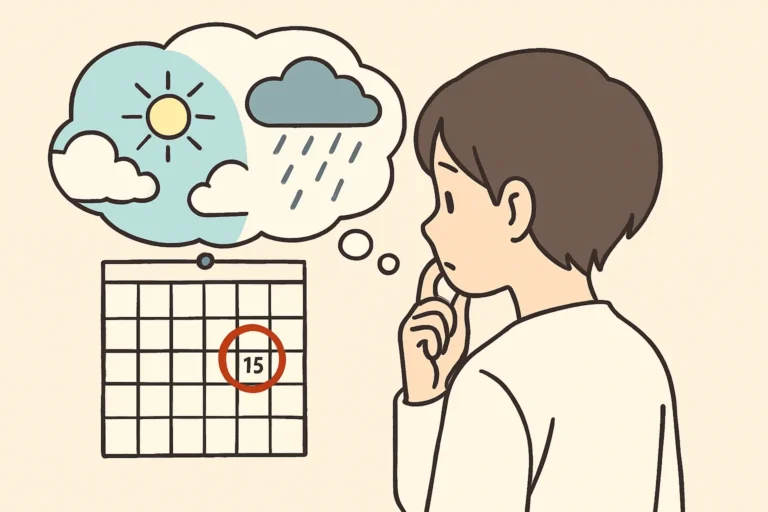
Yesterday’s Forecast: Talk About Past Weather in Korean!
Hello! Welcome to [Maeil Hangul], your daily stop for upgrading your Korean skills!
Have you ever wanted to chat with a Korean friend about what you did over the weekend? A super common way to start that conversation is by talking about the weather! Today, we’re going to learn how to ask and answer questions about yesterday’s weather.
Lately in Korea, with the clear autumn skies, everyone is out enjoying parks and mountains. Imagine telling your friend about your amazing picnic yesterday – you’ll definitely need today’s phrases. Let’s get started!
Key Expressions You Need to Know
Here are some essential phrases to talk about the weather that was.
1. 어제 날씨 어땠어요? (Eoje nalssi eottaesseoyo?)
- Romanization: Eoje nalssi eottaesseoyo?
- English Meaning: How was the weather yesterday?
- Detailed Explanation: This is the most important question for today! It’s a polite and natural way to ask someone about the weather on a past day. 어제 (eoje) means “yesterday,” 날씨 (nalssi) means “weather,” and 어땠어요? (eottaesseoyo?) is the past tense of “how is it?”. You can use this with friends, teachers, or anyone you’re speaking to politely.
2. 맑았어요. (Malgasseoyo.)
- Romanization: Malgasseoyo.
- English Meaning: It was sunny/clear.
- Detailed Explanation: This is the perfect answer for a beautiful, clear day. It comes from the verb 맑다 (makda), which means “to be clear/sunny.”
- 💡 Pronunciation Tip:
This word has a tricky double consonant! The letter is ‘맑’, which has ‘ㄹ(l)’ and ‘ㄱ(g)’ at the bottom. When it’s followed by a consonant like in the dictionary form 맑다, you only pronounce the ‘ㄱ’ so it sounds like [막다/makda].
BUT, when it’s followed by a vowel like -았어요 (-asseoyo), the ‘ㄹ’ stays and the ‘ㄱ’ moves over to the next syllable! So, you don’t say ‘mak-a-sseo-yo’. Instead, you say [말가써요 / mal-ga-sseo-yo]. It feels much smoother and more natural!
3. 비가 왔어요. (Biga wasseoyo.)
- Romanization: Biga wasseoyo.
- English Meaning: It rained.
- Detailed Explanation: A very useful phrase for those not-so-sunny days! 비 (bi) means “rain,” and 왔어요 (wasseoyo) is the past tense of 오다 (oda), which means “to come.” So literally, it means “Rain came.”
4. 좀 추웠어요. (Jom chuwosseoyo.)
- Romanization: Jom chuwosseoyo.
- English Meaning: It was a bit cold.
- Detailed Explanation: 좀 (jom) is a magic word that means “a little” or “a bit,” and it makes your Korean sound much more natural and soft. 추웠어요 (chuwosseoyo) is the past tense of 춥다 (chupda), meaning “to be cold.” You can use this phrase to describe a chilly day.
Example Dialogue
Let’s see how these phrases work in a real conversation! Two friends, A and B, are talking about their weekend.
A: 민준 씨, 어제 한강 공원 재미있었어요?
(Minjun, was Han River Park fun yesterday?)
B: 네! 정말 좋았어요.
(Yes! It was really great.)
A: 어제 날씨 어땠어요?
(How was the weather yesterday?)
B: 맑았어요. 그런데 바람이 불어서 좀 추웠어요.
(It was sunny. But it was windy, so it was a bit cold.)
Culture Tip & Trend Analysis
In Korea, talking about the weather isn’t just small talk; it’s a way to show you care. If a friend mentions they went hiking yesterday, asking “어제 날씨 어땠어요? 춥지 않았어요? (How was the weather yesterday? Wasn’t it cold?)” shows you are interested in their experience.
Also, Korean Z-generation loves posting “날씨 인증샷 (nalssi injeungsyat)” on Instagram, which means a “weather proof-shot.” If the sky was incredibly blue yesterday after a week of rain, you’ll see hundreds of photos of the sky with hashtags like #어제날씨 (yesterday’s weather) and #맑음 (sunny). It’s a way of sharing a collective happy moment. So if you say “어제 날씨 맑았어요,” many Koreans will know exactly the kind of beautiful day you’re talking about!
Let’s Practice!
Time to check what you’ve learned. You can do it!
- Fill in the blank: Your friend asks you, “어제 날씨 어땠어요?” You want to say it rained. How do you answer?
어제 __________.
- Translate: How would you write “It was a bit cold yesterday” in a full Korean sentence?
Great job today! Learning about past weather is a huge step in having more natural, everyday conversations.
Now it’s your turn! How was the weather yesterday where you live? Try answering in the comments using the phrases you learned today!
Frequently Asked Questions (FAQ)
Q: What does "어제" mean in Korean and how do you pronounce it?
A: In Korean, "어제" is pronounced [eoje] and means: means "yesterday,"
Q: What does "날씨" mean in Korean and how do you pronounce it?
A: In Korean, "날씨" is pronounced [nalssi] and means: means "weather," and
Q: What does "어땠어요?" mean in Korean and how do you pronounce it?
A: In Korean, "어땠어요?" is pronounced [eottaesseoyo?] and means: is the past tense of "how is it?". You can use this with friends, teachers, or anyone you're speaking to politely.
Q: What does "맑다" mean in Korean and how do you pronounce it?
A: In Korean, "맑다" is pronounced [makda] and means: , which means "to be clear/sunny."







